Understanding Quadrilaterals Exercise 3.1
NCERT solutions for Class 8 Maths Understanding Quadrilaterals
NCERT Solutions for Class 8 Maths Understanding Quadrilaterals
Class –VIII Mathematics (Ex. 3.1)
NCERT SOLUTION
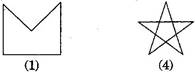
1. Given here are some figures:
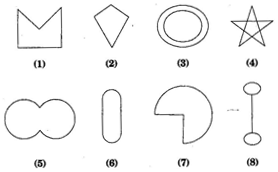
Classify each of them on the basis of the following:
(a) Simple curve
(b) Simple closed curve
(c) Polygon
(d) Convex polygon
(e) Concave polygon
Ans. (a) Simple curve
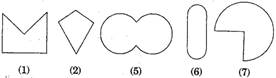
(b) Simple closed curve
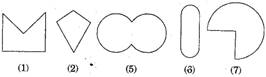
(c) Polygons
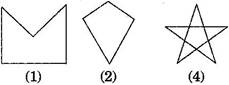
(d) Convex polygons

(e) Concave polygon
2. How many diagonals does each of the following have?
(a) A convex quadrilateral
(b) A regular hexagon
(c) A triangle
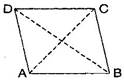
Ans. (a) A convex quadrilateral has two diagonals.
Here, AC and BD are two diagonals.
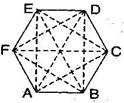
(b) A regular hexagon has 9 diagonals.
Here, diagonals are AD, AE, BD, BE, FC, FB, AC, EC and FD.
(c) A triangle has no diagonal.
NCERT Solutions for Class 8 Maths Exercise 3.1
3. What is the sum of the measures of the angles of a convex quadrilateral? Will this property hold if the quadrilateral is not convex? (Make a non-convex quadrilateral and try)
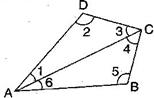
Ans. Let ABCD is a convex quadrilateral, then we draw a diagonal AC which divides the quadrilateral in two triangles.
 A + B + C + D
= 1 + 6 + 5 + 4 + 3 + 2
= (1 + 2 + 3) + (4 + 5 + 6)
= 
= 
Hence, the sum of measures of the triangles of a convex quadrilateral is 
Yes, if quadrilateral is not convex then, this property will also be applied.
Let ABCD is a non-convex quadrilateral and join BD, which also divides the quadrilateral in two triangles.
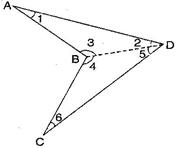
Using angle sum property of triangle,
In  ABD, 1 + 2 + 3 =
  ……….(i)
In BDC, 4 + 5 + 6 = ……….(i)
Adding eq. (i) and (ii),
1 + 2 + 3 + 4 + 5 + 6 =
 1 + 2 + (3 + 4) + 5 + 6
=
A + B + C + D =
Hence proved.
NCERT Solutions for Class 8 Maths Exercise 3.1
4. Examine the table. (Each figure is divided into triangles and the sum of the angles deduced from that.)
| Figure |  |  |  |  |
| Side | 3 | 4 | 5 | 6 |
| Angle sum |  |  |  |  |
What can you say about the angle sum of a convex polygon with number of sides?
Ans. (a) When  = 7, then
Angle sum of a polygon = 

(b) When = 8, then
Angle sum of a polygon =

(c) When = 10, then
Angle sum of a polygon =

(d) When =  then
then
Angle sum of a polygon =
NCERT Solutions for Class 8 Maths Exercise 3.1
5. What is a regular polygon? State the name of a regular polygon of:
(a) 3 sides
(b) 4 sides
(c) 6 sides
Ans. A regular polygon: A polygon having all sides of equal length and the interior angles of equal size is known as regular polygon.
(i) 3 sides
Polygon having three sides is called a triangle.
(ii) 4 sides
Polygon having four sides is called a quadrilateral.
(iii) 6 sides
Polygon having six sides is called a hexagon.
NCERT Solutions for Class 8 Maths Exercise 3.1
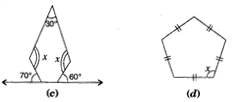
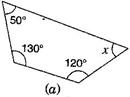
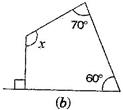
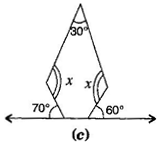
6. Find the angle measures  in the following figures:
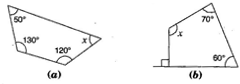
Ans. (a) Using angle sum property of a quadrilateral,




(b) Using angle sum property of a quadrilateral,




(a) First base interior angle
= 
Second base interior angle
= 
There are 5 sides, = 5
 Angle sum of a polygon =
=  =
= 




(b) Angle sum of a polygon =
= =
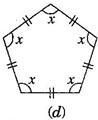



Hence each interior angle is 
NCERT Solutions for Class 8 Maths Exercise 3.1
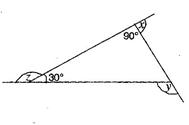
7. (a) Find 
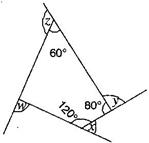
(b) Find 
Ans. (a) Since sum of linear pair angles is 
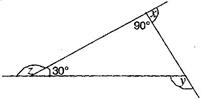


And 

Also 

(b) Using angle sum property of a quadrilateral,
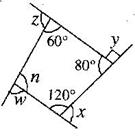




Since sum of linear pair angles is
 ……….(i)
 ……….(ii)
 ……….(iii)
 ……….(iv)
Adding eq. (i), (ii), (iii) and (iv),




