Visualising Solid Shapes Exercise 10.2
NCERT solutions for Class 8 Maths Visualising Solid Shapes
NCERT Solutions for Class 8 Maths Visualising Solid Shapes
Class –VIII Mathematics (Ex. 10.2)
NCERT SOLUTION
1. Can a polygon have for its faces:
(i) 3 triangles
(ii) 4 triangles
(iii) a square and four triangles
Ans. (i) No, a polyhedron cannot have 3 triangles for its faces.
(ii) Yes, a polyhedron can have four triangles which is known as pyramid on triangular base.
(iii) Yes, a polyhedron has its faces a square and four triangles which makes a pyramid on square base.
2. Is it possible to have a polyhedron with any given number of faces? (Hint: Think of a pyramid)
Ans. It is possible, only if the number of faces are greater than or equal to 4.
NCERT Solutions for Class 8 Maths Exercise 10.2
3. Which are prisms among the following:
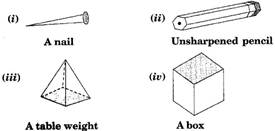
Ans. Figure (ii) unsharpened pencil and figure (iv) a box are prisms.
NCERT Solutions for Class 8 Maths Exercise 10.2
4. (i) How are prisms and cylinders alike?
(ii) How are pyramids and cones alike?
Ans. (i) A prism becomes a cylinder as the number of sides of its base becomes larger and larger.
(ii) A pyramid becomes a cone as the number of sides of its base becomes larger and larger.
5. Is a square prism same as a cube? Explain.
Ans. No, it can be a cuboid also.
NCERT Solutions for Class 8 Maths Exercise 10.2
6. Verify Euler’s formula for these solids.
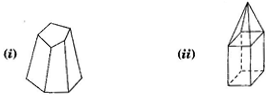
Ans. (i) Here, figure (i) contains 7 faces, 10 vertices and 15 edges.
Using Eucler’s formula, we see
F + V – E = 2
Putting F = 7, V = 10 and E = 15,
F + V – E = 2
 7 + 10 – 5 = 2
17 – 15 = 2
2 = 2
L.H.S. = R.H.S.
(ii) Here, figure (ii) contains 9 faces, 9 vertices and 16 edges.
Using Eucler’s formula, we see
F + V – E = 2
F + V – E = 2
9 + 9 – 16 = 2
18 – 16 = 2
2 = 2
L.H.S. = R.H.S.
Hence verified Eucler’s formula.
NCERT Solutions for Class 8 Maths Exercise 10.2
7. Using Euler’s formula, find the unknown:
| Faces | ? | 5 | 20 |
| Vertices | 6 | ? | 12 |
| Edges | 12 | 9 | ? |
Ans. In first column, F = ?, V = 6 and
E = 12
Using Eucler’s formula, we see
F + V – E = 2
F + V – E = 2
F + 6 – 12 = 2
F – 6 = 2
F = 2 + 6 = 8
Hence there are 8 faces.
In second column, F = 5, V = ? and E = 9
Using Eucler’s formula, we see
F + V – E = 2
F + V – E = 2
5 + V – 9 = 2
V – 4 = 2
V = 2 + 4 = 6
Hence there are 6 vertices.
In third column, F = 20, V = 12 and E = ?
Using Eucler’s formula, we see
F + V – E = 2
F + V – E = 2
20 + 12 – E = 2
32 – E = 2
E = 32 – 2 = 30
Hence there are 30 edges.
NCERT Solutions for Class 8 Maths Exercise 10.2
8. Can a polyhedron have 10 faces, 20 edges and 15 vertices?
Ans. If F = 10, V = 15 and E = 20.
Then, we know Using Eucler’s formula,
F + V – E = 2
L.H.S. = F + V – E
= 10 + 15 – 20
= 25 – 20
= 5
R.H.S. = 2
 L.H.S.
  R.H.S.
Therefore, it does not follow Eucler’s formula.
So polyhedron cannot have 10 faces, 20 edges and 15 vertices.