Tissues part 2
NCERT solutions for Science Tissues
NCERT Class 9 Science Chapter wise Solutions
- 01 – Matter in Our Surroundings
- 02 – Is Matter Around us Pure
- 03 – Atoms and Molecules
- 04 – Structure of the Atom
- 05 – The Fundamental Unit of Life
- 06 – Tissues
- 07 – Diversity in Living Organisms
- 08 – Motion
- 09 – Force and Laws of Motion
- 10 – Gravitation
- 11 – Word and Energy
- 12 – Sound
- 13 – Why Do We Fall Ill
- 14 – Natural Resources
- 15 – Improvement in Food Resources
NCERT Solutions for Class 9 Science Tissues part 2
1. Define the term “tissue”.
Ans. It is a group of cells similar in origin and structure and they are specialized to perform a particular function like muscle cells in our body form the muscle tissue that bring about body movements(specific function).
NCERT Solutions for Class 9 Science Tissues part 2
2. How many types of elements together make up the xylem tissue? Name them.
Ans. Xylem tissue is made up of following 4 types of elements:
i) Tracheids
ii) vessels
iii) fibres
iv) parenchyma
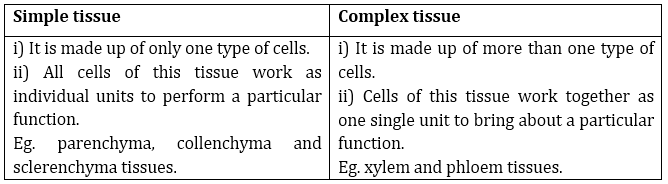
3. How are simple tissues different from complex tissues in plants?
Ans.
NCERT Solutions for Class 9 Science Tissues part 2
4. Differentiate between parenchyma, collenchyma and sclerenchyma on the basis of their cell wall.
Ans.

5. What are the functions of the stomata?
Ans. The functions of stomata are:
i) gaseous exchange like exchange of .
.
ii) Process of transpiration i.e. loss of excess water in the form of water vapour occurs through stomata.
NCERT Solutions for Class 9 Science Tissues part 2
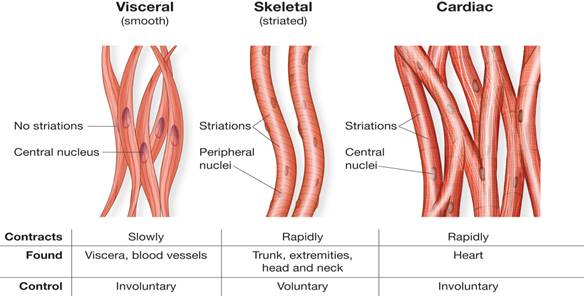
6. Diagrammatically show the difference between the three types of muscle fibres.
Ans.
7. What is the specific function of the cardiac muscle?
Ans. Cardiac muscles are the muscles of heart that pumps blood to all parts of body and the pumping needs rhythmic contraction and relaxation of cardiac muscles throughout the life without any fatigue.
NCERT Solutions for Class 9 Science Tissues part 2
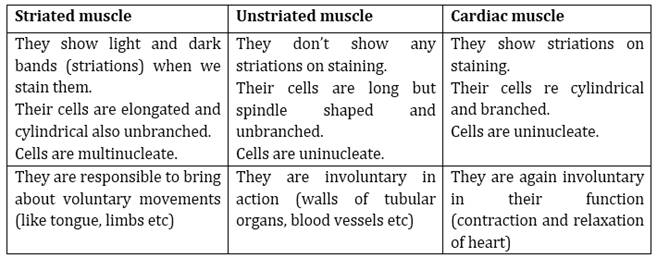
8. Differentiate between striated, unstriated and cardiac muscles on the basis of their structure and site/location in the body.
Ans.
NCERT Solutions for Class 9 Science Tissues part 2
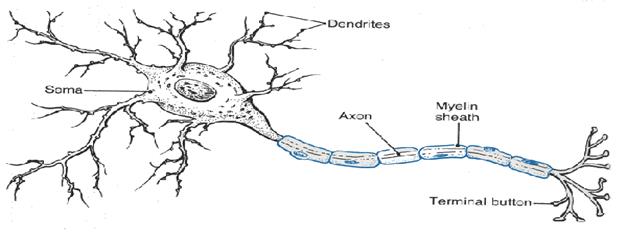
9. Draw a labelled diagram of a neuron.
Ans.
NCERT Solutions for Class 9 Science Tissues part 2
10. Name the following.
(a) Tissue that forms the inner lining of our mouth.
(b) Tissue that connects muscle to bone in humans.
(c) Tissue that transports food in plants.
(d) Tissue that stores fat in our body.
(e) Connective tissue with a fluid matrix.
(f) Tissue present in the brain.
Ans. (a) epithelial tissue
(b) tendons
(c) phloem
(d) adipose tissue
(e) blood
(f) nerve tissue
NCERT Solutions for Class 9 Science Tissues part 2
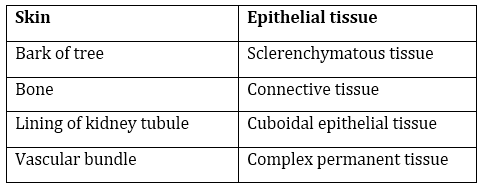
11. Identify the type of tissue in the following: skin, bark of tree, bone, lining of kidney tubule, vascular bundle.
Ans.
12. Name the regions in which parenchyma tissue is present.
Ans. Parenchymatous tissue is present in the epidermis, cortex, pith of the stem, root, leaves, flowers and fruits of plants.
NCERT Solutions for Class 9 Science Tissues part 2
13. What is the role of epidermis in plants?
Ans. It is a protective layer to the plant parts. It can also absorb water from soil like in the roots and even allow exchange of gases through stomata.
14. How does the cork act as a protective tissue?
Ans. In plants the secondary meristem cuts off many external layers of cells that are dead and arranged in a compact manner. Such layers together make cork. They have deposition of suberin which is very hard and impermeable hence protects plants from unfavorable conditions and microbial attack etc.
NCERT Solutions for Class 9 Science Tissues part 2
15. Complete the table:
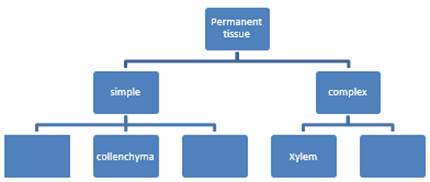
Ans.