Is Matter around Us Pure part 1
NCERT solutions for Science Is Matter around Us Pure
NCERT Class 9 Science Chapter wise Solutions
- 01 – Matter in Our Surroundings
- 02 – Is Mattter Around us Pure
- 03 – Atoms and Molecules
- 04 – Structure of the Atom
- 05 – The Fundamental Unit of Life
- 06 – Tissues
- 07 – Diversity in Living Organisms
- 08 – Motion
- 09 – Force and Laws of Motion
- 10 – Gravitation
- 11 – Word and Energy
- 12 – Sound
- 13 – Why Do We Fall Ill
- 14 – Natural Resources
- 15 – Improvement in Food Resources
NCERT Solutions for Class 9 Science Is Matter around Us Pure part 1
1. What is meant by a substance?
Ans. Substance can be defined as that kind of matter where constituent particles cannot be separated from each other by any physical process since they are all similar in chemical properties.
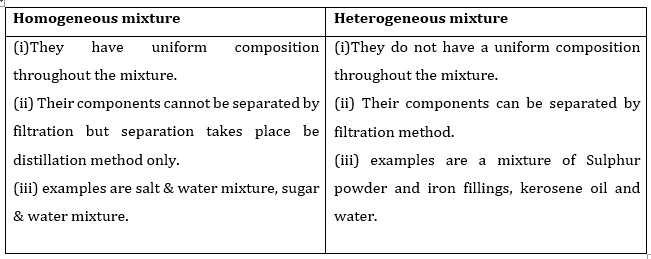
2. List the points of differences between homogeneous and heterogeneous mixtures.
Ans.
NCERT Solutions for Class 9 Science Is Matter around Us Pure part 1
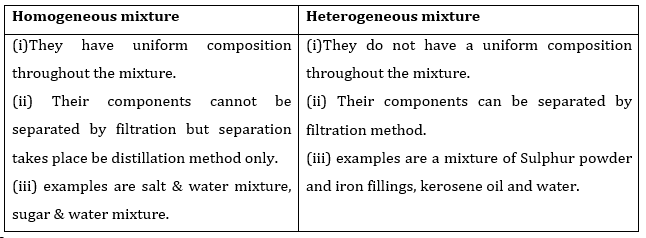
1. Differentiate between homogeneous and heterogeneous mixtures with examples.
Ans.
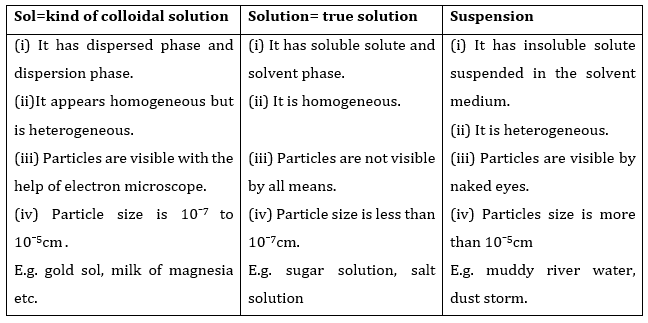
2. How are sol, solution and suspension different from each other?
Ans.
3. To make a saturated solution, 36 g of sodium chloride is dissolved in 100 g of water at 293 K. Find its concentration at this temperature.
Ans. Mass of sodium chloride (solute) = 36 g
Mass of water (solvent) = 100 g
Mass of solution = 36 + 100 = 136 g
Therefore, concentration percentage = mass of solute/mass of solution 
 = 26.47 %
NCERT Solutions for Class 9 Science Is Matter around Us Pure part 1
1. How will you separate a mixture containing kerosene and petrol (difference in their boiling points is more than ), which are miscible with each other?
Ans. We can separate a mixture containing kerosene and petrol by distillation technique since difference in their boiling points is more than . So through distillation we can get them separated.
NCERT Solutions for Class 9 Science Is Matter around Us Pure part 1
2. Name the technique to separate
(i) butter from curd,
(ii) salt from sea-water,
(iii) camphor from salt.
Ans. (i) centrifugation method.
(ii) evaporation method.
(iii) sublimation method.
3. What type of mixtures are separated by the technique of crystallisation?
Ans. From impure samples of solids, pure solid crystals can be obtained by the method of crystallization for eg to obtain pure sugar from impure sample of the same.
NCERT Solutions for Class 9 Science Is Matter around Us Pure part 1
1. Classify the following as chemical or physical changes:
• cutting of trees,
• melting of butter in a pan,
• rusting of almirah,
• boiling of water to form steam,
• passing of electric current, through water and the water breaking down into hydrogen and oxygen gases,
• dissolving common salt in water,
• making a fruit salad with raw fruits, and
• burning of paper and wood.
Ans. cutting of trees = chemical change
melting of butter in a pan = physical change
rusting of almirah = chemical change
boiling of water to form steam = physical change
passing of electric current, through water and the water breaking down into hydrogen and oxygen gases = chemical change
dissolving common salt in water = physical change
making a fruit salad with raw fruits = physical change
burning of paper and wood = chemical change
2. Try segregating the things around you as pure substances or mixtures.
Ans. You can do it by yourself like try mixing chalk powder and water then separate them.