The World of Numbers
The World of Numbers – NCERT Solutions Class 9 Maths Ganita Manjari includes all the questions with solutions given in NCERT Class 9 Ganita Manjari textbook.
NCERT Solutions Class 9
The World of Numbers – NCERT Solutions
Q.1:
A merchant in the port city of Lothal is exchanging bags of spices for copper ingots. He receives 15 ingots for every 2 bags of spices. If he brings 12 bags of spices to the market, how many copper ingots will he leave with?
Solution:
Given that:
2 bags of spices ingots
So, 1 bag of spices ingots
Similarly, for 12 bags of spices
Therefore, the merchant will leave with 90 copper ingots.
Q.2:
Look at the sequence of numbers on one column of the Ishango bone: . What do these numbers have in common? List the next three numbers that fit this pattern.
Solution:
The numbers are all prime numbers (numbers that have only two factors: 1 and itself).
Next three prime numbers after 19 are .
Therefore, the next three numbers are .
Q.3:
We know that Natural Numbers are closed under addition (the sum of any two natural numbers is always a natural number). Are they closed under subtraction? Provide a couple of examples to justify your answer.
Solution:
Closure means the result should also be a natural number.
Examples:
- (Natural number)
- (Not a natural number)
Since subtraction can give a negative number, so natural numbers are not closed under subtraction.
Q.4:
Ancient Indians used the joints of their fingers to count, a practice still seen today. Each finger has 3 joints, and the thumb is used to count them. How many can you count on one hand? How does this relate to the ancient base-12 counting systems?
Solution:
Each finger (except thumb) has 3 joints.
Number of fingers used (excluding thumb)
Total joints
So, we can count up to 12 using one hand.
Relation to base-12 system:
Since counting reaches 12 on one hand, it naturally leads to a base-12 (duodecimal) counting system used in ancient times.
Therefore:
- Total count = 12
- This explains the origin of base- 12 counting system.
Q.5:
The temperature in the high-altitude desert of Ladakh is recorded as at noon. By midnight, it drops by . What is the midnight temperature?
Solution:
Initial temperature
Drop
Midnight temperature
Therefore, the midnight temperature is .
Q.6:
A spice trader takes a loan (debt) of ₹ 850. The next day, he makes a profit (fortune) of ₹ 1,200. The following week, he incurs a loss of ₹450. Write this sequence as an equation using integers and calculate his final financial standing.
Solution:
Debt = – ₹850
Profit ₹1200
Loss
Equation: -₹850 + ₹1200 – ₹450
Step-by-step calculation:
Therefore, his final financial standing is -₹100 (a loss of ₹100).
Q.7:
Calculate the following using Brahmagupta’s laws:
- 0 – (-14)
Solution:
As per Brahmagupta’s Laws:
Debt indicates Negative
Fortune indicates Positive
- Negative Positive Negative [As Debt × Fortune Debt]
Therefore, - Negative Negative Positive [As Debt × Debt Fortune]
Therefore, - As per Brahmagupta, zero minus debt is a fortune.
Subtracting a negative is same as adding:
Therefore, - Negative Positive Negative As Debt Fortune Debt
Therefore, .
Q.8:
Explain, using a real-world example of debt, why subtracting a negative number is the same as adding a positive number (e.g., ).
Solution:
Consider you have 10.
A negative number represents debt.
So, -5 means you owe 5.
Now, means removing a debt of .
If your debt is removed, your money increases by .
So,
Thus, subtracting a negative number is the same as adding a positive number.
Q.9:
Prove that the rational numbers are equal:
2/3 and 4/6
Solution:
To prove that two rational numbers are equal, we simplify them or compare their cross-products.
First Fraction: 2/3 = 2/3
Second Fraction: 4/6 = 2/3 (dividing numerator and denominator by 2)
Therefore, 2/3 and 4/6 are equal.
Q.10:
Prove that the rational numbers are equal:
5/4 and 10/8
Solution:
First Fraction: 5/4 = 5/4
Second Fraction: 10/8 = 5/4 (dividing numerator and denominator by 2)
Therefore, 5/4 and 10/8 are equal.
Q.11:
Prove that the rational numbers are equal:
-3/5 and -6/10
Solution:
First Fraction: -3/5 = -3/5
Second Fraction: -6/10 = -3/5 (dividing numerator and denominator by 2)
Therefore, -3/5 and -6/10 are equal.
Q.12:
Prove that the rational numbers are equal:
9/3 and 3
Solution:
First Fraction: 9/3 = 3
Hence, 9/3 and 3 are equal.
Q.13:
Find the sum: 2/5 + 3/10
Solution:
LCM of 5 and 10 = 10
Simplifying the first number: 2/5 = 4/10 [Making the same denominator]
Now, the sum
= 2/5 + 3/10
= 4/10 + 3/10
= 7/10
Therefore, the sum of 2/5 + 3/10 is 7/10.
Q.14:
Find the sum:
7/12 + 5/8
Solution:
LCM of 12 and 8 = 24
Simplifying the first number: 7/12 = 14/24 [Making the same denominator]
Simplifying the second number: 5/8 = 15/24 [Making the same denominator]
Now, the sum
= 7/12 + 5/8
= 14/24 + 15/24
= 29/24
Therefore, the sum of 7/12 + 5/8 is 29/24.
Q.15:
Find the sum:
– 4/7 + 3/14
Solution:
LCM of 7 and 14 = 14
Simplifying the first number: -4/7 = -8/14 [Making the same denominator]
So, the sum
= – 4/7 + 3/14
= – 8/14 + 3/14
= – 5/14
Therefore, the sum of -4/7 + 3/14 is -5/14.
Q.16:
Find the difference:
5/6 – 1/4
Solution:
LCM of 6 and 4 = 12
Simplifying the first number: 5/6 = 10/12 [Making the same denominator]
Simplifying the Second number: 1/4 = 3/12 [Making the same denominator]
So, the difference
= 5/6 – 1/4
= 10/12 – 3/12
= 7/12
Therefore, the difference is 7/12.
Q.17:
Find the difference:
11/8 – 3/4
Solution:
LCM of 8 and 4 = 8
Simplifying the Second number: 3/4 = 6/8 [Making the same denominator]
So, the difference
= 11/8 – 3/4
= 11/8 – 6/8
= 5/8
Therefore, the difference is 5/8.
Q.18:
Find the difference:
-7/9 – (-2/3)
Solution:
-7/9 – (-2/3) = -7/9 + 2/3
LCM of 9 and 3 = 9
Simplifying the Second number: 2/3 = 6/9 [Making the same denominator]
So, the difference
= – 7/9 – (-2/3)
= – 7/9 + 6/9
= – 1/9
Therefore, the difference is -1/9.
Q.19:
Find the product:
2/3 3/10
Solution:
Therefore, the product is .
Q.20:
Find the product:
7/11 5/8
Solution:
Therefore, the product is 35/88.
Q.21:
Find the product:
-4/7 5/14
Solution:
Therefore, the product is .
Q.22:
Find the quotient:
2/3 3/10
Solution:
To divide fractions, multiply by the reciprocal.
Therefore, the quotient is 20/9.
Q.23:
Find the quotient:
7/11 5/8
Solution:
Therefore, the quotient is 56/55.
Q.24:
Find the quotient:
-4/7 5/14
Solution:
Therefore, the quotient is .
Q.25:
Show that: .
Solution:
Q.26:
Simplify the following using the distributive property:
Solution:
Using distributive property:
Therefore, the simplified value of is .
Q.27:
Find the rational number such that: .
Solution:
, which is universal truth.
So, is true for every value of .
Therefore, x can be any rational number.
Q.28:
Represent the rational numbers and on a single number line.
Solution:
Filling The Spaces: Fractions and Rational Numbers
So on number line:
Mark these three points in this order on the same number line.
Q.29:
Find three distinct rational numbers that lie strictly between and .
Solution:
We need three rational numbers strictly between and .
One valid set is:
All of these lie between -0.5 and 0.25, and are distinct rational numbers.
Q.30:
Simplify the expression:
Solution:
We take LCM of 4 and 12, which is 12.
Now,
Q.31:
A tailor has metres of fine silk. If making one kurta requires metres of silk, exactly how many kurtas can he make?
Solution:
Convert mixed numbers into improper fractions:
Now divide:
Cancel 4:
Q.32:
Find three rational numbers between 3.1415 and 3.1416.
Solution:
We need three rational numbers strictly between 3.1415 and 3.1416.
One possible correct set is:
All three are terminating decimals, so they are rational numbers, and each lies between 3.1415 and 3.1416.
Q.33:
Can you think of other way(s) to find a rational number between any two rational numbers?
Solution:
Yes. One simple method is:
- Take the average (midpoint method) For two rational numbers and , a rational number between them is: This is always rational and lies strictly between and .
- Use equivalent fractions Convert both numbers to a common denominator, then pick a fraction between the two numerators.
- Increase precision (decimal expansion method)
Write both numbers in decimals and insert a number with more decimal places in between.
All these methods always give a rational number between any two rational numbers.
Q.34:
Without performing long division, determine which of the following rational numbers will have terminating decimals and which will be repeating: and . Then check your answers by explicitly performing the long divisions and expressing these rational numbers as decimals.
Solution:
Only 2 and terminating decimal
Long division:
Contains repeating decimal
Long division:
Only 2 and terminating decimal
Long division:
- terminating (0.35)
- repeating (0.2) overline (6)
- terminating (0.052)
Q.35:
Perform the long division for . Identify the repeating block of digits. Does it show cyclic properties if you evaluate ? Now compute , etc. What do you notice?
Solution:
- Long division of So, Repeating block:
- Check This is the same digits as 076923, just rotated.
- Other fractions
- What do we notice?
- All fractions to have the same 6 -digit repeating block:
- The digits are just cyclic shifts (rotations) of each other.
- This shows a cyclic pattern, similar to cyclic numbers like . Final Conclusion:
The fraction produces a repeating decimal with a cyclic structure, and all multiples (for to 12) are cyclic permutations of the same repeating block 076923.
Q.36:
Classify the following numbers as rational or irrational:
- (Notice the pattern: Is it repeating a single block?)
- 23.560185612239874790120
Find the explicit fractions in case they are rational.
Solution:
- Rational Fraction:
- Irrational (12 is not a perfect square)
- Rational Let
- Rational Repeating block = 12345
So it is a repeating decimal ⇒ rational - Irrational No fixed repeating block (pattern keeps increasing zeros), so non-repeating ⟹ irrational
- Rational Terminating decimal ⇒ rational
Convert to fraction:
Final Classification:
- Rational
- Irrational
- Rational
- Rational
- Irrational
- Rational
Q.37:
The number (which means ) is a rational number. Using algebra (let , multiply by 10, and subtract), explain why is exactly equal to 1.
Solution:
Let
Multiply by 10:
Now subtract the first equation from the second:
So,
Final conclusion:
Q.38:
We have seen that the repeating block of is a cyclic number. Try to find more numbers () whose reciprocals produce decimals with repeating blocks that are cyclic.
Solution:
Numbers whose reciprocals produce cyclic repeating decimals are those where the repeating block has length and shows cyclic permutations (like ).Examples:
- This is a cyclic number (given example).
- Also cyclic:
- Multiples of 076923 rotate the digits.
- This is a long cyclic block of 16 digits.
- Also shows cyclic behavior. Key idea:
Primes like often produce long repeating cycles in , and some of them form full cyclic numbers (where digit rotations appear in multiples). About 0.999… = 1
It is not “slightly less than 1” because:- There is no gap between 0.999… and 1
- Their difference is: So,
This shows that decimal representations are not unique: - ..
Final takeaway:
- Some reciprocals of primes produce cyclic numbers (like ).
- Decimal representation is not unique, and 0.999… is exactly equal to 1.
Q.39:
Convert the following rational numbers in the form of a terminating decimal or non-terminating and repeating decimal, whichever the case may be, by the process of long division:
Solution:
- (Terminating decimal)
- (Non-terminating repeating decimal)
Q.40:
Prove that is an irrational number.
Solution:
Proof that is irrational
Assume the opposite, that is rational.
So we can write:
where are co-prime integers and .
Now square both sides:
Multiply by :
So is divisible by 5, which implies is divisible by 5.
Let .
Substitute:
Divide by 5:
So is also divisible by 5, which implies is divisible by 5.
Contradiction:
Both and are divisible by 5, which contradicts the assumption that is in simplest form.
Conclusion:
Q.41:
Convert 12.6 in the form of .
Solution:
Let
Simplify:
Q.42:
Convert 0.0120 in the form of .
Solution:
0.0120 is a terminating decimal.
Now simplify:
Q.43:
Convert in the form of .
Solution:
Let
There is 1 non-repeating digit (0) and 2 repeating digits (52).
Multiply by 10:
Multiply by 1000:
Now subtract:
Simplify:
Q.44:
Convert in the form of .
Solution:
Let
There is 1 non-repeating digit (2) and 2 repeating digits (35).
Step 1: Multiply to remove non-repeating part
Step 2: Multiply to align repeating block
Step 3: Subtract
Step 4: Solve
Q.45:
Convert in the form of .
Solution:
Let
Since 2 digits repeat, multiply by 100:
Now subtract:
Q.46:
Convert in the form of .
Solution:
Let
Step 1: Remove non-repeating part
Step 2: Align repeating part
Step 3: Subtract
Step 4: Solve
Q.47:
Convert in the form of .
Solution:
Let
Here, 2 digits are non-repeating (12) and 1 digit repeats (5).
Step 1: Shift non-repeating part
Step 2: Shift full repeating cycle
Step 3: Subtract
Step 4: Solve
Q.48:
Convert in the form of .
Solution:
Let
Here, 2 digits are non-repeating (12) and 1 digit repeats (5).
Step 1: Remove non-repeating part
Step 2: Align repeating part
Step 3: Subtract
Step 4: Solve
Q.49:
Convert in the form of .
Solution:
Let
Since the repeating block has 4 digits (1625):
Step 1: Multiply by
Step 2: Subtract original
Step 3: Solve
Q.50:
Locate 0.532 on the number line.
Solution:
To locate 0.532 on the number line:
- It lies between 0 and 1.
- Divide the interval 0 to 1 into 1000 equal parts (since it has 3 decimal places).
- Move parts to the right of .
0.532 lies between 0.53 and 0.54 and is closer to 0.53.
Q.51:
Locate on the number line.
Solution:
We first understand the number:
Step 1: Identify its position
It lies between:
Step 2: Convert to fraction (for exact placement)
Let
Subtract:
Step 3: Number line location
So,
It lies slightly above 1.15, closer to 1.16, on the number line between 1 and 2.
Q.52:
Find 6 rational numbers between 3 and 4.
Solution:
We can write 3 and 4 with a common denominator:
Now choose any 6 fractions between them:
Q.53:
Find 5 rational numbers between and .
Solution:
We first make the denominators equal:
Now choose any 5 fractions between them:
Q.54:
Find 5 rational numbers between and .
Solution:
We first make the denominators the same:
Now choose 5 rational numbers between them:
(These can also be simplified if needed.)
Q.55:
If , find the rational number .
Solution:
Take LCM of 3 and :
Multiply both sides by 15:
Q.56:
Let and be two non-zero rational numbers such that . Without assigning any numerical values, determine whether is positive or negative. Justify your answer.
Solution:
Given:
So,
Multiply both sides by :
Conclusion:
is negative.
Q.57:
A rational number has a terminating decimal expansion whose last non-zero digit occurs in the 4th decimal place. Show that such a number can be written in the form , where is an integer not divisible by 10. Is it necessary that the denominator of this rational number, when written in the lowest form, is divisible by or ? Give reasons.
Solution:
Let the number be .
Since its decimal expansion terminates and the last non-zero digit is in the 4th decimal place, we can write it as
where is an integer.
Also, since the last digit is non-zero, is not divisible by 10 (otherwise there would be trailing zeros).
Second part:
Write .
When the fraction is reduced to lowest form, some common factors (2 or 5) between and may cancel.
So, the denominator in lowest form will be of the form:
Therefore, it is NOT necessary that the denominator is divisible by or .
Example:
Here denominator ,
not divisible by or .
- Yes, it can be written as , with not divisible by 10.
- No, the denominator in lowest form need not be divisible by or .
Q.58:
Without performing division, determine whether the decimal expansion of is terminating or non-terminating. If it terminates, state the number of decimal places.
Solution:
Factor the denominator:
A rational number has a terminating decimal if the denominator (in lowest form) has only prime factors 2 and/or 5.
Here,
Denominator only factor terminating
Number of decimal places highest power of 2 or 5 needed to make .
Here , so multiply by denominator becomes
Hence, 3 decimal places.
Q.59:
A rational number in its lowest form has denominator . How many decimal places will its decimal expansion have? Explain your answer.
Solution:
Denominator .
For a rational number in lowest form, the number of decimal places in its terminating decimal is
Here:
So, we multiply numerator and denominator by to make denominator .
Q.60:
Let and . Express both and in the form and where and are integers and . Using the same denominator , write exactly five distinct rational numbers lying between and keeping an integer numerator. Explain why the condition is necessary to find such rational numbers between the two rational numbers and using this method.
Solution:
Given
Step 1: Make same denominator
LCM of 12 and 6 is 12:
Here (not > 6), so multiply both by 3:
Now:
Step 2: Five rational numbers between them
Numbers between 21 and 30:
So required numbers:
Step 3: Why ?
Between and , the number of integers available is:
To get numbers:
Hence, condition ensures enough integers exist to form rational numbers.
Q.61:
Three rational numbers satisfy and . Show that all the rational numbers must be simultaneously zero.
Solution:
Given:
and
Use identity:
Substitute:
Now, squares of rational numbers are non-negative, so the only way their sum is 0 is:
Hence, all three numbers are simultaneously zero.
Q.62:
Show that the rational number lies between the rational numbers and .
Solution:
Assume .
Multiply by 2:
Divide throughout by 2:
Hence, lies between and .
Q.63:
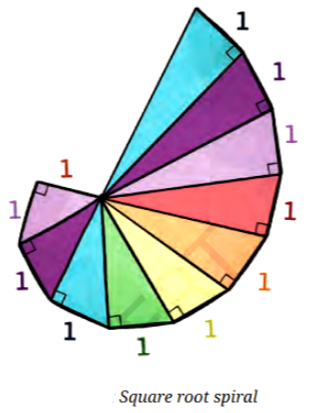
Find the lengths of the hypotenuses of all the right triangles in figure which is referred to as the square root spiral.
Solution:
In a square root spiral, each new right triangle has:
- one leg = 1
- the other leg = previous hypotenuse
Using
a = 15.0
b = 15.0
Successive hypotenuse lengths are:
So, the hypotenuses are:
Q.64:
Can you explain why we need in the definition of a rational number?
Solution:
In the definition of a rational number , we require because division by zero is mathematically undefined. If we allowed to be zero, the expression would lack a consistent numerical value, as no number multiplied by zero can equal a non-zero .
Division is essentially the inverse of multiplication; asking for is like asking “what number times 0 equals 6?” Since any number multiplied by zero is zero, there is no possible solution for a non-zero . If were also zero, the result would be indeterminate, as any number could technically work.
By restricting to non-zero integers, we ensure that every rational number represents a specific, logical point on the number line. This constraint maintains the consistency of arithmetic operations and prevents logical contradictions within the number system. Without this rule, the entire framework of algebra and calculus would collapse into paradoxes.
Q.65:
While adding or subtracting two rational numbers having different denominators, how will you make the denominators equal?
Solution:
To make denominators equal, find the Least Common Multiple of the original denominators. Multiply each numerator and denominator by the necessary factor.
Q.66:
Verify the distributive law for rational numbers.
Solution:
To verify the distributive law , let , and . Both sides equal , confirming this property for rational numbers.
Q.67:
Try and represent and on a number line.
Solution:
To represent , divide each unit into five equal parts and count eight segments to the right of zero.
For , divide units into four parts and count seven segments left of zero. This point lies between -1 and -2.
Q.68:
Can be written as a rational number ?
Solution:
No, cannot be written as a rational number .
Proof (by contradiction):
Assume , where and are coprime integers.
So is even is even let
So is also even.
Thus both and are even, which contradicts that they are coprime.
Q.69:
Try to prove the irrationality of using the approach of proof by contradiction. Will the same approach work for , or ?
Solution:
Assume in simplest form. Squaring gives , so , meaning is a multiple of 3.
Substituting results in , or , proving is also a multiple of 3. This contradiction proves is irrational.
This approach works for , and because they are not perfect squares, ensuring their square roots cannot be expressed as rational fractions.
Q.70:
Try to extend this method for constructing line segments of lengths and using a ruler and a compass. Generalise this method to construct a line segment of any length of the form , where is a positive integer.
Solution:
To construct , start with a segment of length and draw a perpendicular unit segment at its endpoint. The hypotenuse equals .
For , repeat this process from or draw a unit perpendicular from a segment of length 2. The resulting hypotenuse is .
Generalize this by creating a “Wheel of Theodorus.” Once you have , build a perpendicular unit segment from its end to find .
Q.71:
Try to find the decimal expansions of and . What do you observe about the repetition of the digits after the decimal point?
Solution:
The expansion of is while is . Both exhibit repeating remainders, leading to digits that recur infinitely in a periodic pattern.
Q.72:
The decimal expansion of will be terminating precisely when the prime factors of are only 2, only 5 or both 2 and 5. Can you explain why?
Solution:
A rational number terminates if and only if the prime factorization of is of the form , where .
Any terminating decimal with decimal places can be written as:
Since , the denominator of a terminating decimal in simplest form must consist only of prime factors 2 and 5. If any other prime factor (where ) exists in , the fraction will result in a non-terminating, recurring decimal because it can never reach a power of ten.