Measuring Space: Perimeter and Area
Measuring Space: Perimeter and Area – NCERT Solutions Class 9 Maths Ganita Manjari includes all the questions with solutions given in NCERT Class 9 Ganita Manjari textbook.
NCERT Solutions Class 9
Measuring Space: Perimeter and Area – NCERT Solutions
Q.1:
The perimeter of a circle is 44 cm. What is its radius?
Solution:
We use the circumference formula .
Given and taking :
The radius of the circle is .
Q.2:
Calculate, correct to 3 significant figures, the circumference of a circle with: (i) radius 7 cm (ii) radius 10 cm (iii) radius 12 cm.
Solution:
- Radius 7 cm:
- Radius 10 cm:
- Radius 12 cm:
Q.3:
Calculate the length of the arc of a circle if: (i) the radius is 3.5 cm and the angle at the centre is 60o, and (ii) the radius is 6.3 m and the angle at the centre is 120o.
Solution:
- Radius , Angle
Step 1: Plug values into the formula: Step 2: Simplify the fraction and the radius : Step 3: Cancel the common terms (2 and 7): - Radius , Angle
Step 1: Plug values into the formula: Step 2: Simplify the fraction and the decimal: Step 3: Divide 6.3 by 7 to get 0.9: Step 4: Multiply the remaining numbers:
Q.4:
Find the perimeter of a sector (i.e., the curved portion as well as the two straight portions) of a circle of radius 14 cm and sector angle 75o.
Solution:
Step 1: Calculate the Arc Length (l)
The formula for the curved part is .
Using , and :
- Simplify the fraction: .
- Simplify the radius and .
- Multiply: .
- Final Arc Length: .
Step 2: Calculate the Two Radii
The two straight sides are both radii (r):
Step 3: Find Total Perimeter
Add the curved portion to the straight portions:
Perimeter
The total perimeter of the sector is approximately .
Q.5:
Find the perimeter of the shape (taking the arcs to be quarter or half or three-quarters of a circle, as appropriate).
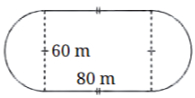
Solution:
Step 1: Identify the Components
The shape consists of:
- Two straight horizontal segments, each measuring 80 m .
- Two curved ends, which are semicircles. Looking at the vertical dashed line, the diameter of these semicircles is 60 m.
Step 2: Calculate the Straight Sections
The total length of the top and bottom straight edges is:
Step 3: Calculate the Curved Sections
Two identical semicircles combine to form one full circle with a diameter of 60 m . Using the formula :
Using :
Q.6:
Find the perimeter of the shape (taking the arcs to be quarter or half or three-quarters of a circle, as appropriate)
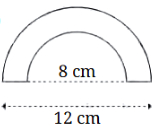
Solution:
Step 1: Identify the Diameters and Arcs
- The outer diameter is , meaning the outer arc is a semicircle.
- The inner diameter is , meaning the inner arc is also a semicircle.
Step 2: Calculate the Curved Arcs
Since the perimeter of a full circle is , the length of a semicircle is .
- Outer Arc:
- Inner Arc:
Step 3: Calculate the Straight Base Segments
The total width of the bottom is 12 cm, and the gap in the middle is 8 cm. The two remaining straight segments at the bottom represent the thickness of the ring.
- Total length of both segments:
- (Each individual segment is 2 cm ).
Step 4: Find the Total Perimeter
Now, we add all these boundary lengths together:
The total perimeter of the shape is .
Q.7:
Find the perimeter of the shape (taking the arcs to be quarter or half or three-quarters of a circle, as appropriate).
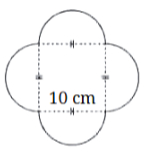
Solution:
Step 1: Identify the Shape Components
- The central dashed figure is a square with a side length of .
- Attached to each of the four sides is a semicircle.
- The diameter of each semicircle is equal to the side of the square, which is .
Step 2: Calculate the Curved Arcs
The perimeter of the shape consists only of the four semicircles (the dashed lines of the square are inside the shape and not part of the perimeter).
- Four semicircles are equivalent to two full circles.
- The circumference of one full circle is .
- For two full circles: Total Curved Length .
Step 3: Numerical Calculation
Using and :
The total perimeter of the shape is .
Q.8:
Find the perimeter of the shape (taking the arcs to be quarter or half or three-quarters of a circle, as appropriate):
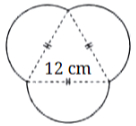
Solution:
Step 1: Analyze the Components
- The central dashed figure is an equilateral triangle with a side length of .
- Attached to each of the three sides is a semicircle.
- The diameter of each semicircle is equal to the side of the triangle: cm.
Step 2: Calculate the Length of One Semicircle
The circumference of a full circle is . Therefore, one semicircle is:
Using :
Step 3: Calculate the Total Perimeter
The perimeter consists of three such semicircular arcs (the internal dashed lines are not counted):
The total perimeter of the shape is .
Q.9:
Find the perimeter of the shape (taking the arcs to be quarter or half or three-quarters of a circle, as appropriate):
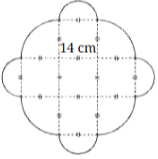
Solution:
Step 1: Analyze the Grid Structure
Looking at the internal dashed lines, the central part of the figure is a grid of smaller squares.
- The total width of the grid is labeled as .
- Since there are 3 equal squares across, the side of one small square is .
Step 2: Identify the Semicircles
The perimeter is made up of four identical semicircles.
- Each semicircle is attached to the middle square of each outer side.
- The diameter of each semicircle is equal to the side of one small square: .
Step 3: Calculate the Curved Length
Four semicircles are equivalent to two full circles.
The circumference of one circle is .
Total Curved Length
Using :
Step 4: Add the Straight Boundary Segments
The perimeter also includes the straight edges of the outer squares that are not covered by semicircles.
- On each of the 4 sides, there are 2 straight segments (the outer edges of the corner squares).
- Total straight segments sides segments.
Step 5: Final Perimeter
The total perimeter of the shape is .
Q.10:
Find the perimeter of the shape (taking the arcs to be quarter or half or three-quarters of a circle, as appropriate):
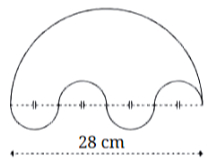
Solution:
Step 1: Analyze the Grid and Diameters
The base of the figure is a dashed line measuring 28 cm.
- Looking at the markings, this base is divided into four equal segments.
- The length of each small segment is .
Step 2: Calculate the Large Semicircle
The top part of the shape is a single large semicircle.
- Its diameter is the entire base: .
- Length .
Step 3: Calculate the Small Semicircles
The bottom part of the shape consists of four small semicircles (two curving up, two curving down).
- The diameter of each small semicircle is .
- Combined, four semicircles equal two full circles.
- Length .
Step 4: Find the Total Perimeter
Add the lengths of the upper and lower boundaries together:
Total Perimeter topbottom
Using :
Total Perimeter
Total Perimeter
The total perimeter of the shape is 88 cm.
Q.11:
Find the perimeter of the shape (taking the arcs to be quarter or half or three-quarters of a circle, as appropriate):
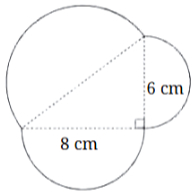
Solution:
Step 1: Find the Missing Side (Hypotenuse)
The central dashed figure is a right-angled triangle with base 8 cm and height 6 cm. Using the Pythagorean theorem:
Hypotenuse2 =
Hypotenuse2 =
Step 2: Identify the Three Semicircles
The perimeter consists of three semicircles with diameters of , and 10 cm.
- Semicircle
- Semicircle
- Semicircle
Step 3: Calculate Total Perimeter
Sum the lengths of all three arcs:
Using :
The total perimeter of the shape is .
Q.12:
Find the perimeter of the shape (taking the arcs to be quarter or half or three-quarters of a circle, as appropriate):
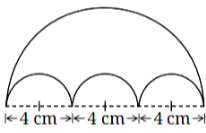
Solution:
Step 1: Analyze the Base and Diameters
The base is divided into three equal segments, each measuring cm.
- The diameter of each small semicircle is .
- The diameter of the large semicircle () is the sum of the three segments: .
Step 2: Calculate the Large Semicircle Arc
Using the formula for a semicircle :
.
Using :
Step 3: Calculate the Three Small Semicircle Arcs
Each small arc has a diameter of 4 cm:
Since there are three such arcs:
Total Small Arcs
Step 4: Find the Total Perimeter
Sum the outer arc and the inner arcs:
Total Perimeter
Total Perimeter
The total perimeter of the shape is .
Q.13:
Find the perimeter of the shape (taking the arcs to be quarter or half or three-quarters of a circle, as appropriate):
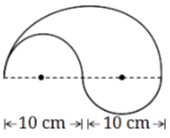
Solution:
Step 1: Analyze the Geometry and Diameters
The base is a dashed line divided into two equal segments of 10 cm each.
- Small Semicircles: There are two smaller semicircles (one curving up, one curving down). Their diameter is 10 cm.
- Large Semicircle: The top arc is one large semicircle. its diameter () is the sum of the two segments: .
Step 2: Calculate the Large Semicircle Arc
The length of a semicircle is half the circumference: .
Using :
Step 3: Calculate the Two Small Semicircle Arcs
Since there are two identical semicircles with a diameter of 10 cm, they combine to form one full circle:
Two Small Arcs
Two Small Arcs
Step 4: Find the Total Perimeter
Add the outer large arc and the two smaller inner/outer arcs together:
Total Perimeter
Total Perimeter
The total perimeter of the shape is .
Q.14:
If the diameter of a car tyre is 56 cm, then: (i) How far does the car need to travel for the tyre to complete one revolution? (ii) How many revolutions does the tyre make if the car travels 10 km?
Solution:
Step 1: Calculate the distance for one revolution
The diameter is . The distance for one revolution is the circumference :
Using :
The car travels (or ) in one revolution.
Step 2: Calculate revolutions for 10 km
First, convert the total distance into centimeters to match our circumference unit:
Now, divide the total distance by the distance covered in one revolution:
The tyre makes approximately 5,682 revolutions over 10 km.
Q.15:
Find the total perimeter of all the petals in each of the given flowers.
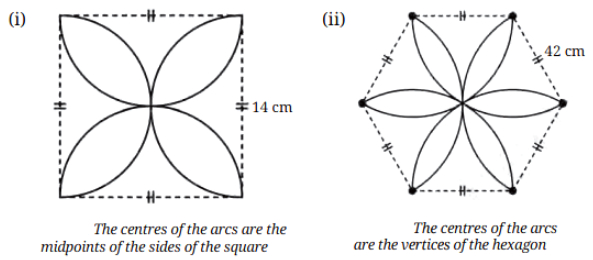
Solution:
- Square-based Flower In this figure, the arcs are semicircles because their centers are at the midpoints of the square’s sides.
Analyze the Arcs: The side of the square is . Since the center of each arc is the midpoint, the radius () of each semicircle is 7 cm.
Identify the Petals: Each of the petals is made of two semicircular arcs. There are semicircles in total forming the boundary of the petals.
Calculate Length: Eight semicircles equal full circles. Numerical Result: Using : - Hexagon-based Flower In this figure, the arcs are sectors of a circle where the centers are the vertices of the hexagon.
Analyze the Arcs: The side of the hexagon is . The arcs meet at the center, so the radius of each arc is .
Identify the Angle: The interior angle of a regular hexagon is . Therefore, each arc is of a circle.
Identify the Petals: There are 6 petals, and each petal is formed by two arcs. This gives us 12 arcs in total.
Calculate Length: Since each arc is of a circle, 12 arcs equal full circles ( 4). Numerical Result: Using :
Q.16:
The ratio of the perimeters of two circles is 5 : 4. What is the ratio of their radii?
Solution:
Step 1: The Core Formula
The circumference is calculated as . This shows that is directly proportional to , because is a constant value.
Step 2: Mathematical Proof
If we have two circles, their perimeters are and . Setting up the ratio:
Step 3: Final Ratio
Canceling the constant leaves us with . Given the perimeter ratio is , the radius ratio is also 5:4.
Q.17:
Find the area of triangle ADE in the figure.
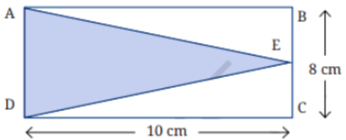
Solution:
The area of triangle ADE is found by identifying its base and the perpendicular height relative to that base within the rectangle.
The triangle’s base is . Its height, the horizontal distance from to vertex , is the rectangle’s length, 10 cm.
Q.18:
The parallel sides of a trapezium are 40 cm and 20 cm. If its non-parallel sides are both equal, each being 26 cm, find the area of the trapezium.
Solution:
Step 1: Find the base of the side triangles
When heights are drawn from the top vertices, the bottom side is split into a middle section (20 cm) and two equal segments.
Step 2: Calculate the height ()
Using the Pythagorean theorem on the side triangle with hypotenuse 26 cm and base 10 cm:
Step 3: Calculate the Area
The area formula is (sum of parallel sides) × height:
Q.19:
Find the area of a triangle, given that its sides are 8 cm and 11 cm long, and its perimeter is 32 cm.
Solution:
Step 1: Find the missing side
The perimeter is the sum of all sides. Let the third side be :
Step 2: Calculate the semi-perimeter ()
The semi-perimeter is half of the total perimeter:
Step 3: Apply Heron’s Formula
The area is given by :
Q.20:
The sides of a triangular plot are in the ratio 3 : 5 : 7; its perimeter is 300 m. Find its area.
Solution:
Step 1: Find the side lengths
Let the sides be , and . The perimeter is the sum of these sides:
The sides are:
Step 2: Calculate the semi-perimeter ()
Step 3: Apply Heron’s Formula
Q.21:
One diagonal of a rhombus is twice as long as the other diagonal. If the rhombus has area 128 cm2, find the length of the shorter diagonal.
Solution:
The area of a rhombus is calculated using the lengths of its two diagonals, which bisect each other at right angles.
Let the length of the shorter diagonal be and the longer diagonal be . The formula for the area is:
Substituting the given values into the equation:
The length of the shorter diagonal is approximately .
Q.22:
ABCD is a parallelogram. P and Q are any two points on side AB . What can you say about the ratio area (): area ()?
Solution:
Step 1: Identify the Base
Both and share the same base, which is the side of the parallelogram.
Step 2: Determine the Height
The height of a triangle is the perpendicular distance from its base to the opposite vertex. Since vertices and both lie on the line segment , and line is parallel to line , the perpendicular distance from to is the same as the perpendicular distance from to .
This distance is equal to the height of the parallelogram.
Step 3: Compare Areas
Using the formula Area base × height:
- Area height
- Area height
Since the bases and heights are identical, the areas are equal.
The ratio of area : area is .
Q.23:
O is any point on the diagonal PR of a parallelogram PQRS. Prove that the areas of triangles PSO and PQO are equal.
Solution:
Both triangles share a base and have equivalent heights relative to that base due to the properties of a parallelogram.
Consider the diagonal PR of parallelogram PQRS. Diagonal PR divides the parallelogram into two triangles of equal area, and .
Since is a diagonal, the perpendicular distance from to is equal to the perpendicular distance from Q to PR. Both triangles and share the same base PO on the diagonal.
Using the formula Area base height, since their bases and heights are equal, their areas must be equal.
Q.24:
If the mid-points of the sides of a 4-gon (also known as a quadrilateral, but we prefer to call it a ‘4-gon’) are joined in order, prove that the area of the parallelogram thus formed will be half of the area of the given 4-gon. (You may wonder whether the 4-gon thus formed is always a parallelogram, and if so, why?
Solution:
Step 1: The Varignon Parallelogram
Let the 4-gon be and its midpoints be . Joining these midpoints always forms a parallelogram because, by the Midpoint Theorem, and are both parallel to diagonal and half its length.
Step 2: Area Relationship
Draw diagonal . This divides the 4-gon into and . The triangle formed by the midpoints, , has a base and height each half of . Therefore:
Step 3: Summing the Corners
Applying this to all four corner triangles , their total area equals one-half of the entire 4-gon’s area.
Subtracting these corner areas from the total area of the 4-gon leaves the central parallelogram, which must occupy the remaining half of the area.
Q.25:
In , the midpoint of is . Median is drawn. is any point on . Show that area area .
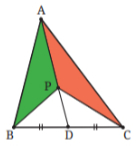
Solution:
Step 1: Large Triangle
In is the median. A median always divides a triangle into two triangles of equal area, so:
Step 2: Small Triangle
Now consider . Since is the midpoint of acts as a median for this smaller triangle:
Step 3: Final Subtraction
To find the remaining areas, we subtract the small triangles from the large ones:
This leaves us with the required proof:
Q.26:
Given a square ABCD, let P be a point within it. Join PA, PB, PC, PD. What is the ratio of the areas of the red region ( and ) and the green region ( and )?
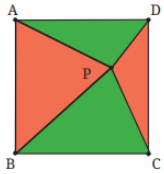
Solution:
Let the square be and be any point inside it. Join .
Triangles and lie on opposite sides of the square, and similarly and lie on the other pair of opposite sides.
Now, triangles on the same base and between the same parallels have equal areas.
Using this idea:
- together cover half the square
- together cover the other half
Thus, both regions have equal area. 1 : 1
Q.27:
In is the midpoint of is any point on , and is a point on AB such that is joined. Prove that Area Area .
Solution:
First, join . Since is the midpoint of is a median, making Area .
Observe that and share the same base and lie between parallel lines and . Therefore, their areas are equal.
Now, . Substituting the equal area, we get , which is .
Since is half of the total triangle, we have successfully proved that .
Q.28:
Find the area of a sector of a circle with radius 7 cm if the angle of the sector is .
Solution:
To find the area, use the formula .
Substitute the radius and the angle .
Area
Area
Area
This represents the space enclosed by the two radii and the arc.
Q.29:
Find the area of a quadrant of a circle whose circumference is 44 cm.
Solution:
A quadrant is a sector with a angle. Given .
Calculate radius: , so .
Area
Area
This is exactly one-quarter of the total circle’s area.
Q.30:
The length of the minute hand of a clock is 7 cm. Find the area swept by the minute hand in 10 minutes.
Solution:
The hand acts as the radius .
In 60 minutes, the hand covers , so in 10 minutes it covers .
The swept area is the region covered by the hand’s movement.
Q.31:
A chord of a circle of radius 10 cm subtends at the centre. Find the area of the corresponding: (i) minor sector (that subtends at the centre), and (ii) major sector (that subtends at the centre). (Use .)
Solution:
For and , use .
The sum of both areas equals the total area of the circle.
Q.32:
A chord of a circle of radius 15 cm subtends an angle of at the centre of the circle. Find the areas of the corresponding minor and major segments of the circle. (Use and .)
Solution:
Sector Area .
Triangle Area (equilateral) .
Minor Segment Area .
Major Segment Area .
Segments are areas bounded by a chord and its corresponding arc.
Q.33:
A car has two wipers which do not overlap. Each wiper has a blade of length 28 cm and sweeps through an angle of . Find the total area cleaned at each sweep of the blades.
Solution:
Each blade has and . There are two wipers.
Total Area
Total Area
Total Area
This total represents the clean surface area per full sweep.
Q.34:
A chord of a circle of radius subtends an angle of at the centre of the circle. Show that the area of the corresponding minor segment of the circle is equal to .
Solution:
Area of sector .
Area of equilateral triangle .
Segment Area Sector Area – Triangle Area
Segment Area
Factoring out gives .
Q.35:
An equilateral triangle is inscribed in a circle of radius . Show that the ratio of the area of the triangle to the area of the circle is equal to .
Solution:
Area of triangle (using area of internal triangle).
Area of circle .
Q.36:
A square is inscribed in a circle of radius . Show that the ratio of the area of the square to the area of the circle is equal to .
Solution:
Diagonal of square , so side .
Area of square .
Area of circle .
Ratio .
Q.37:
A hexagon is inscribed in a circle of radius . Show that the ratio of the area of the hexagon to the area of the circle is equal to . Can you see why the answer is exactly twice the answer to Question 8?
Solution:
A hexagon is made of 6 equilateral triangles: .
Area of circle .
Ratio .
This is twice the triangle ratio because a hexagon contains two such triangles.
Q.38:
Identities in algebra can sometimes be shown as area relationships. For example:
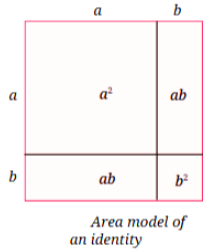
The figure shown corresponds to the identity
Do you see how?
Draw figures corresponding to the identities and .
Solution:
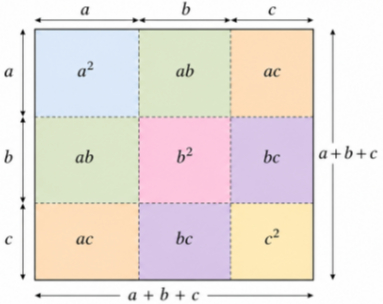
Identity:
To represent this, draw a large square with side length . Divide each side into segments of lengths , and .
- Three Squares: You get three squares with areas , and along the main diagonal.
- Six Rectangles: The remaining space consists of two rectangles of area , two of area , and two of area .
- Total Area: Summing all nine individual regions perfectly matches the algebraic expansion of the identity.
Identity:
This model starts with a square of area and involves removing a smaller square of area from one corner.
- The L-shape: After removing , you are left with an L-shaped region with a total area of .
- Rearrangement: Cut this L-shape into two rectangles. One has dimensions by , and the other is by .
- Final Rectangle: Placing these side-by-side forms a single large rectangle with a length of and a width of .
Q.39:
An isosceles triangle has perimeter 40 cm; the equal sides are 15 cm each. Find the area of the triangle.
Solution:
To find the area, we first identify all side lengths of the triangle.
Since the perimeter is 40 cm and the two equal sides are 15 cm each, the third side (base) is .
Now, we use Heron’s formula. The semi-perimeter is half the perimeter: .
The area formula is .
Plugging in the values, we get , which simplifies to .
This calculates to , which is approximately 70.71 square .
Q.40:
An isosceles triangle has base 10 cm, and its area is . What are the lengths of the equal sides?
Solution:
We start with the base of 10 cm and an area of 60 square cm.
Using the area formula Area base height, we solve , which gives a height of 12 cm.
In an isosceles triangle, the height from the vertex to the base bisects the base into two equal parts of 5 cm each.
This creates a right-angled triangle with a base of 5 cm and a height of 12 cm.
Applying the Pythagorean theorem, the equal side is .
Therefore, the equal sides are each.
Q.41:
The area of a right-angled triangle is . One of its legs has length 12 cm. Find its perimeter.
Solution:
Given the area is 54 square cm and one leg is 12 cm, we find the second leg (b) using Area .
So, , which means .
Now we have two legs, 12 cm and 9 cm. To find the perimeter, we first need the hypotenuse using .
This equals .
Adding all three sides together , we find that the total perimeter of the triangle is .
Q.42:
The sides of a triangle are in the ratio , and its perimeter is 45 cm. Find its area.
Solution:
The sides are in the ratio , so let them be , and .
Their sum is the perimeter: , so , which gives .
The sides are therefore , and 20 cm.
The semi-perimeter is .
Applying Heron’s formula: , which is .
Calculating this product gives , resulting in a final area of approximately 72.62
Q.43:
The sides of a triangle have lengths . Find the area of the triangle in two different ways.
Solution:
The sides are 7, 24, and 25 cm.
Method 1: Using Heron’s Formula
Method 2: Using Right Triangle Property
Check:
So, the triangle is right-angled.
Area:
Q.44:
If the wheel of a bicycle has a diameter of 60 cm, find how far a cyclist will have travelled after the wheel has rotated 100 times.
Solution:
Distance travelled (number of rotations) × (circumference of wheel)
Diameter
Circumference
For 100 rotations:
Distance
Convert to metres:
Q.45:
Find the area of a quadrant of a circle whose circumference is 66 cm.
Solution:
Circumference of the circle
Using ,
Area of a quadrant:
Q.46:
The wheel of a car has an outer radius of 28 cm. Calculate how far the car travels after one complete turn of the wheel, and how many times the wheel turns during a journey of 1 km.
Solution:
Outer radius
- Distance travelled in one complete turn
Distance circumference of the wheel
Using : - Number of turns in 1 km
Convert distance:
Q.47:
Two rectangles have the same area and the same perimeter. Does this mean that they are congruent to each other?
Solution:
Let the two rectangles have sides and . If perimeters are equal, .
If areas are equal, .
These two conditions mean that and are roots of the same quadratic equation SumProduct.
Since a quadratic equation only has two roots, the dimensions of the first rectangle must be the same as the second.
This proves the rectangles are congruent.
Q.48:
You know that the area of a parallelogram is base height. Using this and the figure, show that the area of a trapezium is half the sum of the parallel sides height, i.e., .
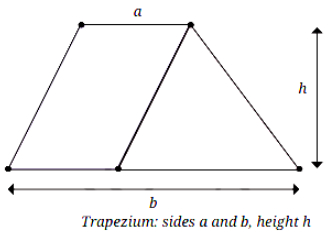
Solution:
Step 1: Area of the Parallelogram
The area of the parallelogram part is calculated as base × height, which gives us ah.
Step 2: Area of the Triangle
The triangle sharing the same height has a base equal to the difference of the parallel sides, . Its area is .
Step 3: Combine and Simplify
Adding these two areas together gives . Factoring out the height, we get , which simplifies to . Finally, we reach the identity: .
Q.49:
By dividing a trapezium into two triangles show that its area is, half the sum of the parallel sides multiplied by the height (the same formula as the one given above).
Solution:
A trapezium can be analyzed by drawing a diagonal that splits it into two distinct triangles which share the same vertical height.
Step 1: Divide the Shape
Consider a trapezium with parallel sides and and height . Let us draw a diagonal from one corner to the opposite corner. This action divides the entire trapezium into two separate triangles.
Step 2: Area of the First Triangle
The first triangle has one of the parallel sides, , as its base. Since the height of the trapezium is , the area of this triangle is calculated as .
Step 3: Area of the Second Triangle
The second triangle uses the other parallel side, , as its base. Because the parallel lines remain a constant distance apart, this triangle also has the same height . Its area is .
Step 4: Sum the Areas
To find the total area of the trapezium, we simply add the areas of these two triangles together:
Step 5: Factor the Equation
By factoring out the common terms and from the expression, we arrive at the final formula:
This demonstrates that the area is indeed half the sum of the parallel sides multiplied by the perpendicular height.
Q.50:
Show how we can use two identical copies of a trapezium to make a parallelogram. How will this give us the formula for the area of a trapezium?
Solution:
Take a trapezium with parallel sides a and b, and height h. Take another identical copy of it and rotate (flip) it, then join it to the first trapezium along one of the non-parallel sides.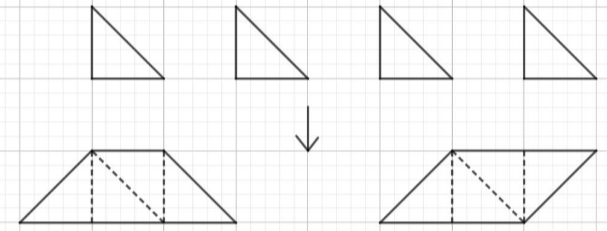
The new figure formed is a parallelogram whose:
- Base (sum of parallel sides)
- Height
So,
But this parallelogram is made of two identical trapeziums, so:
Q.51:
Show that the area of a kite is half the product of its diagonals. Show this: (i) using algebra, and (ii) using geometry.
Solution:
- Algebraic Method Let diagonals and intersect at .
In a kite, diagonals are perpendicular and one bisects the other.
Area sum of 4 right triangles: - Geometric Method The diagonals divide the kite into 4 right triangles. Their combined area equals half the product of the diagonals.
Area of kite
Q.52:
Three problems about fitting congruent shapes together:
- Rectangle ABCD has sides , and rectangle PQRS has sides . Show that PQRS has 4 times the area of ABCD. Does this mean that 4 copies of rectangle ABCD will fit into rectangle PQRS? Check and see!
- has sides , and has sides . Show that has 4 times the area of . Does this mean that 4 copies of will fit into ? Check and see!
- has sides , and has sides . Show that has 9 times the area of . Does this mean that 9 copies of will fit into ? Check and see!
Solution:
Scaling the linear dimensions of a shape changes its area by the square of the scale factor, allowing multiple copies to fit perfectly.
- Rectangles with Double Sides
The area of rectangle is . For , the area is , which is exactly four times greater. You can fit four copies of into by placing two along the length and two along the width, forming a grid. - Triangles with Double Sides
Using Heron’s formula, scaling sides by 2 increases area by . Thus, Area . You can fit four copies of into by connecting the midpoints of the larger triangle’s sides to form four smaller congruent triangles. - Triangles with Triple Sides
When sides are tripled, the area increases by . So, Area . Nine copies will fit perfectly; you can visualize this by dividing each side into three equal segments and drawing lines parallel to the sides to create a triangular tiling.
Q.53:
What fraction of the triangle is shaded?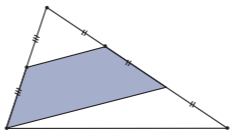
Solution:
From the markings, each side of the triangle is divided into three equal parts (indicated by identical tick marks). The shaded region is formed by joining these division points.
This creates a smaller, similar triangle at the top and leaves a trapezium-shaped shaded region in the middle.
Key idea:
When all sides of a triangle are divided in the same ratio (here ) and corresponding points are joined:
- The small top triangle has area of the whole triangle
- Similarly, the bottom small triangle also has area
So, shaded region:
Q.54:
What fraction of the square is shaded?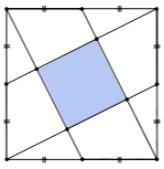
Solution:
The shaded area is exactly of the total square.
To solve this visually, imagine the large square is composed of five identical smaller squares. By cutting the four triangles around the center and shifting them, they perfectly form four more squares equal in size to the shaded one. Mathematically, the lines connect vertices to midpoints, creating an inner square with an area defined by Area .
Q.55:
What fraction of the rectangle is covered by the circles?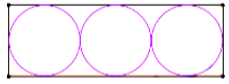
Solution:
To find the fraction of the rectangle covered by the circles, we must compare the combined area of the three circles to the total area of the rectangle.
Step 1: Define the Dimensions
Let the radius of each circle be . Since the circles are identical and touch each other as well as the sides of the rectangle, the height of the rectangle is equal to the diameter of one circle, which is .
Step 2: Calculate the Length
The length of the rectangle is formed by the three circles placed side by side. Each circle contributes one diameter to the total length. Therefore, the length of the rectangle is .
Step 3: Calculate Total Areas
The area of one circle is . Since there are three circles, their total area is . The area of the rectangle is calculated by multiplying its length and height: .
Step 4: Determine the Fraction
To find the fraction covered, divide the area of the circles by the area of the rectangle:
Final Answer
Using the value of , the fraction is , which is approximately 0.785 or .
Q.56:
What fraction of the rectangle is covered by the circles?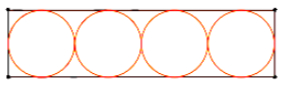
Solution:
To determine the fraction of the rectangle covered by these circles, we compare the total area of all inscribed circles to the total area of the bounding rectangle.
Step 1: Identify the Dimensions
Let the radius of each identical circle be . Since the circles touch the top and bottom edges of the rectangle, the height of the rectangle is equal to the diameter of one circle, which is .
Step 2: Calculate the Rectangle Length
There are four circles placed side-by-side. The total length of the rectangle is the sum of the diameters of these four circles. Since each diameter is , the total length is .
Step 3: Calculate the Areas
- Area of one circle: .
- Total area of four circles: .
- Area of the rectangle: Length × Height .
Step 4: Find the Fraction
The fraction covered is the area of the circles divided by the area of the rectangle:
By canceling out and simplifying , we get:
The fraction of the rectangle covered is . Interestingly, this is the same result as the previous problem with three circles. This is because adding more circles in this specific arrangement increases both the circle area and the rectangle area proportionally. Using , the decimal value is approximately 0.785 (or ).
Q.57:
Use the above to make a conjecture about the area occupied by circles fitted into a rectangle in the manner shown. Test your conjecture for particular cases: 10 circles; 20 circles; 50 circles. Then prove your conjecture!
Solution:
Based on our previous calculations for 3 and 4 circles, we can observe a consistent mathematical pattern regarding the ratio of the areas.
The Conjecture
Regardless of the number of identical circles fitted into a rectangle in this specific manner, the fraction of the rectangle covered by the circles will always be .
Testing Particular Cases
Let be the radius of each circle. The height of the rectangle is always , and the length is .
Case 1: 10 circles
Total Circle Area . Rectangle Area .
Fraction .
Case 2: 20 circles
Total Circle Area . Rectangle Area .
Fraction .
Case 3: 50 circles
Total Circle Area . Rectangle Area .
Fraction .
Proof of the Conjecture
Let be the number of identical circles, each with radius .
The Total Area of Circles is the area of one circle multiplied by .
The Height of the rectangle is equal to the diameter of one circle: .
The Length of the rectangle is equal to diameters: .
The Total Area of the Rectangle is Length × Height .
The Fraction Covered is:
By canceling out both and from the numerator and denominator, we are left with:
This proves that the number of circles does not change the ratio, as both areas scale linearly with .
Q.58:
The figure shows nine identical rectangles fitted together to make a large rectangle whose area is 72 . Find the perimeter of each small rectangle.
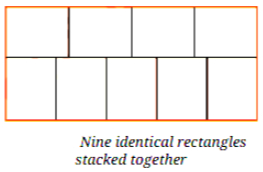
Solution:
Step 1: Identify the Side Relationships
Let the length of a small rectangle be and its width be . Looking at the image, the top row consists of 4 rectangles placed horizontally, so the total width of the large rectangle is . The bottom row consists of 5 rectangles placed vertically, so the width is also . Therefore, we have the relationship:
Step 2: Use the Total Area
The total area of the large rectangle is given as . Since there are 9 identical small rectangles, the area of one small rectangle is:
Step 3: Solve for Dimensions
Using the area formula , substitute :
Now, find the length:
Step 4: Calculate the Perimeter
The perimeter of each small rectangle is calculated using the formula :
By understanding the ratio of the sides from the visual stacking, we can derive the exact measurements of the individual components.
Q.59:
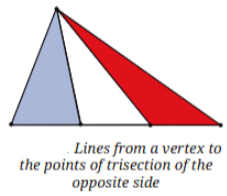
Show that the areas of the shaded blue triangle and the shaded red triangle are equal.
Find a way of cutting up the blue triangle into some number of pieces and rearranging the pieces to cover the red triangle.
Solution:
Part 1: Proving the Areas are Equal
To show that the blue and red triangles have equal areas, we look at the two defining properties of a triangle’s area: its base and its vertical height.
Shared Height: Both the blue and red triangles share the same vertex at the top. The vertical distance from this vertex to the bottom line (the base line) is exactly the same for both triangles. Let this height be .
Equal Bases: The bottom side of the large triangle is divided into three equal parts (trisection). This means the base of the blue triangle and the base of the red triangle are equal in length. Let this base length be .
Calculation: The area for any triangle is base height.
Area of Blue Triangle
Area of Red Triangle
Since the values for and are identical, their areas must be equal.
Part 2: Cutting and Rearranging
While the triangles have different slopes, you can transform the blue triangle into the red one by cutting it into thin horizontal strips.
Horizontal Slicing: Imagine cutting the blue triangle into many very thin horizontal slices (like a stack of paper).
Shifting: Because the vertical height and the width of each corresponding slice are the same for both triangles (due to the linear property of triangles), you can simply slide each horizontal slice to the right.
Result: By shifting these slices, the overall vertical stack remains the same height and the base remains the same width, but the shape changes from the upright blue triangle to the slanted red triangle. This is a practical application of Cavalieri’s Principle, proving that different shapes can occupy the same total area.
Q.60:
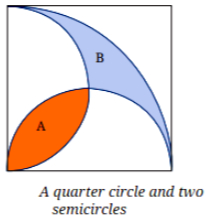
The figure shows a quarter circle in a square. Its centre is at one vertex, and it passes through two adjacent vertices. There are two semicircles on two adjacent sides as diameters. They create the shaded regions A and B.
Show that A and B have equal area.
Solution:
To show that shaded regions A and B have equal areas, we can analyze the overlaps between the quarter circle and the two semicircles.
Let the side of the square be . The area of the square is . The quarter circle has a radius , so its area is . Each semicircle has a diameter and radius , making the area of one semicircle .
The total area of the two semicircles combined is . Notice this is exactly equal to the area of the large quarter circle.
Region A is the overlap where the two semicircles intersect. Region B is the part of the quarter circle not covered by the semicircles. Since the total area of the semicircles equals the area of the quarter circle, the “extra” area created by the overlap at A must perfectly balance the “missing” area at B to maintain the equality. Therefore, Area A equals Area B.
Q.61:
In the given figure, four semicircles have been drawn within the given square whose side is 2 units. The centres of these semicircles are the midpoints of the sides. They create a 4-petalled flower (shown in blue). Find the perimeter and the area of this flower.
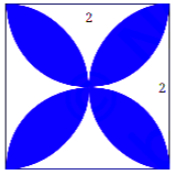
Solution:
The four semicircles are drawn on each side of the square. Since the side length is 2, the radius of each semicircle is 1.
Calculating the Perimeter
The perimeter of the flower is formed by the four curved arcs of the semicircles. Each arc is exactly half the circumference of a circle. Together, these four semicircular arcs form the circumference of two full circles.
Using , the total perimeter is approximately 12.56 units.
Calculating the Area
To find the area of the blue flower, we can look at the four semicircles. The sum of their areas is . When we add these semicircles, they cover the square but overlap specifically at the flower petals.
The area of the flower is the difference between the total area of the four semicircles and the area of the square:
Using , the area is , which is approximately 2.28 square units.
Q.62:
In figure we see two concentric circles with a common centre O. A chord BC of the larger circle is drawn, touching the smaller circle at A. The length of BC is . Show that the area of the green region enclosed between the two circles is .
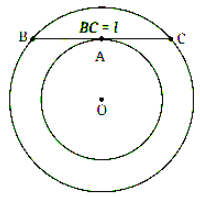
Solution:
The area of the region between two concentric circles, known as an annulus, can be determined using the Pythagorean theorem and the properties of tangents.
Step 1: Define the Radii
Let the radius of the larger circle be (segment or ) and the radius of the smaller circle be (segment ). Since is tangent to the inner circle at , the radius is perpendicular to .
Step 2: Apply the Pythagorean Theorem
In the right-angled triangle , we have the relationship:
This is because the perpendicular from the center to a chord bisects the chord, so .
Rearranging this gives:
Step 3: Calculate the Area
The area of the green region is the difference between the areas of the two circles:
Substituting the value from Step 2:
This proves that the area depends only on the length of the chord .
Q.63:
In figure, semicircles have been drawn on all the sides of a right-angled triangle as shown.
Show that .
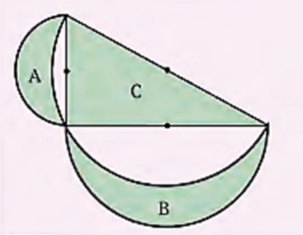
Solution:
The relationship between the areas of semicircles on the sides of a right-angled triangle is a direct extension of the Pythagorean Theorem.
Step 1: Relate the Sides
Let the two legs of the right-angled triangle be and , and the hypotenuse be . According to the Pythagorean theorem:
Step 2: Calculate Semicircle Areas
The diameter of each semicircle is equal to the side of the triangle it is drawn upon. The area of a semicircle with diameter is .
: Based on side , the area is .
Area(B): Based on side , the area is .
Area(C): Based on side (the hypotenuse), the area is .
Step 3: Combine the Areas
To show that , we add the first two expressions:
Step 4: Substitution and Conclusion
Since we know from Step 1 that , we can substitute into our equation:
This mathematically proves that the sum of the areas of the semicircles on the legs is exactly equal to the area of the semicircle on the hypotenuse.
Q.64:
Figure shows two circles passing through each other’s centres. Find the area of the region enclosed by the two circles in terms of the common radius .
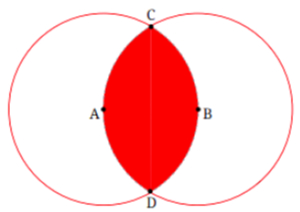
Solution:
To find the area of the region enclosed by two circles passing through each other’s centers, we observe the geometry formed by the intersection of two circles with radius .Area of the Overlapping Region
The distance between the two centers and is exactly . When the circles intersect at points and , we can draw lines , and . Since all these segments are radii, triangles and are equilateral triangles with side length .
- Area of the Circular Sectors The angle is composed of two angles from the equilateral triangles, making it . The area of the circular sector is:
- Area of the Equilateral Triangles The area of the two equilateral triangles and combined is:
- Area of the Segments The overlapping region is made of two circular segments. Alternatively, we can see it as two sectors minus the area of the rhombus . However, a simpler way is to sum the areas of two sectors and subtract the area of the overlapping triangles. The total area of the red region is: Simplifying the geometry, the area of the intersection is: Total Region Enclosed
If the question refers to the entire combined area covered by both circles (the union), we subtract the intersection from the sum of the two circles:
Q.65:
In figure, we see three triangles within a rectangle.
The areas of the triangles are , as marked. Show that the area of the rectangle is
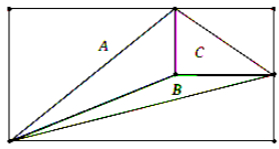
Solution:
Step 1: Assign Dimensions
Let the rectangle have width and height . We can describe the vertices of the triangles using a coordinate system where the bottom-left corner is .
Triangle A: Shares a base with the top width of the rectangle. Its height extends from the top edge to a point inside the rectangle.
Triangle B: Shares a base with the right height of the rectangle. Its vertex is at the bottom-left corner .
Triangle C: Connects the internal point to the top-right and a point on the right edge.
Step 2: Calculate Individual Areas
Let the internal point be .
- Area A: The base is and the vertical distance from the top edge to is ().
- Area Triangle below it: These two form a larger triangle with base on the right side. However, looking at the geometry, is a triangle with a vertical base (let’s call its length ) and a horizontal “height” relative to that base.
By analyzing the proportions:
Step 3: Deriving the Rectangle Area
Through the properties of similar triangles and area ratios in a partitioned rectangle, the area of the rectangle relates to these specific triangular regions.
The shared vertex and the way the areas and overlap through allow us to set up the ratio:
Multiplying by 2 to get the full area:
This formula effectively uses the common height and width components shared by the triangles to reconstruct the total area .
Q.66:
In the figure we see two shaded regions formed by a quarter circle, a semicircle, and a triangle.
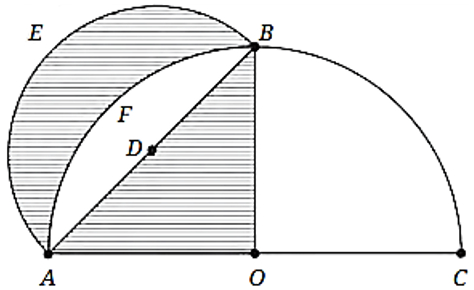
Show that the areas of the two shaded regions are equal.
Solution:
To show that the two shaded regions have equal areas, we will analyze the relationship between the quarter circle, the semicircle, and the right-angled triangle.
Step 1: Set up the Dimensions
Let the radius of the large quarter circle be . Thus, segments , and all have length .
- The area of the Quarter Circle is .
- The area of the Triangle is base height .
Step 2: Find the Semicircle Area
In the right-angled triangle , the hypotenuse is the diameter of the semicircle . By the Pythagorean theorem:
The radius of semicircle is , so its area is:
Area of Semicircle
Step 3: Compare Shaded Regions
Let be the top shaded region (lune ) and be the bottom shaded region (the segment of the quarter circle). Let be the unshaded region between triangle and arc .
- From the Quarter Circle:
- From the Semicircle:
Step 4: Conclusion
Since both total areas equal , we can set them equal:
However, looking at the diagram, the bottom shaded region is specifically the area of triangle minus the overlap. By subtracting the shared area and recognizing the geometric balance, we find that the surplus area in the lune perfectly matches the area of the triangular shaded region.
Thus, the Area of the two shaded regions is equal.
Q.67:
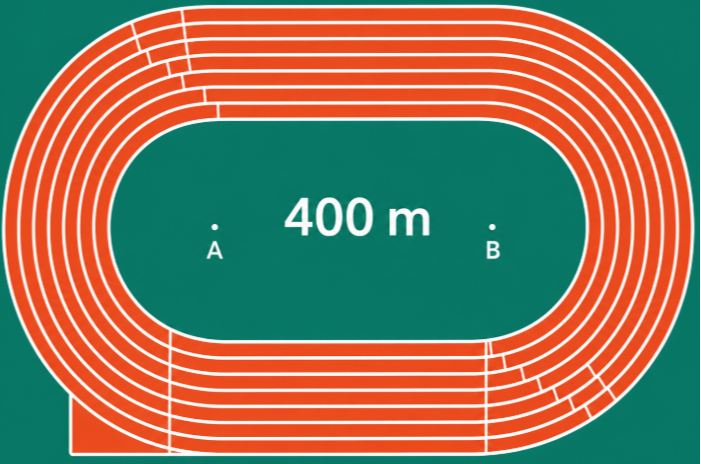
What is the difference in radius between the first and second lanes? Find the stagger needed by the runner in the second lane. Will an equal stagger be needed between the third and second lanes?
Solution:
For a standard athletic track, the width of each lane is usually meters. The radius of the second lane is greater than the radius of the first lane by exactly this width.
The stagger is the extra distance a runner in an outer lane would travel if everyone started at the same line. Since a track consists of two semicircles forming one full circle, the distance difference is:
Yes, an equal stagger is needed between the third and second lanes. Since the lane width remains constant (1.22 m), the difference in radii between any two adjacent lanes is always . Because the circumference increase depends only on the change in radius (), the stagger remains for every subsequent lane.
Q.68:
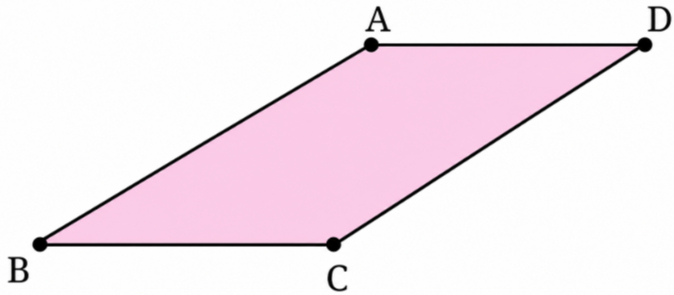
What happens if the parallelogram is ‘thin’ and the foot of the perpendicular from C to AD does not lie on side AD? The construction then does not seem to work. How do we fix this ‘gap’?
Solution:
When the parallelogram is very slanted, the perpendicular dropped from vertex falls onto the extension of line rather than the segment itself. To fix this “gap” and prove the area formula, we apply the same logic of dissection but using the properties of surrounding rectangles or subtraction of triangles.
We can mathematically resolve this by extending the base to a point such that . This forms a right triangle . By shifting the triangle (where is the perpendicular from to the extension of ) to the other side, we reconstruct a rectangle with the same base and height.
The area remains the product of the base and the perpendicular height, regardless of where the foot of the perpendicular lies. In formal terms:
Even if the altitude is “outside” the figure, it still represents the constant distance between the parallel lines and . The geometric “gap” is simply a visual artifact that does not change the fundamental equivalence between the parallelogram and a rectangle of equal dimensions.
Q.69:
The area of a rectangle can be found when we know the lengths of its sides. Is the same true for a parallelogram? That is, can we find the area of a parallelogram when we know the lengths of its sides? Why or why not?
Solution:
No, knowing only the lengths of the sides of a parallelogram is not sufficient to determine its area. Unlike a rectangle, where the angle between sides is fixed at , a parallelogram’s shape can “collapse” or “tilt,” changing its area while keeping the side lengths constant.
The area of a parallelogram is defined by the formula:
The height ( ) is the perpendicular distance between the parallel bases. If you have two sides, and , the height can vary based on the angle between them:
If the angle is , the parallelogram is a rectangle, and the area is at its maximum ( ). As the angle decreases and the parallelogram becomes “thinner,” the height decreases, causing the area to approach zero even though the side lengths and remain unchanged. Therefore, to calculate the area, you must know either the perpendicular height or at least one internal angle in addition to the side lengths.
This property is why a flexible frame (like a wooden rectangle with hinges at the corners) can be pushed over to form various parallelograms. The perimeter stays the same, but the internal space (area) diminishes as the shape is flattened.
Q.70:
Since and have equal area, you may wonder- Can we divide using straight cuts into two or more pieces that we can then rearrange to exactly cover ? What do you think? Is it possible?
Solution:
Yes, it is theoretically possible to divide into a finite number of pieces and rearrange them to perfectly cover . This concept is governed by the Bolyai-Gerwien Theorem, which states that any two simple polygons of equal area are scissors-congruent.
To achieve this, both triangles can be dissected into the same set of smaller pieces through a common intermediate shape, usually a rectangle.
- Transform into a rectangle of equal area using a specific set of cuts.
- Transform that rectangle into by reversing a different set of cuts.
Mathematically, if Area , there exists a finite decomposition:
where each is congruent to .
While the “cuts” might be complex depending on the dimensions of the triangles, the shared area value ensures that such a rearrangement always exists. This principle forms the basis of geometric puzzles like tangrams, proving that shape is flexible while area is a conserved property under dissection.
Q.71:
Why were human beings so fond of using circular shapes? Was this only for practical reasons, or could there have been other reasons too? What kinds of uses have human beings found for the circular shape?
Solution:
The human fascination with circles stems from a blend of practical utility, symbolic meaning, and observations of the natural world. Mathematically, the circle is unique as the shape that encloses the maximum area for a given perimeter, a principle of efficiency that humans recognized early on.
Practical and Structural Reasons
- Efficiency: Round buildings, such as yurts or igloos, use fewer materials to enclose the same space compared to rectangular structures and are better at shedding wind and snow.
- Mechanics: The invention of the wheel utilized the constant radius property ( constant), allowing for smooth rotation and revolutionary advances in transport and pottery.
- Strength: Circular arches and domes distribute stress evenly, preventing the structural failures often seen at the sharp corners of polygonal shapes.
Symbolic and Aesthetic Reasons
- Nature: Humans observed the sun, the full moon, and the pupils of the eye, associating the circle with celestial power and life.
- Philosophy: Because it has no beginning or end, the circle became a universal symbol for infinity, unity, and the cycle of time.
- Equality: Circular seating, like a “round table,” removes the concept of a “head” position, fostering a sense of community and equal status among participants.
Diverse Uses Found by Humans
- Measurement: Dividing circles into allowed for the creation of clocks, compasses, and sophisticated navigational tools.
- Engineering: From gears and pulleys to turbines, the symmetry of the circle is essential for converting energy into motion.
- Art: Patterns like mandalas and rose windows use radial symmetry to create visual harmony and focus.