Exercise 8.2
NCERT solutions for Class 9 Maths Quadrilateral
NCERT Solutions for Class 9 Mathematics Quadrilaterals
1. ABCD is a quadrilateral in which P, Q, R and S are the mid-points of sides AB, BC, CD and DA respectively (See figure). AC is a diagonal. Show that:
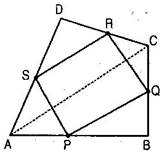
(i) SR  AC and SR =
  AC
AC
(ii) PQ = SR
(iii) PQRS is a parallelogram.
Ans. In  ABC, P is the mid-point of AB and Q is the mid-point of BC.
Then PQ AC and PQ = AC
(i) In ACD, R is the mid-point of CD and S is the mid-point of AD.
Then SR AC and SR = AC
(ii) Since PQ = AC and SR = AC
Therefore, PQ = SR
(iii) Since PQ AC and SR AC
Therefore, PQ SR [two lines parallel to given line are parallel to each other]
Now PQ = SR and PQ SR
Therefore, PQRS is a parallelogram.
2. ABCD is a rhombus and P, Q, R, S are mid-points of AB, BC, CD and DA respectively. Prove that quadrilateral PQRS is a rectangle.
Ans. Given: P, Q, R and S are the mid-points of respective sides AB, BC, CD and DA of rhombus. PQ, QR, RS and SP are joined.
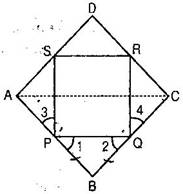
To prove: PQRS is a rectangle.
Construction: Join A and C.
Proof: In ABC, P is the mid-point of AB and Q is the mid-point of BC.
 PQ AC and PQ = AC ……….(i)
In ADC, R is the mid-point of CD and S is the mid-point of AD.
SR AC and SR = AC ……….(ii)
From eq. (i) and (ii), PQ SR and PQ = SR
PQRS is a parallelogram.
Now ABCD is a rhombus. [Given]
AB = BC
 AB = BC PB = BQ
 1 = 2 [Angles opposite to equal sides are equal]
Now in triangles APS and CQR, we have,
AP = CQ [P and Q are the mid-points of AB and BC and AB = BC]
Similarly, AS = CR and PS = QR [Opposite sides of a parallelogram]
APS  CQR [By SSS congreuancy]
3 = 4 [By C.P.C.T.]
Now we have 1 + SPQ + 3 = 
And 2 + PQR + 4 = [Linear pairs]
1 + SPQ + 3 = 2 + PQR + 4
Since 1 = 2 and 3 = 4 [Proved above]
SPQ = PQR ……….(iii)
Now PQRS is a parallelogram [Proved above]
SPQ + PQR = ……….(iv) [Interior angles]
Using eq. (iii) and (iv),
SPQ + SPQ = 2SPQ =
SPQ = 
Hence PQRS is a rectangle.
NCERT Solutions for Class 9 Maths Exercise 8.2
3. ABCD is a rectangle and P, Q, R and S are the mid-points of the sides AB, BC, CD and DA respectively. Show that the quadrilateral PQRS is a rhombus.
Ans. Given: A rectangle ABCD in which P, Q, R and S are the mid-points of the sides AB, BC, CD and DA respectively. PQ, QR, RS and SP are joined.
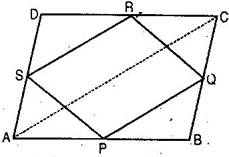
To prove: PQRS is a rhombus.
Construction: Join AC.
Proof: In ABC, P and Q are the mid-points of sides AB, BC respectively.
PQ AC and PQ = AC ……….(i)
In ADC, R and S are the mid-points of sides CD, AD respectively.
SR AC and SR = AC ……….(ii)
From eq. (i) and (ii), PQ SR and PQ = SR ……….(iii)
PQRS is a parallelogram.
Now ABCD is a rectangle. [Given]
AD = BC
AD = BC AS = BQ ……….(iv)
In triangles APS and BPQ,
AP = BP [P is the mid-point of AB]
PAS = PBQ [Each ]
And AS = BQ [From eq. (iv)]
APS BPQ [By SAS congruency]
PS = PQ [By C.P.C.T.] ………(v)
From eq. (iii) and (v), we get that PQRS is a parallelogram.
PS = PQ
Two adjacent sides are equal.
Hence, PQRS is a rhombus.
NCERT Solutions for Class 9 Maths Exercise 8.2
4. ABCD is a trapezium, in which AB DC, BD is a diagonal and E is the mid-point of AD. A line is drawn through E, parallel to AB intersecting BC at F (See figure). Show that F is the mid-point of BC.
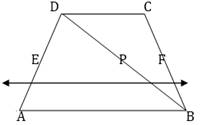
Ans. Let diagonal BD intersect line EF at point P.
In DAB,
E is the mid-point of AD and EP AB [ EF AB (given) P is the part of EF]
P is the mid-point of other side, BD of DAB.
[A line drawn through the mid-point of one side of a triangle, parallel to another side intersects the third side at the mid-point]
Now in BCD,
P is the mid-point of BD and PF DC [ EF AB (given) and AB DC (given)]
EF DC and PF is a part of EF.
F is the mid-point of other side, BC of BCD. [Converse of mid-point of theorem]
NCERT Solutions for Class 9 Maths Exercise 8.2
5. In a parallelogram ABCD, E and F are the mid-points of sides AB and CD respectively (See figure). Show that the line segments AF and EC trisect the diagonal BD.
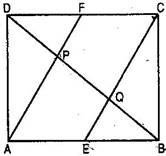
Ans. Since E and F are the mid-points of AB and CD respectively.
AE = AB and CF = CD……….(i)
But ABCD is a parallelogram.
AB = CD and AB DC
AB = CD and AB DC
AE = FC and AE FC [From eq. (i)]
AECF is a parallelogram.
FA CE FP CQ [FP is a part of FA and CQ is a part of CE] ………(ii)
Since the segment drawn through the mid-point of one side of a triangle and parallel to the other side bisects the third side.
In DCQ, F is the mid-point of CD and FP CQ
P is the mid-point of DQ.
DP = PQ ……….(iii)
Similarly, In ABP, E is the mid-point of AB and EQ AP
Q is the mid-point of BP.
BQ = PQ ……….(iv)
From eq. (iii) and (iv),
DP = PQ = BQ ………(v)
Now BD = BQ + PQ + DP = BQ + BQ + BQ = 3BQ
BQ =  BD ……….(vi)
From eq. (v) and (vi),
DP = PQ = BQ = BD
Points P and Q trisects BD.
So AF and CE trisects BD.
NCERT Solutions for Class 9 Maths Exercise 8.2
6. Show that the line segments joining the mid-points of opposite sides of a quadrilateral bisect each other.
Ans. Given: A quadrilateral ABCD in which EG and FH are the line-segments joining the mid-points of opposite sides of a quadrilateral.
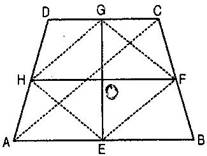
To prove: EG and FH bisect each other.
Construction: Join AC, EF, FG, GH and HE.
Proof: In ABC, E and F are the mid-points of respective sides AB and BC.
EF AC and EF AC ……….(i)
Similarly, in ADC,
G and H are the mid-points of respective sides CD and AD.
HG AC and HG AC ……….(ii)
From eq. (i) and (ii),
EF HG and EF = HG
EFGH is a parallelogram.
Since the diagonals of a parallelogram bisect each other, therefore line segments (i.e. diagonals) EG and FH (of parallelogram EFGH) bisect each other.
NCERT Solutions for Class 9 Maths Exercise 8.2
7. ABC is a triangle right angled at C. A line through the mid-point M of hypotenuse AB and parallel to BC intersects AC at D.
Ans. (i) In ABC, M is the mid-point of AB [Given]
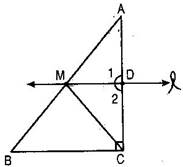
MD BC
AD = DC [Converse of mid-point theorem]
Thus D is the mid-point of AC.
(ii) BC (given) consider AC as a transversal.
1 = C [Corresponding angles]
1 = [C = ]
Thus MD  AC.
AC.
(iii) In AMD and CMD,
AD = DC [proved above]
1 = 2 = [proved above]
MD = MD [common]
AMD CMD [By SAS congruency]
AM = CM [By C.P.C.T.] ……….(i)
Given that M is the mid-point of AB.
AM = AB ……….(ii)
From eq. (i) and (ii),
CM = AM = AB