Exercise 8.1
NCERT solutions for Class 9 Maths Quadrilateral
NCERT Solutions for Class 9 Mathematics Quadrilaterals
1. The angles of a quadrilateral are in the ratio 3: 5: 9: 13. Find all angles of the quadrilateral.
Ans. Let in quadrilateral ABCD,  A =
A =  B =
B =  C =
C =  and D =
Since, sum of all the angles of a quadrilateral = 
 A + B + C + D =




Now A = 
B = 
C = 
And D = 
Hence angles of given quadrilateral are  and
and 
2. If the diagonals of a parallelogram are equal, show that it is a rectangle.
Ans. Given: ABCD is a parallelogram with diagonal AC = diagonal BD
To prove: ABCD is a rectangle.
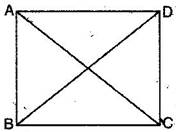
Proof: In triangles ABC and ABD,
AB = AB[Common]
AC = BD[Given]
AD = BC[opp. Sides of a  gm]
gm]
 ABC
ABC  BAD [By SSS congruency]
DAB = CBA [By C.P.C.T.] ……….(i)
But DAB + CBA =  ……….(ii)
[ ADBC and AB cuts them, the sum of the interior angles of the same side of transversal is ]
From eq. (i) and (ii),
DAB = CBA = 
Hence ABCD is a rectangle.
3. Show that is diagonals of a quadrilateral bisect each other at right angles, then it is a rhombus.
Ans. Given: Let ABCD is a quadrilateral.
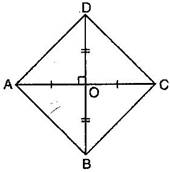
Let its diagonal AC and BD bisect each other at right angle at point O.
OA = OC, OB = OD
And AOB = BOC = COD = AOD =
To prove: ABCD is a rhombus.
Proof: In AOD and BOC,
OA = OC[Given]
AOD = BOC [Given]
OB = OD[Given]
AOD COB [By SAS congruency]
AD = CB[By C.P.C.T.] ……….(i)
Again, In AOB and COD,
OA = OC[Given]
AOB = COD [Given]
OB = OD[Given]
AOB COD [By SAS congruency]
AD = CB [By C.P.C.T.] ……….(ii)
Now In AOD and BOC,
OA = OC[Given]
AOB = BOC [Given]
OB = OB[Common]
AOB COB [By SAS congruency]
AB = BC[By C.P.C.T.] ……….(iii)
From eq. (i), (ii) and (iii),
AD = BC = CD = AB
And the diagonals of quadrilateral ABCD bisect each other at right angle.
Therefore, ABCD is a rhombus.
4. Show that the diagonals of a square are equal and bisect each other at right angles.
Ans. Given: ABCD is a square. AC and BD are its diagonals bisect each other at point O.
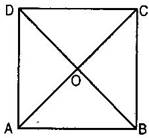
To prove: AC = BD and AC  BD at point O.
Proof: In triangles ABC and BAD,
AB = AB[Common]
ABC = BAD =
BC = AD[Sides of a square]
ABC BAD [By SAS congruency]
AC = BD[By C.P.C.T.]Hence proved.
Now in triangles AOB and AOD,
AO = AO[Common]
AB = AD[Sides of a square]
OB = OD[Diagonals of a square bisect each other]
AOB AOD [By SSS congruency]
AOB = AOD [By C.P.C.T.]
But AOB + AOD = [Linear pair]
AOB = AOD = 
OA BD or AC BD Hence proved.
NCERT Solutions for Class 9 Maths Exercise 8.1
5. Show that if the diagonals of a quadrilateral are equal and bisect each other at right angles, then it is a square.
Ans. Let ABCD be a quadrilateral in which equal diagonals AC and BD bisect each other at right angle at point O.
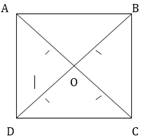
We haveAC = BD and OA = OC……….(i)
And OB = OD……….(ii)
Now OA + OC = OB + OD
OC + OC = OB + OB [Using (i) & (ii)]
2OC = 2OB
OC = OB……….(iii)
From eq. (i), (ii) and (iii), we get, OA = OB = OC = OD ……….(iv)
Now in AOB and COD,
OA = OD [proved]
AOB = COD[vertically opposite angles]
OB = OC [proved]
AOB DOC[By SAS congruency]
AB = DC [By C.P.C.T.]……….(v)
Similarly, BOC AOD [By SAS congruency]
BC = AD [By C.P.C.T.]……….(vi)
From eq. (v) and (vi), it is concluded that ABCD is a parallelogram because opposite sides of a quadrilateral are equal.
Now in ABC and BAD,
AB = BA [Common]
BC = AD [proved above]
AC = BD [Given]
ABC BAD[By SSS congruency]
ABC = BAD[By C.P.C.T.]……….(vii)
But ABC + BAD = [ABCD is a parallelogram]……….(viii)
AD BC and AB is a transversal.
ABC + ABC = [Using eq. (vii) and (viii)]
2ABC = ABC =
ABC = BAD =……….(ix)
Opposite angles of a parallelogram are equal.
But ABC = BAD =
ABC = ADC = ……….(x)
BAD = BDC =……….(xi)
From eq. (x) and (xi), we get
ABC = ADC = BAD = BDC =……….(xii)
Now in AOB and BOC,
OA = OC [Given]
AOB = BOC = [Given]
OB = OB [Common]
AOB COB[By SAS congruency]
AB = BC……….(xiii)
From eq. (v), (vi) and (xiii), we get,
AB = BC = CD = AD ……….(xiv)
Now, from eq. (xii) and (xiv), we have a quadrilateral whose equal diagonals bisect each other at right angle.
Also sides are equal make an angle of with each other.
ABCD is a square.
NCERT Solutions for Class 9 Maths Exercise 8.1
6. Diagonal AC of a parallelogram ABCD bisects A (See figure). Show that:
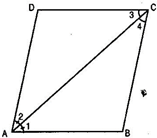
(i) It bisects C also.
(ii) ABCD is a rhombus.
Ans. Diagonal AC bisects A of the parallelogram ABCD.
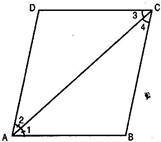
(i) Since AB DC and AC intersects them.
1 = 3 [Alternate angles] ……….(i)
Similarly 2 = 4 ……….(ii)
But 1 = 2 [Given]……….(iii)
3 = 4[Using eq. (i), (ii) and (iii)]
Thus AC bisects C.
(ii)2 = 3 = 4 = 1
AD = CD[Sides opposite to equal angles]
AB = CD = AD = BC
Hence ABCD is a rhombus.
NCERT Solutions for Class 9 Maths Exercise 8.1
7. ABCD is a rhombus. Show that the diagonal AC bisects A as well as C and diagonal BD bisects B as well as D.
Ans. ABCD is a rhombus. Therefore, AB = BC = CD = AD
Let O be the point of bisection of diagonals.
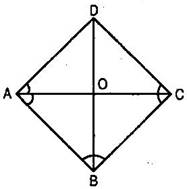
OA = OC and OB = OD
In AOB and AOD,
OA = OA [Common]
AB = AD [Equal sides of rhombus]
OB = OD (diagonals of rhombus bisect each other]
AOB AOD [By SSS congruency]
OAD = OAB [By C.P.C.T.]
OA bisects A ……….(i)
Similarly, BOC DOC [By SSS congruency]
OCB = OCD[By C.P.C.T.]
OC bisects C ……….(ii)
From eq. (i) and (ii), we can say that diagonal AC bisects A and C.
Now in AOB and BOC,
OB = OB [Common]
AB = BC [Equal sides of rhombus]
OA = OC (diagonals of rhombus bisect each other]
AOB COB [By SSS congruency]
OBA = OBC [By C.P.C.T.]
OB bisects B ……….(iii)
Similarly, AOD COD [By SSS congruency]
ODA = ODC[By C.P.C.T.]
BD bisects D ……….(iv)
From eq. (iii) and (iv), we can say that diagonal BD bisects B and D.
NCERT Solutions for Class 9 Maths Exercise 8.1
8. ABCD is a rectangle in which diagonal AC bisects A as well as C. Show that:
(i) ABCD is a square.
(ii) Diagonal BD bisects both B as well as D.
Ans. ABCD is a rectangle. Therefore AB = DC……….(i)
And BC = AD
Also A = B = C = D =
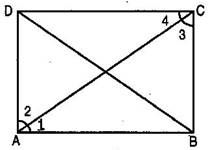
(i) In ABC and ADC
1 = 2 and 3 = 4
[AC bisects A and C (given)]
AC = AC [Common]
ABC ADC[By ASA congruency]
AB = AD ……….(ii)
From eq. (i) and (ii), AB = BC = CD = AD
Hence ABCD is a square.
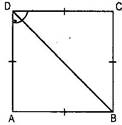
(ii) In ABC and ADC
AB = BA [Since ABCD is a square]
AD = DC [Since ABCD is a square]
BD = BD [Common]
ABD CBD [By SSS congruency]
ABD = CBD [By C.P.C.T.]……….(iii)
And ADB = CDB[By C.P.C.T.]……….(iv)
From eq. (iii) and (iv), it is clear that diagonal BD bisects both B and D.
NCERT Solutions for Class 9 Maths Exercise 8.1
9. In parallelogram ABCD, two points P and Q are taken on diagonal BD such that DP = BQ (See figure). Show that:
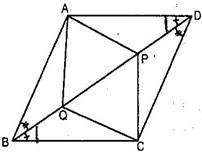
(i) APD CQB
(ii) AP = CQ
(iii) AQB CPD
(iv) AQ = CP
(v) APCQ is a parallelogram.
Ans. (i) In APD and CQB,
DP = BQ[Given]
ADP = QBC [Alternate angles (ADBC and BD is transversal)]
AD = CB [Opposite sides of parallelogram]
APD CQB [By SAS congruency]
(ii) Since APD CQB
AP = CQ[By C.P.C.T.]
(iii) In AQB and CPD,
BQ = DP[Given]
ABQ = PDC [Alternate angles (ABCD and BD is transversal)]
AB = CD[Opposite sides of parallelogram]
AQB CPD [By SAS congruency]
(iv) Since AQB CPD
AQ = CP[By C.P.C.T.]
(v) In quadrilateral APCQ,
AP = CQ[proved in part (i)]
AQ = CP[proved in part (iv)]
Since opposite sides of quadrilateral APCQ are equal.
Hence APCQ is a parallelogram.
NCERT Solutions for Class 9 Maths Exercise 8.1
10. ABCD is a parallelogram and AP and CQ are the perpendiculars from vertices A and C on its diagonal BD (See figure). Show that:
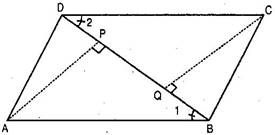
(i) APB CQD
(ii) AP = CQ
Ans. Given: ABCD is a parallelogram. AP BD and CQ BD
To prove: (i) APB CQD (ii) AP = CQ
Proof: (i) In APB and CQD,
1 = 2[Alternate interior angles]
AB = CD[Opposite sides of a parallelogram are equal]
APB = CQD =
APB CQD [By ASA Congruency]
(ii) Since APB CQD
AP = CQ [By C.P.C.T.]
NCERT Solutions for Class 9 Maths Exercise 8.1
11. An ABC and DEF, AB = DE, AB DE, BC = EF and BC EF. Vertices A, B and C are joined to vertices D, E and F respectively (See figure). Show that:
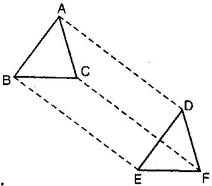
(i) Quadrilateral ABED is a parallelogram.
(ii) Quadrilateral BEFC is a parallelogram.
(iii) AD CF and AD = CF
(iv) Quadrilateral ACFD is a parallelogram.
(v) AC = DF
(vi) ABC DEF
Ans. (i) In ABC and DEF
AB = DE[Given]
And AB DE[Given]
ABED is a parallelogram.
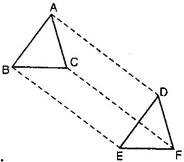
(ii) In ABC and DEF
BC = EF[Given]
And BC EF[Given]
BEFC is a parallelogram.
(iii) As ABED is a parallelogram.
AD BE and AD = BE ……….(i)
Also BEFC is a parallelogram.
CF BE and CF = BE……….(ii)
From (i) and (ii), we get
AD CF and AD = CF
(iv) As AD CF and AD = CF
ACFD is a parallelogram.
(v) As ACFD is a parallelogram.
AC = DF
(vi) In ABC and DEF,
AB = DE [Given]
BC = EF [Given]
AC = DF [Proved]
ABC  DEF[By SSS congruency]
NCERT Solutions for Class 9 Maths Exercise 8.1
12. ABCD is a trapezium in which AB CD and AD = BC (See figure). Show that:
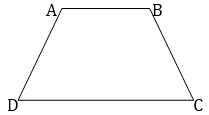
(i) A = B
(ii) C = D
(iii) ABC BAD
(iv) Diagonal AC = Diagonal BD
Ans. Given: ABCD is a trapezium.
AB CD and AD = BC
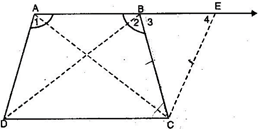
To prove: (i) A = B
(ii) C = D
(iii) ABC BAD
(iv) Diag. AC = Diag. BD
Construction: Draw CE AD and extend
AB to intersect CE at E.
Proof: (i) As AECD is a parallelogram.[By construction]
AD = EC
But AD = BC [Given]
BC = EC
3 = 4 [Angles opposite to equal sides are equal]
Now 1 + 4 = [Interior angles]
And 2 + 3 = [Linear pair]
1 + 4 = 2 + 3
1 = 2 [3 = 4 ]
A = B
(ii)3 = C[Alternate interior angles]
And D = 4 [Opposite angles of a parallelogram]
But 3 = 4 [BCE is an isosceles triangle]
C = D
(iii) In ABC and BAD,
AB = AB [Common]
1 = 2 [Proved]
AD = BC [Given]
ABC BAD[By SAS congruency]
(iv) We had observed that,
ABC BAD
AC = BD [By C.P.C.T.]