Exercise 7.3
NCERT solutions for Class 9 Maths Triangles
NCERT Solutions for Class 9 Mathematics Triangles
1.  ABC and DBC are two isosceles triangles on the same base BC and vertices A and D are on the same side of BC (See figure). If AD is extended to intersect BC at P, show that:
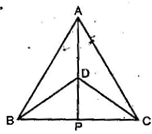
(i) ABD  ACD
ACD
(ii) ABP ACP
(iii) AP bisects  A as well as D.
(iv) AP is the perpendicular bisector of BC.
Ans. (i)ABC is an isosceles triangle.
 AB = AC
DBC is an isosceles triangle.
BD = CD
Now in ABD and ACD,
AB = AC [Given]
BD = CD [Given]
AD = AD [Common]
ABD ACD [By SSS congruency]
 BAD = CAD [By C.P.C.T.] ……….(i)
(ii) Now in ABP and ACP,
AB = AC [Given]
BAD = CAD [From eq. (i)]
AP = AP
ABP ACP [By SAS congruency]
(iii) Since ABP ACP [From part (ii)]
BAP = CAP [By C.P.C.T.]
AP bisects A.
Since ABD ACD [From part (i)]
ADB = ADC [By C.P.C.T.] ……….(ii)
Now ADB + BDP =  [Linear pair] ……….(iii)
And ADC + CDP = [Linear pair] ……….(iv)
From eq. (iii) and (iv),
ADB + BDP = ADC + CDP
ADB + BDP = ADB + CDP [Using (ii)]
BDP = CDP
DP bisects D or AP bisects D.
(iv) Since ABP ACP [From part (ii)]
BP = PC [By C.P.C.T.] ……….(v)
And APB = APC [By C.P.C.T.] …….(vi)
Now APB + APC = [Linear pair]
APB + APC = [Using eq. (vi)]
2APB =
APB = 
AP  BC ……….(vii)
From eq. (v), we have BP PC and from (vii), we have proved AP B. So, collectively AP is perpendicular bisector of BC.
NCERT Solutions for Class 9 Maths Exercise 7.3
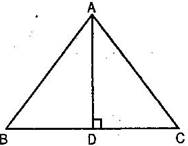
2. AD is an altitude of an isosceles triangle ABC in which AB = AC. Show that:
(i) AD bisects BC.
(ii) AD bisects A.
Ans. In ABD and ACD,
AB = AC [Given]
ADB = ADC =  [AD BC]
AD = AD [Common]
ABD ACD [RHS rule of congruency]
BD = DC [By C.P.C.T.]
AD bisects BC
Also BAD = CAD [By C.P.C.T.]
AD bisects A.
NCERT Solutions for Class 9 Maths Exercise 7.3
3. Two sides AB and BC and median AM of the triangle ABC are respectively equal to side PQ and QR and median PN of PQR (See figure). Show that:
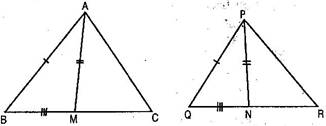
(i) ABM PQN
(ii) ABC PQR
Ans. AM is the median of ABC.
BM = MC =  BC ……….(i)
PN is the median of PQR.
QN = NR = QR ……….(ii)
Now BC = QR [Given] BC = QR
BM = QN ……….(iii)
(i) Now in ABM and PQN,
AB = PQ [Given]
AM = PN [Given]
BM = QN [From eq. (iii)]
ABM PQN [By SSS congruency]
B = Q [By C.P.C.T.] ……….(iv)
(ii) In ABC and PQR,
AB = PQ [Given]
B = Q [Prove above]
BC = QR [Given]
ABC PQR [By SAS congruency]
NCERT Solutions for Class 9 Maths Exercise 7.3
4. BE and CF are two equal altitudes of a triangle ABC. Using RHS congruence rule, prove that the triangle ABC is isosceles.
Ans. In BEC and CFB,
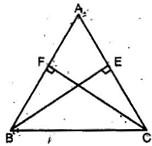
BEC = CFB [Each ]
BC = BC [Common]
BE = CF [Given]
BEC CFB [RHS congruency]
EC = FB [By C.P.C.T.] …..(i)
Now In AEB and AFC
AEB = AFC [Each ]
A = A [Common]
BE = CF [Given]
AEB AFC [ASA congruency]
AE = AF [By C.P.C.T.] …………(ii)
Adding eq. (i) and (ii), we get,
EC + AE = FB + AF
AB = AC
ABC is an isosceles triangle.
NCERT Solutions for Class 9 Maths Exercise 7.3
5. ABC is an isosceles triangles with AB = AC. Draw AP BC and show that B = C.
Ans. Given: ABC is an isosceles triangle in which AB = AC
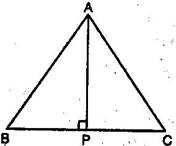
To prove: B = C
Construction: Draw AP BC
Proof: In ABP and ACP
APB = APC = [By construction]
AB = AC [Given]
AP = AP [Common]
ABP ACP [RHS congruency]
B = C [By C.P.C.T.]