Exercise 7.1
NCERT solutions for Class 9 Maths Triangles
NCERT Solutions for Class 9 Mathematics Triangles
1. In quadrilateral ABCD (See figure). AC = AD and AB bisects  A. Show that
  ABC
ABC  ABD. What can you say about BC and BD?
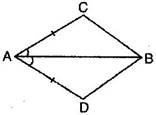
Ans. Given: In quadrilateral ABCD, AC = AD and AB bisects A.
To prove: ABC ABD
Proof: In ABC and ABD,
AC = AD [Given]
BAC = BAD [ AB bisects A]
AB = AB [Common]
 ABC ABD [By SAS congruency]
Thus BC = BD [By C.P.C.T.]
2. ABCD is a quadrilateral in which AD = BC and DAB = CBA. (See figure). Prove that:
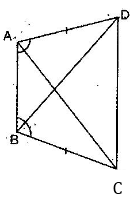
(i) ABD BAC
(ii) BD = AC
(iii) ABD = BAC
Ans. (i) In ABC and ABD,
BC = AD [Given]
DAB = CBA [Given]
AB = AB [Common]
ABC ABD [By SAS congruency]
Thus AC = BD [By C.P.C.T.]
(ii) Since ABC ABD
AC = BD [By C.P.C.T.]
(iii) Since ABC ABD
ABD = BAC [By C.P.C.T.]
3. AD and BC are equal perpendiculars to a line segment AB. Show that CD bisects AB (See figure)
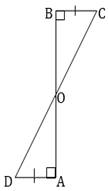
Ans. In BOC and AOD,
OBC = OAD =  [Given]
BOC = AOD [Vertically Opposite angles]
BC = AD [Given]
BOC AOD [By ASA congruency]
 OB = OA and OC = OD [By C.P.C.T.]
NCERT Solutions for Class 9 Maths Exercise 7.1
4.  and
and  are two parallel lines intersected by another pair of parallel lines
  and
and  (See figure). Show that ABC CDA.
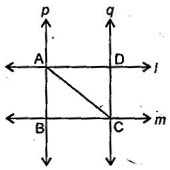
Ans. AC being a transversal. [Given]
Therefore DAC = ACB [Alternate angles]
Now  [Given]
And AC being a transversal. [Given]
Therefore BAC = ACD [Alternate angles]
Now In ABC and ADC,
ACB = DAC [Proved above]
BAC = ACD [Proved above]
AC = AC [Common]
ABC CDA [By ASA congruency]
NCERT Solutions for Class 9 Maths Exercise 7.1
5. Line is the bisector of the angle A and B is any point on  BP and BQ are perpendiculars from B to the arms of A. Show that:
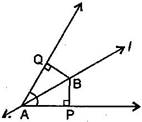
(i) APB AQB
(ii) BP = BQ or P is equidistant from the arms of A (See figure).
Ans. Given: Line bisects A.
BAP = BAQ
(i) In ABP and ABQ,
BAP = BAQ [Given]
BPA = BQA = [Given]
AB = AB [Common]
APB AQB [By ASA congruency]
(ii) Since APB AQB
BP = BQ [By C.P.C.T.]
B is equidistant from the arms of A.
NCERT Solutions for Class 9 Maths Exercise 7.1
6. In figure, AC = AB, AB = AD and BAD = EAC. Show that BC = DE.^
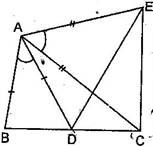
Ans. Given that BAD = EAC
Adding DAC on both sides, we get
BAD + DAC = EAC + DAC
BAC = EAD ……….(i)
Now in ABC and AED,
AB = AD [Given]
AC = AE [Given]
BAC = DAE [From eq. (i)]
ABC ADE [By SAS congruency]
BC = DE [By C.P.C.T.]
NCERT Solutions for Class 9 Maths Exercise 7.1
7. AB is a line segment and P is the mid-point. D and E are points on the same side of AB such that BAD = ABE and EPA = DPB. Show that:
(i) DAF FBP
(ii) AD = BE (See figure)
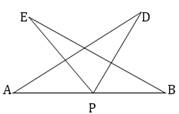
Ans. Given that EPA = DPB
Adding EPD on both sides, we get
EPA + EPD = DPB + EPD
APD = BPE ……….(i)
Now in APD and BPE,
PAD = PBE [BAD = ABE (given),
PAD = PBE]
AP = PB [P is the mid-point of AB]
APD = BPE [From eq. (i)]
DPA EBP [By ASA congruency]
AD = BE [ By C.P.C.T.]
NCERT Solutions for Class 9 Maths Exercise 7.1
8. In right triangle ABC, right angled at C, M is the mid-point of hypotenuse AB. C is joined to M and produced to a point D such that DM = CM. Point D is joined to point B. (See figure)
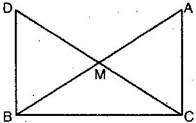
Show that:
(i) AMC BMD
(ii) DBC is a right angle.
(iii) DBC ACB
(iv) CM =  AB
AB
Ans. (i) In AMC and BMD,
AM = BM [AB is the mid-point of AB]
AMC = BMD [Vertically opposite angles]
CM = DM [Given]
AMC BMD [By SAS congruency]
ACM = BDM ……….(i)
CAM = DBM and AC = BD [By C.P.C.T.]
(ii) For two lines AC and DB and transversal DC, we have,
ACD = BDC [Alternate angles]
AC  DB
DB
Now for parallel lines AC and DB and for transversal BC.
DBC = ACB [Alternate angles] ……….(ii)
But ABC is a right angled triangle, right angled at C.
ACB = ……….(iii)
Therefore DBC = [Using eq. (ii) and (iii)]
DBC is a right angle.
(iii) Now in DBC and ABC,
DB = AC [Proved in part (i)]
DBC = ACB = [Proved in part (ii)]
BC = BC [Common]
DBC ACB [By SAS congruency]
(iv) Since DBC ACB [Proved above]
DC = AB
AM + CM = AB
CM + CM = AB [ DM = CM]
2CM = AB
CM = AB