Exercise 5.2
NCERT solutions for Class 9 Maths Introduction to Euclids Geometry
NCERT Solutions for Class 9 Mathematics Introduction to Euclids Geometry
1. How would you rewrite Euclid’s fifth postulate so that it would be easier to understand?
Ans. We need to rewrite Euclid’s fifth postulate so that it is easier to understand.
We know that Euclid’s fifth postulate states that “No intersection of lines will take place when the sum of the measures of the interior angles on the same side of the falling line is exactly 180°.”
We know that Play fair’s axiom states that “For every line l and for every point P not lying on l, there exists a unique line m passing through P and parallel to l”.
The above mentioned Play fair’s axiom is easier to understand in comparison to the Euclid’s fifth postulate.
Let us consider a line l that passes through a point p and another line m. Let these lines be at a same plane.
Let us consider the perpendicular CD on l and FE on m.
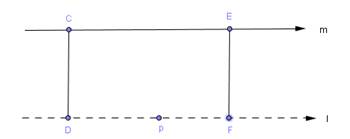
From the above figure, we can conclude that CD = EF.
Therefore, we can conclude that the perpendicular distance between lines m and l will be constant throughout, and the lines m and l will never meet each other or in other words, we can say that the lines m and l are equidistant from each other.
NCERT Solutions for Class 9 Maths Exercise 5.2
2. Does Euclid’s fifth postulate imply the existence of parallel lines? Explain.
Ans. We need to verify whether Euclid’s fifth postulate imply the existence of parallel lines or not.
The answer to the above statement is Yes.
Let us consider two lines m and l.
In the figure given below, we can conclude that the lines m and l will intersect further.
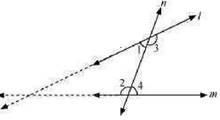
From the figure, we can conclude that
 and
and 
We know that Euclid’s fifth postulate states that “No intersection of lines will take place when the sum of the measures of the interior angles on the same side of the falling line is exactly 180°.”
Let us consider lines l and m.
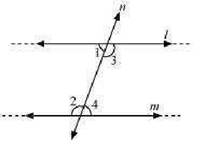
From the above figure, we can conclude that lines l and m will never intersect from either side.
Therefore, we can conclude that the lines l and m are parallel.