Exercise 1.3
NCERT solutions for Class 9 Maths Number Systems
NCERT Solutions for Class 9 Maths Number Systems
1. Write the following in decimal form and say what kind of decimal expansion each has: 
(i) 
(ii) 
(iii) 
(iv) 
(v) 
(vi) 
Ans. (i)
On dividing 36 by 100, we get
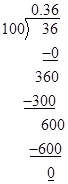
Therefore, we conclude that , which is a terminating decimal.
(ii)
On dividing 1 by 11, we get
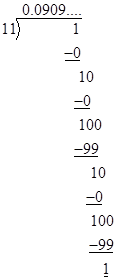
We can observe that while dividing 1 by 11, we got the remainder as 1, which will continue to be 1.
Therefore, we conclude that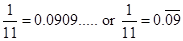 , which is a non-terminating decimal and recurring decimal.
(iii)
On dividing 33 by 8, we get
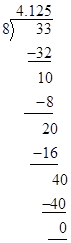
We can observe that while dividing 33 by 8, we got the remainder as 0.
Therefore, we conclude that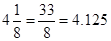 , which is a terminating decimal.
(iv)
On dividing 3 by 13, we get
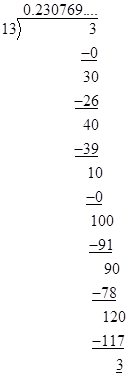
We can observe that while dividing 3 by 13 we got the remainder as 3, which will continue to be 3 after carrying out 6 continuous divisions.
Therefore, we conclude that , which is a non-terminating decimal and recurring decimal.
(v)
On dividing 2 by 11, we get
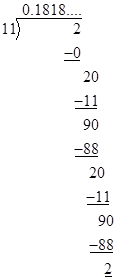
We can observe that while dividing 2 by 11, first we got the remainder as 2 and then 9, which will continue to be 2 and 9 alternately.
Therefore, we conclude that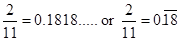 , which is a non-terminating decimal and recurring decimal.
(vi)
On dividing 329 by 400, we get
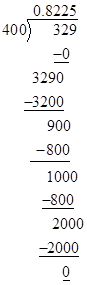
We can observe that while dividing 329 by 400, we got the remainder as 0.
Therefore, we conclude that , which is a terminating decimal.
NCERT Solutions for Class 9 Maths Exercise 1.3
2. You know that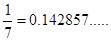 . Can you predict what the decimal expansions of
 are, without actually doing the long division? If so, how?
[Hint: Study the remainders while finding the value of  carefully.]
Ans. We are given that .
.
We need to find the values of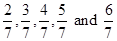 , without performing long division.
We know that, can be rewritten as .
.
On substituting value of as , we get
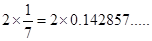

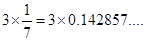

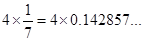

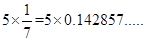

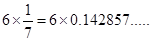

Therefore, we conclude that, we can predict the values of, without performing long division, to get
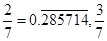
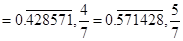
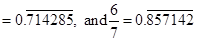
NCERT Solutions for Class 9 Maths Exercise 1.3
3. Express the following in the form , where p and q are integers and q
 0.
0.
(i) 
(ii) 
(iii) 
Ans. Solution:
(i)

We need to multiply both sides by 10 to get

We need to subtract (a)from (b), to get
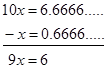
We can also write as
as or
or .
.
Therefore, on converting in theform, we get the answer as .
.
(ii)

We need to multiply both sides by 10 to get

We need to subtract (a)from (b), to get
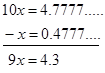
We can also write as
as or
or .
.
Therefore, on converting in theform, we get the answer as .
.
(iii)

We need to multiply both sides by 1000 to get

We need to subtract (a)from (b), to get
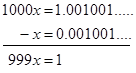
We can also write  as
as .
.
Therefore, on converting in theform, we get the answer as .
.
NCERT Solutions for Class 9 Maths Exercise 1.3
4. Express in the form. Are you surprised by your answer? Discuss why the answer makes sense with your teacher and classmates.
Ans. 
We need to multiply both sides by 10 to get

We need to subtract (a)from (b), to get
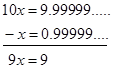
We can also write  as
as .
.
Therefore, on converting in theform, we get the answer as
 .
.
Yes, at a glance we are surprised at our answer.
But the answer makes sense when we observe that 0.9999……… goes on forever. SO there is not gap between 1 and 0.9999……. and hence they are equal.
NCERT Solutions for Class 9 Maths Exercise 1.3
5. What can the maximum number of digits be in the recurring block of digits in the decimal expansion of ? Perform the division to check your answer.
Ans. We need to find the number of digits in the recurring block of.
Let us perform the long division to get the recurring block of.
We need to divide 1 by 17, to get
We can observe that while dividing 1 by 17 we got the remainder as 1, which will continue to be 1 after carrying out 16 continuous divisions.
Therefore, we conclude that , which is a non-terminating decimal and recurring decimal.
NCERT Solutions for Class 9 Maths Exercise 1.3
6. Look at several examples of rational numbers in the form (q 0), where p and q are integers with no common factors other than 1 and having terminating decimal representations (expansions). Can you guess what property q must satisfy?
Ans. Solution:
Let us consider the examples of the form that are terminating decimals.


We can observe that the denominators of the above rational numbers have powers of 2, 5 or both.
Therefore, we can conclude that the property, which q must satisfy in, so that the rational numberis a terminating decimal is that q must have powers of 2, 5 or both.
NCERT Solutions for Class 9 Maths Exercise 1.3
7. Write three numbers whose decimal expansions are non-terminating non-recurring.
Ans. The three numbers that have their expansions as non-terminating on recurring decimal are given below.
0.04004000400004….
0.07007000700007….
0.013001300013000013….
NCERT Solutions for Class 9 Maths Exercise 1.3
8. Find three different irrational numbers between the rational numbers and
and .
.
Ans. Let us convert into decimal form, to get
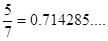 and
and 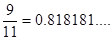
Three irrational numbers that lie between are:
are:
0.73073007300073….
0.74074007400074….
0.76076007600076….
NCERT Solutions for Class 9 Maths Exercise 1.3
9. Classify the following numbers as rational or irrational:
(i) 23
(ii) 225
(iii) 0.3796
(iv) 7.478478…
(v) 1.101001000100001…
Ans. (i)
We know that on finding the square root of 23, we will not get an integer.
Therefore, we conclude thatis an irrational number.
(ii)
We know that on finding the square root of 225, we get 15, which is an integer.
Therefore, we conclude thatis a rational number.
(iii) 0.3796
We know that 0.3796 can be converted into.
While, converting 0.3796 intoform, we get
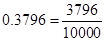 .
.
The rational number can be converted into lowest fractions, to get
 .
.
We can observe that 0.3796 can be converted into a rational number.
Therefore, we conclude that 0.3796 is a rational number.
(iv) 7.478478….
We know that 7.478478…. is a non-terminating recurring decimal, which can be converted intoform.
While, converting 7.478478…. intoform, we get


While, subtracting (a) from (b), we get
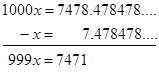
We know that can also be written as
 .
.
Therefore, we conclude that 7.478478…. is a rational number.
(v) 1.101001000100001….
We can observe that the number 1.101001000100001…. is a non-terminating on recurring decimal.
We know that non-terminating and non-recurring decimals cannot be converted intoform.
Therefore, we conclude that 1.101001000100001…. is an irrational number.