Exploring Sequences and Progressions – NCERT Solutions Class 9 Maths Ganita Manjari includes all the questions with solutions given in NCERT Class 9 Ganita Manjari textbook.
NCERT Solutions Class 9
Exploring Sequences and Progressions – NCERT Solutions
Q.1:
Why is it useful to have an explicit formula for the nth term of a sequence?
Solution:
It is useful to have an explicit formula for the nth term because:
It helps us find any term directly without writing all the previous terms.
It saves time and effort, especially for large values of n.
It helps in identifying patterns clearly (like linear patterns such as 2n – 1).
It allows us to solve problems easily, such as finding which term has a given value.
An explicit formula makes working with sequences faster, easier, and more systematic.
Q.2:
Can you find the rule describing the nth term of the sequence of square numbers?
Solution:
Yes. The sequence of square numbers is:
1,4,9,16,25,… Observe:
1=12
4=22
9=32
16=42
25=52
So, the rule is: nth term =n2 The nth term of the sequence of square numbers is n2.
Q.3:
Find the first five terms of the sequence in which the nth term is given by tn=3n−4.
Solution:
tn=3n−4
n=1:3(1)−4=−1
n=2:6−4=2
n=3:9−4=5
n=4:12−4=8
n=5:15−4=11
First five terms:
−1,2,5,8,11
Q.4:
Find the first five terms of the sequence in which the nth term is given by tn=2−5n.
Solution:
tn=2−5n
n=1:2−5=−3
n=2:2−10=−8
n=3:2−15=−13
n=4:2−20=−18
n=5:2−25=−23
First five terms:
−3,−8,−13,−18,−23
Q.5:
Find the first five terms of the sequence in which the nth term is given by tn=n2−2n+3.
Solution:
tn=n2−2n+3
n=1:1−2+3=2
n=2:4−4+3=3
n=3:9−6+3=6
n=4:16−8+3=11
n=5:25−10+3=18
First five terms:
2,3,6,11,18
Q.6:
Find the 10th and 15th terms of the sequence tn=5n−3 for n≥1.
Solution:
Given: tn=5n−3 Find: 10th term
t10=5(10)−3=50−3=47 15th term
t15=5(15)−3=75−3=72 10th term = 47 15th term =72
Q.7:
Determine whether 97 and 172 are terms of the sequence tn=5n−3 for n≥1.
Solution:
Given: tn=5n−3 To check if a number is a term, set 5n−3= given number and solve for n.
For 97:
5n−3=97 5n=100 n=20 (a whole number) So, 97 is a term (20th term).
For 172:
5n−3=172 5n=175 n=35 (a whole number) So, 172 is also a term (35th term).
Q.8:
Which term of the sequence tn=5n−3 for n≥1 is 607?
Solution:
Given: tn=5n−3 We need to find n such that the term is 607. Set:
5n−3=607 5n=610 n=122 607 is the 122nd term of the sequence.
Q.9:
A sequence is given by the recursive rule t1=−5,tn+1=tn+3 for n≥1. Find the first five terms of the sequence. Is 52 a term of this sequence? If so, which term is it?
Solution:
Given:
t1=−5,tn+1=tn+3 This means each term increases by 3. First five terms:
t1=−5
t2=−5+3=−2
t3=−2+3=1
t4=1+3=4
t5=4+3=7
So, first five terms:
−5,−2,1,4,7 Now check if 52 is a term: General term:
tn=−5+(n−1)×3 Set equal to 52:
−5+3(n−1)=52 3(n−1)=57 n−1=19 n=20 Yes, 52 is a term, and it is the 20th term of the sequence.
Q.10:
Let T1=1,T2=2,T3=4, and Tn=Tn−1+Tn−2+Tn−3 for n≥4. Find T4,T5,T6,T7, and T8.
Solution:
Given: T1=1,T2=2,T3=4 and Tn=Tn−1+Tn−2+Tn−3 Now find terms step by step:
T4=T3+T2+T1=4+2+1=7
T5=T4+T3+T2=7+4+2=13
T6=T5+T4+T3=13+7+4=24
T7=T6+T5+T4=24+13+7=44
T8=T7+T6+T5=44+24+13=81
T4=7,T5=13,T6=24,T7=44,T8=81
Q.11:
Find the 10th and 26th terms of the AP: 3, 8, 13, 18, …
Solution:
Given AP: 3,8,13,18,… First term a=3, common difference d=5 Use formula:
tn=a+(n−1)d 10th term:
t10=3+(10−1)×5=3+45=48 26th term:
t26=3+(26−1)×5=3+125=128 10th term = 48 26th term = 128
Q.12:
Which term of the AP : 21, 18, 15, … is -81? Also, is 0 a term of this AP? Give reasons for your answer.
Solution:
Given AP: 21,18,15,… First term a=21, common difference d=−3 General term:
tn=a+(n−1)d=21+(n−1)(−3)
Find which term is -81:
21+(n−1)(−3)=−81 21−3(n−1)=−81 21−3n+3=−81 24−3n=−81 −3n=−105 n=35 So, -81 is the 35th term. Check if 0 is a term:
21+(n−1)(−3)=0 21−3(n−1)=0 24−3n=0 3n=24 n=8 Since n is a whole number, 0 is a term. -81 is the 35th term. Yes, 0 is the 8th term of the AP.
Q.13:
Find the nth term of the AP: 11, 8, 5, 2 … Write the recursive rule for this AP.
Solution:
Given AP: 11,8,5,2,… First term a=11, common difference d=−3 nth term:
tn=a+(n−1)d=11+(n−1)(−3) tn=11−3(n−1)=14−3n So, tn=14−3n
Recursive rule:
t1=11,tn=tn−1−3 for n≥2 Final Answer:
tn=14−3n Recursive rule: t1=11,tn=tn−1−3
Q.14:
An AP consists of 50 terms in which the 3rd term is 12 and the last term is 106. Find the 29th term.
Solution:
Given:
t3=a+2d=12
t50=a+49d=106
Subtract the first equation from the second:
(a+49d)−(a+2d)=106−12 47d=94⇒d=2 Now substitute d=2 in a+2d=12:
a+4=12⇒a=8 Now find the 29th term:
t29=a+(29−1)d=8+28×2=8+56=64 29th term = 64
Q.15:
How many 2-digit numbers are divisible by 3? What is the sum of all these 2-digit numbers?
Solution:
Two-digit numbers range from 10 to 99. Numbers divisible by 3 in this range form an AP:
12,15,18,…,99 Here, a=12,d=3, last term l=99
Number of terms:
n=dl−a+1=399−12+1=29+1=30 So, there are 30 numbers.
Sum of these numbers:
S=2n(a+l)=230(12+99)=15×111=1665 Number of terms = 30 Sum = 1665
Q.16:
Harish started work at an annual salary of ₹ 5,00,000 and received an increment of ₹ 20,000 each year. After how many years did his income reach ₹ 7,00,000?
Solution:
Harish’s salary forms an AP:
First term a=5,00,000
Common difference d=20,000
Required term =7,00,000
Use tn=a+(n−1)d :
7,00,000=5,00,000+(n−1)×20,000 7,00,000−5,00,000=(n−1)×20,000 2,00,000=(n−1)×20,000 n−1=10⇒n=11 This means salary becomes ₹ 7,00,000 in the 11th year. Since he starts at year 1, the number of years taken:
11−1=10 His income reached ₹ 7,00,000 after 10 years.
Q.17:
A child arranges marbles in rows so that the first row has 1 marble, the second has 2 marbles, the third has 3, and so on up to 25 rows. How many marbles does the child use in all?
Solution:
Number of marbles in rows:
1,2,3,…,25 This is an AP with: a=1,d=1,n=25
Sum of first n terms:
Sn=2n(a+l) Here, last term l=25
S25=225(1+25)=225×26=25×13=325 Total marbles = 325
Q.18:
Find the 12th term of a GP with common ratio 2, whose 8th term is 192.
Solution:
For a GP,
tn=arn−1 Given:
Common ratio r=2
t8=192
t8=ar7=a⋅27=128a=192 a=128192=23 Now find 12th term:
t12=ar11=23⋅211=23⋅2048=3⋅1024=3072 12th term = 3072
Q.19:
Find the 10th and nth terms of the GP: 5, 25, 125, …
Solution:
Given GP: 5,25,125,… First term a=5, common ratio r=5 nth term:
tn=a⋅rn−1=5⋅5n−1=5n 10th term:
t10=510=9765625
Q.20:
A sequence is given by the recursive rule t1=2,tn+1=3tn−2 for n≥1. Which term of the sequence is 730?
Solution:
Given:
t1=2,tn+1=3tn−2 Find terms until we reach 730:
t1=2
t2=3(2)−2=4
t3=3(4)−2=10
t4=3(10)−2=28
t5=3(28)−2=82
t6=3(82)−2=244
t7=3(244)−2=730
730 is the 7th term of the sequence.
Q.21:
Which term of the GP: 2, 6, 18, … is 4374? Write the explicit formula as well as the recursive formula for the nth term.
Solution:
Given GP: 2,6,18,… First term a=2, common ratio r=3
Explicit formula:
tn=a⋅rn−1=2⋅3n−1 Find which term is 4374:
2⋅3n−1=4374 3n−1=2187=37 n−1=7⇒n=8 So, 4374 is the 8th term.
Recursive formula:
t1=2,tn=3tn−1(n≥2) Final Answer: 4374 is the 8th term Explicit: tn=2⋅3n−1 Recursive: t1=2,tn=3tn−1
Q.22:
A ball is dropped from a height of 80 metres. After hitting the ground, it bounces back to 60% of the height from which it fell. It continues bouncing in this way - each time rising to 60% of the previous height.
What height does the ball reach after the 5th bounce?
What is the total vertical distance the ball has travelled by the time it hits the ground for the 6th time?
Solution:
Given: Initial height =80m Each bounce reaches 60%=0.6 of previous height
Height after 5th bounce Heights form a GP: 80×(0.6)n After 5th bounce: h5=80×(0.6)5=80×0.07776=6.2208m So, height ≈6.22m
Total distance till it hits ground 6th time Motion: First fall: 80 m Then for each bounce: goes up and comes down Heights after each bounce: h1=48,h2=28.8,h3=17.28,h4=10.368,h5=6.2208 Total distance: Distance =80+2(h1+h2+h3+h4+h5) =80+2(48+28.8+17.28+10.368+6.2208) =80+2(110.6688)=80+221.3376=301.3376m
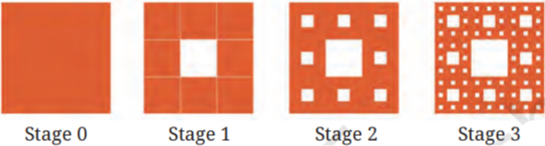
Figure shows Stages 0 to 3 of the Sierpiński square carpet. Stage 0 of this fractal is a square sheet of paper. To construct Stage 1, each side of the square is trisected and the points of trisection of opposite sides are joined to obtain nine smaller squares. The centre square is then removed and the 8 smaller squares are retained, leaving a square hole in the centre. The same process is repeated on the eight smaller shaded squares to obtain Stage 2 and so on.
Look at the figure and try to answer the following questions.
How many red squares are there in Stages 0 to 3? (1)
Can you predict the number of red squares in Stages 4 and 5? (1)
Can you find a rule for the number of red squares at the nth stage? Write the explicit formula as well as the recursive formula for the number of red squares at any stage. (2) OR Suppose the area of the square in Stage 0 is 1 square unit. What is the area of the red region in Stages 1, 2 and 3? What will be the area of the red region in Stages 4 and 5? Find the explicit as well as the recursive formula for the area of the red region at the nth stage. What happens to this area as n, the number of stages, goes on increasing? (2)
Solution:
Number of red squares in Stages 0 to 3: Stage 0 = 1 Stage 1=8 Stage 2=8×8=64 Stage 3=8×8×8=512 So, the sequence is: 1,8,64,512
Stage 4 and Stage 5: Stage 4=84=4096 Stage 5=85=32768
Rule (explicit and recursive): This is a geometric progression with common ratio 8. Explicit formula: tn=8n (if Stage 0 is n=0 ) So: Stage n→tn=8n Recursive formula: t0=1 tn=8×tn−1, for n≥1 OR Each stage keeps 8 out of 9 equal parts, so area multiplies by 8/9 each time.
Area of red region: Stage 0 = 1 Stage 1 = 8/9 Stage 2=(8/9)2=64/81 Stage 3=(8/9)3=512/729
Stage 4 and 5: Stage 4=(8/9)4 Stage 5=(8/9)5
Formula: Explicit formula: sn=(8/9)n Recursive formula: s0=1 sn=(8/9)×sn−1, for n≥1
Q.25:
Find the 31st term of an AP whose 11th term is 38 and 16th term is 73.
\begin{equation*} a+15 d=73 \end{equation*} …(2) Subtract (1) from (2):
(a+15d)−(a+10d)=73−38 5d=35 d=7 Now put d=7 in (1):
a+10×7=38 a+70=38 a=−32 Now find 31st term:
a31=a+30d a31=−32+30×7 a31=−32+210 a31=178
Q.26:
Determine the AP whose third term is 16 and whose 7th term exceeds the 5th term by 12.
Solution:
We are given:
3rd term: a + 2d = 16 …(1)
7th term exceeds 5th term by 12:
(a + 6d) – (a + 4d) = 12 2d = 12 d = 6
Now put d = 6 in equation (1):
a + 2 × 6 = 16 a + 12 = 16 a = 4
So, the AP is:
a = 4, d = 6
Hence the AP is: 4, 10, 16, 22, 28, …
Q.27:
How many three-digit numbers are divisible by 7?
Solution:
All 3-digit numbers divisible by 7 form an AP: First 3-digit multiple of 7: 100÷7=14 remainder, so next multiple =15×7=105 So, first term a=105 Largest 3-digit multiple of 7: 999÷7=142 remainder, so largest multiple =142×7=994 So, last term l = 994 Common difference d=7 Now, number of terms:
n=dl−a+1 n=7994−105+1 n=7889+1 n=127+1 n=128
Q.28:
How many multiples of 4 lie between 10 and 250?
Solution:
We need multiples of 4 between 10 and 250. First multiple of 4 greater than 10:
12=3×4 So, first term a=12 Last multiple of 4 less than 250:
248=62×4 So, last term l =248 Common difference d=4 Now number of terms:
n=(l−a)/d+1 n=(248−12)/4+1 n=236/4+1 n=59+1 n=60 Final answer: 60 multiples of 4 lie between 10 and 250.
Q.29:
Find a GP for which the sum of the first two terms is -4 and the fifth term is 4 times the third term.
Solution:
Let the GP be: a,ar,ar2,ar3,ar4,… Given:
Sum of first two terms =−4
a + ar = -4 a(1 + r) = -4 …(1) Also, fifth term is 4 times the third term:
ar4=4(ar2) Divide both sides by ar2(a=0,r=0):
r2=4 So, r=2 or r=−2
Now solve both cases:
Case 1: r=2 From (1):
a(1+2)=−4 3a=−4 a=−4/3 So GP:
−4/3,−8/3,−16/3,−32/3,… Case 2: r=−2 From (1):
a(1−2)=−4 −a=−4 a=4 So GP:
4,−8,16,−32,…
Q.30:
Find all possible ways of expressing 100 as the sum of consecutive natural numbers.
Solution:
Let the number 100 be expressed as sum of n consecutive natural numbers starting from a: a+(a+1)+(a+2)+…+n terms
Sum =2n[2a+(n−1)]=100 So,
n(2a+n−1)=200 2an=200−n(n−1) Now we try values of n such that a is a natural number.
n=1: a=100 So, 100 n=5 5a+10=100 5a=90→a=18 So, 18+19+20+21+22 n=8: 8a+28=100 8a=72→a=9 So, 9+10+11+12+13+14+15+16 For other values of n,a is not a natural number.
Q.31:
The number of bacteria in a certain culture doubles every hour. If there were 30 bacteria present in the culture originally, how many bacteria will be present at the end of the 2nd hour, 4th hour and nth hour?
Solution:
The number of bacteria doubles every hour, so it forms a GP: Initial bacteria = 30 So,
a=30 r=2 General term:
an=a⋅rn−1 End of 2nd hour:
a2=30⋅22−1=30⋅2=60 End of 4th hour:
a4=30⋅24−1=30⋅23=30⋅8=240 End of nth hour:
an=30⋅2n−1
2nd hour = 60 bacteria
4th hour =240 bacteria
nth hour =30⋅2n−1 bacteria
Q.32:
The sum of the 4th and 8th terms of an AP is 24 and the sum of the 6th and 10th terms is 44. Find the first three terms of the AP.
Solution:
Let the AP be: a, a + d, a + 2d, …
Given:
4th term = a + 3d 8th term = a + 7d
So, (a + 3d) + (a + 7d) = 24 2a + 10d = 24 a + 5d = 12 …(1)
Also:
6th term = a + 5d 10th term = a + 9d
So, (a + 5d) + (a + 9d) = 44 2a + 14d = 44 a + 7d = 22 …(2)
Now subtract (1) from (2):
(a + 7d) – (a + 5d) = 22 – 12 2d = 10 d = 5
Now put d = 5 in (1):
a + 5 × 5 = 12 a + 25 = 12 a = -13
Q.33:
Find the smallest value of n such that the sum of the first n natural numbers is greater than 1,000.
Solution:
Sum of first n natural numbers is:
Sn=2n(n+1) We need:
2n(n+1)>1000 n(n+1)>2000 Now test values: n=44 : 44×45=1980 (not enough) n=45 : 45×46=2070 (greater than 2000) So smallest value is n=45
Q.34:
Which term of the GP: 2, 8, 32, … is 131072? Write the explicit formula as well as the recursive formula for the nth term.
Solution:
Given GP: 2, 8, 32, … First term:
a=2 Common ratio:
r=8/2=4 Explicit formula (nth term) For a GP:
an=a⋅rn−1 So,
an=2⋅4n−1 Find which term is 131072
2⋅4n−1=131072 Divide by 2 :
4n−1=65536 Now,
65536=48( since 48=(22)8=216=65536) So,
n−1=8 n=9 Recursive formula First term: a1=2 Recurrence relation: an=4⋅an−1,n≥2
Q.35:
The sum of the first three terms of a GP is 1213 and their product is -1. Find the common ratio and the terms.
Solution:
Let the GP be:
a,ar,ar2 Given 1: Sum of first three terms
a+ar+ar2=1213
\begin{equation*} a\left(1+r+r^2\right)=\frac{13}{12} \end{equation*} …(1) Given 2: Product of three terms
a⋅ar⋅ar2=−1 a3r3=−1 (ar)3=−1 So,
\begin{equation*} a r=-1 \end{equation*} …(2) Step 1: Use (2) in (1) From (2), a=−r1 Substitute in (1):
−r1(1+r+r2)=1213 Multiply both sides by r :
−(1+r+r2)=1213r Multiply by 12 :
−12(1+r+r2)=13r −12−12r−12r2=13r
Bring all terms to one side:
−12−25r−12r2=0 Multiply by -1 :
12r2+25r+12=0 Step 2: Solve quadratic
12r2+25r+12=0 Discriminant:
252−4⋅12⋅12=625−576=49 r=24−25±7 So: r=24−18=−43 r=24−32=−34
Step 3: Find terms Using ar=−1 Case 1: r=−43
a=r−1=−43−1=34 Terms:
34,−1,43
Case 2: r=−34
a=−34−1=43 Terms:
43,−1,34
Q.36:
If the 4th, 10th and 16th terms of a GP are x, y and z respectively, prove that x, y, z are in GP.
Solution:
Let the GP be: a,ar,ar2,ar3,… Given: 4th term =x=ar3 10th term =y=ar9 16th term = z = ar 15
Now consider y2 :
y2=(ar9)2=a2r18 Now consider xz :
xz=(ar3)(ar15)=a2r18 Compare:
y2=a2r18=xz So,
y2=xz Conclusion: Since y2=xz, the numbers x,y,z are in Geometric Progression (GP). Hence proved.
Q.37:
The sum of the first three terms of a geometric progression is 26, and the sum of their squares is 364. Find the terms of the GP.
Solution:
Let the three terms of the GP be:
a,ar,ar2 Given:
a+ar+ar2=26 …(1) a2+a2r2+a2r4=364 …(2) From (1):
a(1+r+r2)=26 From (2):
a2(1+r2+r4)=364 Now divide (2) by (1) 2 :
(1+r+r2)21+r2+r4=262364 (1+r+r2)21+r2+r4=137 Using identity:
1+r2+r4=(1+r+r2)2−2r(1+r+r2) So,
1−1+r+r22r=137 1+r+r22r=136
1+r+r2r=133 Solving:
13r=3(1+r+r2) 3r2−10r+3=0 Solving quadratic:
r=3 or r=31 Case 1: r=3
a(1+3+9)=26⇒13a=26⇒a=2 Terms:
2,6,18 Case 2: r=1/3
a(1+31+91)=26⇒a=18 Terms:
18,6,2
Q.38:
Suppose P1=1,P2=2 and for n>2,Pn=P1+P2+⋯+Pn−1+1. Find the values of P1,P2,…,P8. Can you find a simpler recursive formula for Pn? Can you give an explicit formula?
Solution:
Given:
P1=1,P2=2
and for n>2,
Pn=P1+P2+⋯+Pn−1+1 Step 1: Find first 8 terms We calculate step by step:
P1=1
P2=2
Now,
P3=1+2+1=4 P4=1+2+4+1=8 P5=1+2+4+8+1=16 P6=32 P7=64 P8=128 So, first 8 terms are:
1,2,4,8,16,32,64,128 Step 2: Simpler recursive formula We observe: each term is double of previous term.
So,
Pn=2Pn−1,n≥2
with P1=1
Step 3: Explicit formula This is a GP with:
first term a=1
common ratio r=2
So,
Pn=2n−1 Final Answer: First 8 terms:
1,2,4,8,16,32,64,128 Recursive formula:
P1=1,Pn=2Pn−1 Explicit formula:
Pn=2n−1
Q.39:
Suppose W1=1,W2=2 and for n>2,Wn=W1+W2+⋯+Wn−2+2. Find the values of W1,W2,…,W8. Do you recognise this sequence?
Solution:
Given:
W1=1,W2=2
and for n>2,
Wn=W1+W2+⋯+Wn−2+2 Step 1: Find terms one by one We use the given rule carefully
W3=W1+2=1+2=3
W4=W1+W2+2=1+2+2=5
W5=W1+W2+W3+2=1+2+3+2=8
W6=1+2+3+5+2=13
W7=1+2+3+5+8+2=21
W8=1+2+3+5+8+13+2=34 Step 2: Write the sequence
1,2,3,5,8,13,21,34
Step 3: Recognition If we observe carefully, from the 3rd term onwards:
3=1+2,5=2+3,8=3+5,… So this is the Fibonacci sequence, with a small modification in the definition. Values are:
1,2,3,5,8,13,21,34 This is a form of the Fibonacci sequence.