Nutrition in animals
NCERT solutions for Science Nutrition in animals
NCERT Class 7 Social Science Chapter wise Solutions
- Nutrition in Plants
- Nutrition in Animals
- Fibre To Fabric
- Heat
- Acids Bases And Salts
- Physical And Chemical Changes
- Climate
- Winds Storms And Cyclones
- Soil
- Respiration In Organisms
- Transportation in Animals And Plants
- Reproduction In Plants
- Motion And Time
- Electric Current And Its Effects
- Light
- Water
- Forests: Our Lifeline
- Waste Water Story
NCERT solutions for Class 7 Science Nutrition in animals
Class–VII (CHAPTER-02)
NUTRITION IN ANIMALS
Question1. Fill in the blanks:
(a) The main steps of digestion in humans are ———–, ———-, ———-, ———- and ———.
(b) The largest gland in the human body is ————-.
(c) The stomach releases hydrochloric acid and ———— juice which act on food.
(d) The inner wall of the small intestine has many finger-like outgrowths called—–.
(e) Amoeba digests its food in the ————–.
Answer:
Fill in the blanks:
(a) The main steps of digestion in humans are ingestion, digestion, absorption, assimilation and egestion.
(b) The largest gland in the human body is liver.
(c) The stomach releases hydrochloric acid and gastric juice which act on food.
(d) The inner wall of the small intestine has many finger-like outgrowths called villi.
(e) Amoeba digests its food in the food vacuole.
Question2. Mark ‘T’ if the statement is true and “F” if it is false.
(a) Digestion of starch starts in the stomach. (T/F)
(b) The tongue helps in mixing food with saliva. (T/F)
(c) The gall bladder temporally stores bile. (T/F)
(d) The ruminants bring back swallowed grass into their mouth and chew it for some time. (T/F)
Answer:
(a) F
(b) T
(c) T
(d) T
NCERT solutions for Class 7 Science Nutrition in animals
Question 3.Tick ( ) mark the correct answers in each of the following:
(a) Fat is completely digested in the
(i) Stomach
(ii) mouth
(iii) Small intestine
(iv) large intestine.
Answer:
(a) (iii) small intestine.
(b) (iv) large intestine.
Question 4.Match the item of Column I with those given in Column II.
| Column I | Column II |
| Food Components | Product of digestion |
| Carbohydrates | Fatty acids and glycerol |
| Proteins | Sugar |
| Fats | Amino Acids |
Answer:
Food components – product of digestion
Carbohydrates – Sugar
Proteins – Amino Acids
Fats – Fatty acids and glycerol
Question5. What are villi? What is their location and function?
Answer:
The inner wall of the small intestine have thousands of finger-like outgrowths. These are called villi. Villi are located in the small intestine. The villi increase the surface area for absorption of the digested food. Each villus has a network of thin and small blood vessels close to its surface. The surface of the villi absorbs the digested food materials.
NCERT solutions for Class 7 Science Nutrition in animals
Question6. Where is the bile produced? Which component of the food does it digest?
Answer:
Bile is produced by liver and is stored in gall bladder. Bile juice digests fat.
Question7. Name the carbohydrate that can be digested by ruminants but not the humanbeings. Give the reason also.
Answer:
Cellulose can be digested by ruminants but not by human beings. The human being do notproduce cellulose digesting enzyme.
NCERT solutions for Class 7 Science Nutrition in animals
Question8. Name the type of carbohydrate that can be digested by ruminants but not byhumans. Give the reason also.
Answer:
Cellulose is a type of carbohydrate that can be digested by ruminants but not by humans.Ruminants have a large sac-like structure called rumen which is present in between thesmall intestine and large intestine. The cellulose is digested here by the action of certainbacteria which are not present in humans.
Question 9. Why do we get instant energy from glucose?
Answer:
Glucose is the simplest form of carbohydrate which can be broken easily to give energy. So,glucose is called instant energizer.
NCERT solutions for Class 7 Science Nutrition in animals
Question 10. Which part of the digestive canal is involved in :
(i) Absorption of food ————.
(ii) Chewing of food ————-.
(iii) Killing of Bacteria ———-.
(iv) Complete digestion of food ———–.
(v) Formation of faeces ———–.
Answer:
(i) small intestine
(ii) buccal cavity
(iii) stomach
(iv) small intestine
(v) large intestine
Question11. Write one similarity and one difference between the nutrition in amoeba andhuman beings.
Answer:
Similarity: Both amoeba and human use digestive juices to digest food.
Difference: Human needs to chew food, whereas in amoeba, there is no chewing.
NCERT solutions for Class 7 Science Nutrition in animals
Question 12. Match the items of Column I with suitable items in Column II.
| Column I | Column II |
| (a) Salivary gland | (i) Bile juice secretion |
| (b) Stomach | (ii) Storage of undigested food |
| (c) Liver | (iii) Saliva secretion |
| (d) Rectum | (iv) Acid release |
| (e) Small intestine | (v) Digestion is completed |
| (f) Large intestine | (vi) Absorption of water |
| (vii) Release of faeces. |
Answer:
(a) (iii)
(b) (iv)
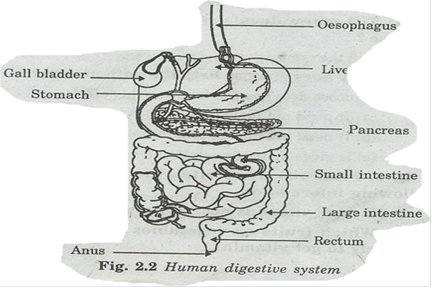
Question13. Label fig. 2.2 of the digestive system.
Answer:
NCERT solutions for Class 7 Science Nutrition in animals
Question14. Can we survive only on raw, leafy vegetables/grass? Discuss.
Answer:
No, because to live alive a healthy life we need a complete balance of all nutrients. Rawgreen vegetables may have cellulose which cannot be digested by us. So, only green leafyvegetables will not solve the purpose.