NCERT solutions for Maths Triangles and its Properties
NCERT Solutions for Class 7 Maths Triangles and its Properties
Class –VII Mathematics (Ex. 6.5)
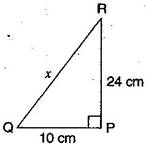
Question 1.PQR is a triangle, right angled at P. If PQ = 10 cm and PR = 24 cm, find QR.
Answer:
Given: PQ = 10 cm, PR = 24 cm
Let QR be x cm.
In right angled triangle QPR,
(Hypotenuse)2=(Base)2+(Perpendicular)2
[By Pythagoras theorem]
⇒(QR)2=(PQ)2+(PR)2
⇒x2=(10)2+(24)2
⇒x2 = 100 + 576 = 676
⇒x=676 = 26 cm
Thus, the length of QR is 26 cm.
NCERT Solutions for Class 7 Maths Exercise 6.5
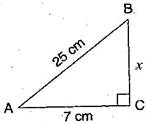
Question 2.ABC is a triangle, right angled at C. If AB = 25 cm and AC = 7 cm, find BC.
Answer:
Given: AB = 25 cm, AC = 7 cm
Let BC be x cm.
In right angled triangle ACB,
(Hypotenuse)2=(Base)2+(Perpendicular)2
[By Pythagoras theorem]
⇒(AB)2=(AC)2+(BC)2
⇒(25)2=(7)2+x2
⇒ 625 = 49 + x2
⇒x2 = 625 – 49 = 576
⇒x=576 = 24 cm
Thus, the length of BC is 24 cm.
NCERT Solutions for Class 7 Maths Exercise 6.5
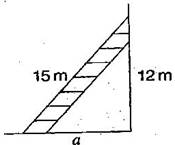
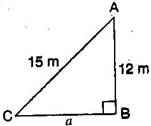
Question 3.A 15 m long ladder reached a window 12 m high from the ground on placing it against a wall at a distance a. Find the distance of the foot of the ladder from the wall.
Answer:
Let AC be the ladder and A be the window.
Given: AC = 15 m, AB = 12 m, CB = a m
In right angled triangle ACB,
(Hypotenuse)2=(Base)2+(Perpendicular)2
[By Pythagoras theorem]
⇒(AC)2=(CB)2+(AB)2
⇒(15)2=(a)2+(12)2
⇒ 225 = a2 + 144
⇒a2 = 225 – 144 = 81
⇒a=81 = 9 cm
Thus, the distance of the foot of the ladder from the wall is 9 m.
NCERT Solutions for Class 7 Maths Exercise 6.5
Question 4.Which of the following can be the sides of a right triangle?
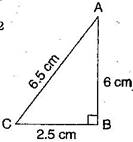
2.5 cm, 6.5 cm, 6 cm
2 cm, 2 cm, 5 cm
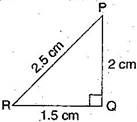
1.5 cm, 2 cm, 2.5 cm
In the case of right angled triangles, identify the right angles.
Answer:
Let us consider, the larger side be the hypotenuse and also using Pythagoras theorem,
(Hypotenuse)2=(Base)2+(Perpendicular)2
(i) 2.5 cm, 6.5 cm, 6 cm
In ΔABC,(AC)2=(AB)2+(BC)2
L.H.S. = (6.5)2 = 42.25 cm
R.H.S. = (6)2+(2.5)2 = 36 + 6.25 = 42.25 cm
Since, L.H.S. = R.H.S.
Therefore, the given sides are of the right angled triangle.
Right angle lies on the opposite to the greater side 6.5 cm, i.e., at B.
(ii) 2 cm, 2 cm, 5 cm
(5)2=(2)2+(2)2
L.H.S. = (5)2 = 25
R.H.S. = (2)2+(2)2 = 4 + 4 = 8
Since, L.H.S. = R.H.S.
Therefore, the given sides are not of the right angled triangle.
(iii) 1.5 cm, 2 cm, 2.5 cm
In ΔPQR, (PR)2=(PQ)2+(RQ)2
L.H.S. = (2.5)2 = 6.25 cm
R.H.S. = (1.5)2+(2)2 = 2.25 + 4 = 6.25 cm
Since, L.H.S. = R.H.S.
Therefore, the given sides are of the right angled triangle.
Right angle lies on the opposite to the greater side 2.5 cm, i.e., at Q.
NCERT Solutions for Class 7 Maths Exercise 6.5
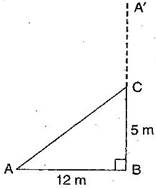
Question 5.A tree is broken at a height of 5 m from the ground and its top touches the ground at a distance of 12 m from the base of the tree. Find the original height of the tree.
Answer:
Let A’CB represents the tree before it broken at the point C and let the top A’ touches the ground at A after it broke. Then ΔABC is a right angled triangle, right angled at B.
AB = 12 m and BC = 5 m
Using Pythagoras theorem, In ΔABC
(AC)2=(AB)2+(BC)2
⇒(AC)2=(12)2+(5)2
⇒(AC)2=144+25
⇒(AC)2=169
⇒ AC = 13 m
Hence, the total height of the tree = AC + CB = 13 + 5 = 18 m.
NCERT Solutions for Class 7 Maths Exercise 6.5
Question 6.Angles Q and R of a ΔPQR are 25∘ and 65∘.
Write which of the following is true:
PQ2+QR2=RP2
PQ2+RP2=QR2
RP2+QR2=PQ2
25∘65∘
Answer:
In ΔPQR,
∠PQR + ∠QRP + ∠RPQ = 180∘
[By Angle sum property of a Δ ]
⇒25∘+65∘+∠RPQ = 180∘
⇒90∘+∠RPQ = 180∘
⇒∠RPQ = 180∘–90∘=90∘
Thus, ΔPQR is a right angled triangle, right angled at P.