CBSE.club

Rational Numbers Ex-9.1

NCERT solutions for Maths Rational Numbers
NCERT Solutions for Class 7 Maths Exercise 9.1

NCERT Solutions for Class 7 Maths Rational Numbers

Class –VII Mathematics (Ex. 9.1)
Question 1.List five rational numbers between:

(i) 1– 1 and 0

(ii) 2– 2 and 1– 1

(iii) 45\frac{{ – 4}}{5} and 23\frac{{ – 2}}{3}

(iv) 12\frac{{ – 1}}{2} and 23\frac{2}{3}

Answer:

(i) 1– 1 and 0

Let us write 1– 1 and 0 as rational numbers with denominator 6.

\Rightarrow 1=66– 1 = \frac{{ – 6}}{6} and 0 = 06\frac{0}{6}

\therefore 66<56<46<36<26<16<0\frac{{ – 6}}{6} < \frac{{ – 5}}{6} < \frac{{ – 4}}{6} < \frac{{ – 3}}{6} < \frac{{ – 2}}{6} < \frac{{ – 1}}{6} < 0

\Rightarrow 1<56<23<12<13<16<0– 1 < \frac{{ – 5}}{6} < \frac{{ – 2}}{3} < \frac{{ – 1}}{2} < \frac{{ – 1}}{3} < \frac{{ – 1}}{6} < 0

Therefore, five rational numbers between 1– 1 and 0 would be

56,23,12,13,16\frac{{ – 5}}{6},\frac{{ – 2}}{3},\frac{{ – 1}}{2},\frac{{ – 1}}{3},\frac{{ – 1}}{6}

(ii) 2– 2 and 1– 1

Let us write 2– 2 and 1– 1 as rational numbers with denominator 6.

\Rightarrow 2=126– 2 = \frac{{ – 12}}{6} and 1=66– 1 = \frac{{ – 6}}{6}

\therefore 126<116<106<96<86<76<66\frac{{ – 12}}{6} < \frac{{ – 11}}{6} < \frac{{ – 10}}{6} < \frac{{ – 9}}{6} < \frac{{ – 8}}{6} < \frac{{ – 7}}{6} < \frac{{ – 6}}{6}

\Rightarrow 2<116<53<32<43<76<1– 2 < \frac{{ – 11}}{6} < \frac{{ – 5}}{3} < \frac{{ – 3}}{2} < \frac{{ – 4}}{3} < \frac{{ – 7}}{6} < – 1

Therefore, five rational numbers between 2– 2 and 1– 1 would be

116,53,32,43,76\frac{{ – 11}}{6},\frac{{ – 5}}{3},\frac{{ – 3}}{2},\frac{{ – 4}}{3},\frac{{ – 7}}{6}

(iii) 45\frac{{ – 4}}{5} and 23\frac{{ – 2}}{3}

Let us write 45\frac{{ – 4}}{5} and 23\frac{{ – 2}}{3} as rational numbers with the same denominators.

\Rightarrow 45=3645\frac{{ – 4}}{5} = \frac{{ – 36}}{{45}} and 23=3045\frac{{ – 2}}{3} = \frac{{ – 30}}{{45}}

\therefore 3645<3545<3445<3345<3245<3145<3045\frac{{ – 36}}{{45}} < \frac{{ – 35}}{{45}} < \frac{{ – 34}}{{45}} < \frac{{ – 33}}{{45}} < \frac{{ – 32}}{{45}} < \frac{{ – 31}}{{45}} < \frac{{ – 30}}{{45}}

\Rightarrow 45<79<3445<1115<3245<3145<23\frac{{ – 4}}{5} < \frac{{ – 7}}{9} < \frac{{ – 34}}{{45}} < \frac{{ – 11}}{{15}} < \frac{{ – 32}}{{45}} < \frac{{ – 31}}{{45}} < \frac{{ – 2}}{3}

Therefore, five rational numbers between 45\frac{{ – 4}}{5} and 23\frac{{ – 2}}{3} would be

79,3445,1115,3245,3145,23\frac{{ – 7}}{9},\frac{{ – 34}}{{45}},\frac{{ – 11}}{{15}},\frac{{ – 32}}{{45}},\frac{{ – 31}}{{45}},\frac{{ – 2}}{3}

(iv) 12\frac{{ – 1}}{2} and 23\frac{2}{3}

Let us write 12\frac{{ – 1}}{2} and 23\frac{2}{3} as rational numbers with the same denominators.

\Rightarrow 12=36\frac{{ – 1}}{2} = \frac{{ – 3}}{6} and 23=46\frac{2}{3} = \frac{4}{6}

\therefore 36<26<16<0<16<26<36<46\frac{{ – 3}}{6} < \frac{{ – 2}}{6} < \frac{{ – 1}}{6} < 0 < \frac{1}{6} < \frac{2}{6} < \frac{3}{6} < \frac{4}{6}

\Rightarrow 12<13<16<0<16<13<12<23\frac{{ – 1}}{2} < \frac{{ – 1}}{3} < \frac{{ – 1}}{6} < 0 < \frac{1}{6} < \frac{1}{3} < \frac{1}{2} < \frac{2}{3}

Therefore, five rational numbers between 12\frac{{ – 1}}{2} and 23\frac{2}{3} would be 13,16,0,16,13\frac{{ – 1}}{3},\frac{{ – 1}}{6},0,\frac{1}{6},\frac{1}{3}.


NCERT Solutions for Class 7 Maths Exercise 9.1

Question 2.Write four more rational numbers in each of the following patterns:

(i) 35,610,915,1220,\frac{{ – 3}}{5},\frac{{ – 6}}{{10}},\frac{{ – 9}}{{15}},\frac{{ – 12}}{{20}},………

(ii) 14,28,312,.\frac{{ – 1}}{4},\frac{{ – 2}}{8},\frac{{ – 3}}{{12}},……….

(iii) 16,212,318,424,\frac{{ – 1}}{6},\frac{2}{{ – 12}},\frac{3}{{ – 18}},\frac{4}{{ – 24}},………

(iv) 23,23,46,69,.\frac{{ – 2}}{3},\frac{2}{{ – 3}},\frac{4}{{ – 6}},\frac{6}{{ – 9}},……….

Answer:

(i) 35,610,915,1220,\frac{{ – 3}}{5},\frac{{ – 6}}{{10}},\frac{{ – 9}}{{15}},\frac{{ – 12}}{{20}},………

\Rightarrow 3×15×1,3×25×2,3×35×3,3×45×4,\frac{{ – 3 \times 1}}{{5 \times 1}},\frac{{ – 3 \times 2}}{{5 \times 2}},\frac{{ – 3 \times 3}}{{5 \times 3}},\frac{{ – 3 \times 4}}{{5 \times 4}},………

Therefore, the next four rational numbers of this pattern would be

3×55×5,3×65×6,3×75×7,3×85×8\frac{{ – 3 \times 5}}{{5 \times 5}},\frac{{ – 3 \times 6}}{{5 \times 6}},\frac{{ – 3 \times 7}}{{5 \times 7}},\frac{{ – 3 \times 8}}{{5 \times 8}} = 1525,1830,2135,2440\frac{{ – 15}}{{25}},\frac{{ – 18}}{{30}},\frac{{ – 21}}{{35}},\frac{{ – 24}}{{40}}

(ii) 14,28,312,.\frac{{ – 1}}{4},\frac{{ – 2}}{8},\frac{{ – 3}}{{12}},……….

\Rightarrow 1×14×1,1×24×2,1×34×3,.\frac{{ – 1 \times 1}}{{4 \times 1}},\frac{{ – 1 \times 2}}{{4 \times 2}},\frac{{ – 1 \times 3}}{{4 \times 3}},……….

Therefore, the next four rational numbers of this pattern would be

1×44×4,1×54×5,1×64×6,1×74×7\frac{{ – 1 \times 4}}{{4 \times 4}},\frac{{ – 1 \times 5}}{{4 \times 5}},\frac{{ – 1 \times 6}}{{4 \times 6}},\frac{{ – 1 \times 7}}{{4 \times 7}} = 416,520,624,728\frac{{ – 4}}{{16}},\frac{{ – 5}}{{20}},\frac{{ – 6}}{{24}},\frac{{ – 7}}{{28}}

(iii) 16,212,318,424,\frac{{ – 1}}{6},\frac{2}{{ – 12}},\frac{3}{{ – 18}},\frac{4}{{ – 24}},………

\Rightarrow 1×16×1,1×26×2,1×36×3,1×46×4,\frac{{ – 1 \times 1}}{{6 \times 1}},\frac{{1 \times 2}}{{ – 6 \times 2}},\frac{{1 \times 3}}{{ – 6 \times 3}},\frac{{1 \times 4}}{{ – 6 \times 4}},………

Therefore, the next four rational numbers of this pattern would be

1×56×5,1×66×6,1×76×7,1×86×8\frac{{1 \times 5}}{{ – 6 \times 5}},\frac{{1 \times 6}}{{ – 6 \times 6}},\frac{{1 \times 7}}{{ – 6 \times 7}},\frac{{1 \times 8}}{{ – 6 \times 8}} = 530,636,742,848\frac{5}{{ – 30}},\frac{6}{{ – 36}},\frac{7}{{ – 42}},\frac{8}{{ – 48}}

(iv) 23,23,46,69,.\frac{{ – 2}}{3},\frac{2}{{ – 3}},\frac{4}{{ – 6}},\frac{6}{{ – 9}},……….

\Rightarrow 2×13×1,2×13×1,2×23×2,2×33×3,.\frac{{ – 2 \times 1}}{{3 \times 1}},\frac{{2 \times 1}}{{ – 3 \times 1}},\frac{{2 \times 2}}{{ – 3 \times 2}},\frac{{2 \times 3}}{{ – 3 \times 3}},……….

Therefore, the next four rational numbers of this pattern would be

2×43×4,2×53×5,2×63×6,2×73×7\frac{{2 \times 4}}{{ – 3 \times 4}},\frac{{2 \times 5}}{{ – 3 \times 5}},\frac{{2 \times 6}}{{ – 3 \times 6}},\frac{{2 \times 7}}{{ – 3 \times 7}} = 812,1015,1218,1421\frac{8}{{ – 12}},\frac{{10}}{{ – 15}},\frac{{12}}{{ – 18}},\frac{{14}}{{ – 21}}


NCERT Solutions for Class 7 Maths Exercise 9.1

Question 3.Give four rational numbers equivalent to:

(i) 27\frac{{ – 2}}{7}

(ii) 53\frac{5}{{ – 3}}

(iii) 49\frac{4}{9}

Answer:

(i) 27\frac{{ – 2}}{7}

2×27×2=414,\frac{{ – 2 \times 2}}{{7 \times 2}} = \frac{{ – 4}}{{14}},2×37×3=621,\frac{{ – 2 \times 3}}{{7 \times 3}} = \frac{{ – 6}}{{21}},2×47×4=828,\frac{{ – 2 \times 4}}{{7 \times 4}} = \frac{{ – 8}}{{28}},2×57×5=1035\frac{{ – 2 \times 5}}{{7 \times 5}} = \frac{{ – 10}}{{35}}

Therefore, four equivalent rational numbers are 414,621,828,1035\frac{{ – 4}}{{14}},\frac{{ – 6}}{{21}},\frac{{ – 8}}{{28}},\frac{{ – 10}}{{35}}.

(ii) 53\frac{5}{{ – 3}}

5×23×2=106,\frac{{5 \times 2}}{{ – 3 \times 2}} = \frac{{10}}{{ – 6}},5×33×3=159,\frac{{5 \times 3}}{{ – 3 \times 3}} = \frac{{15}}{{ – 9}},5×43×4=2012,\frac{{5 \times 4}}{{ – 3 \times 4}} = \frac{{20}}{{ – 12}},5×53×5=2515\frac{{5 \times 5}}{{ – 3 \times 5}} = \frac{{25}}{{ – 15}}

Therefore, four equivalent rational numbers are 106,159,2012,2515\frac{{10}}{{ – 6}},\frac{{15}}{{ – 9}},\frac{{20}}{{ – 12}},\frac{{25}}{{ – 15}}.

(iii) 49\frac{4}{9}

4×29×2=818,\frac{{4 \times 2}}{{9 \times 2}} = \frac{8}{{18}},4×39×3=1227,\frac{{4 \times 3}}{{9 \times 3}} = \frac{{12}}{{27}},4×49×4=1636,\frac{{4 \times 4}}{{9 \times 4}} = \frac{{16}}{{36}},4×59×5=2045\frac{{4 \times 5}}{{9 \times 5}} = \frac{{20}}{{45}}

Therefore, four equivalent rational numbers are 818,1227,1636,2045\frac{8}{{18}},\frac{{12}}{{27}},\frac{{16}}{{36}},\frac{{20}}{{45}}.


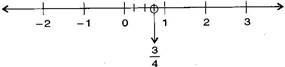
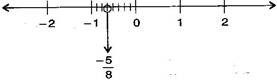
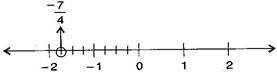
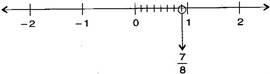
Question 4.Draw the number line and represent the following rational numbers on it:

(i) 34\frac{3}{4}

(ii) 58\frac{{ – 5}}{8}

(iii) 74\frac{{ – 7}}{4}

(iv) 78\frac{7}{8}

Answer:

(i) 34\frac{3}{4}

(ii) 58\frac{{ – 5}}{8}

(iii) 74\frac{{ – 7}}{4}

(iv) 78\frac{7}{8}


NCERT Solutions for Class 7 Maths Exercise 9.1

Question 5.The points P, Q, R, S, T, U, A and B on the number line are such that, TR = RS = SU and AP = PQ = QB. Name the rational numbers represented by P, Q, R and S.

Answer:

Each part which is between the two numbers is divided into 3 parts.

Therefore, A = 63,\frac{6}{3}, P = 73,\frac{7}{3}, Q = 83\frac{8}{3} and B = 93\frac{9}{3}

Similarly T = 33,\frac{{ – 3}}{3}, R = 43,\frac{{ – 4}}{3}, S = 53\frac{{ – 5}}{3} and U = 63\frac{{ – 6}}{3}

Thus, the rational numbers represented P, Q, R and S are 73,83,43\frac{7}{3},\frac{8}{3},\frac{{ – 4}}{3} and 53\frac{{ – 5}}{3} respectively.


NCERT Solutions for Class 7 Maths Exercise 9.1

Question 6.Which of the following pairs represent the same rational numbers:

(i) 721\frac{{ – 7}}{{21}} and 39\frac{3}{9}

(ii) 1620\frac{{ – 16}}{{20}} and 2025\frac{{20}}{{ – 25}}

(iii) 23\frac{{ – 2}}{{ – 3}} and 23\frac{2}{3}

(iv) 35\frac{{ – 3}}{5} and 1220\frac{{ – 12}}{{20}}

(v) 85\frac{8}{{ – 5}} and 2415\frac{{ – 24}}{{15}}

(vi) 13\frac{1}{3} and 19\frac{{ – 1}}{9}

(vii) 59\frac{{ – 5}}{{ – 9}} and 59\frac{5}{{ – 9}}

Answer:

(i) 721\frac{{ – 7}}{{21}} and 39\frac{3}{9}

\Rightarrow 721\frac{{ – 7}}{{21}} = 13\frac{{ – 1}}{3} and 39\frac{3}{9} = 13\frac{1}{3} [Converting into lowest term]

\because 13\frac{{ – 1}}{3}\ne13\frac{1}{3}

\therefore 721\frac{{ – 7}}{{21}}\ne39\frac{3}{9}

(ii) 1620\frac{{ – 16}}{{20}} and 2025\frac{{20}}{{ – 25}}

\Rightarrow 1620\frac{{ – 16}}{{20}} = 45\frac{{ – 4}}{5} and 2025\frac{{20}}{{ – 25}} = 45=45\frac{4}{{ – 5}} = \frac{{ – 4}}{5}

[Converting into lowest term]

\because 45\frac{{ – 4}}{5} = 45\frac{{ – 4}}{5}

\therefore 1620\frac{{ – 16}}{{20}} = 2025\frac{{20}}{{ – 25}}

(iii) 23\frac{{ – 2}}{{ – 3}} and 23\frac{2}{3}

\Rightarrow 23\frac{{ – 2}}{{ – 3}} = 23\frac{2}{3} and 23\frac{2}{3} = 23\frac{2}{3} [Converting into lowest term]

\because 23\frac{2}{3} = 23\frac{2}{3}

\therefore 23\frac{{ – 2}}{{ – 3}} = 23\frac{2}{3}

(iv) 35\frac{{ – 3}}{5} and 1220\frac{{ – 12}}{{20}}

\Rightarrow 35\frac{{ – 3}}{5} = 35\frac{{ – 3}}{5} and 1220\frac{{ – 12}}{{20}} = 35\frac{{ – 3}}{5} [Converting into lowest term]

\because 35\frac{{ – 3}}{5} = 35\frac{{ – 3}}{5}

\therefore 35\frac{{ – 3}}{5} = 1220\frac{{ – 12}}{{20}}

(v) 85\frac{8}{{ – 5}} and 2415\frac{{ – 24}}{{15}}

\Rightarrow 85\frac{8}{{ – 5}} = 85\frac{{ – 8}}{5} and 2415\frac{{ – 24}}{{15}} = 85\frac{{ – 8}}{5} [Converting into lowest term]

\because 85\frac{{ – 8}}{5} = 85\frac{{ – 8}}{5}

\therefore 85\frac{8}{{ – 5}} = 2415\frac{{ – 24}}{{15}}

(vi) 13\frac{1}{3} and 19\frac{{ – 1}}{9}

\Rightarrow 13\frac{1}{3} = 13\frac{1}{3} and 19\frac{{ – 1}}{9} = 19\frac{{ – 1}}{9} [Converting into lowest term]

\because 13\frac{1}{3}\ne19\frac{{ – 1}}{9}

\therefore 13\frac{1}{3}\ne19\frac{{ – 1}}{9}

(vii) 59\frac{{ – 5}}{{ – 9}} and 59\frac{5}{{ – 9}}

\Rightarrow 59\frac{{ – 5}}{{ – 9}} = 59\frac{5}{9} and 59\frac{5}{{ – 9}} = 59\frac{5}{9} [Converting into lowest term]

\because 59\frac{5}{9}\ne59\frac{5}{{ – 9}}

\therefore 59\frac{{ – 5}}{{ – 9}}\ne59\frac{5}{{ – 9}}


NCERT Solutions for Class 7 Maths Exercise 9.1

Question 7.Rewrite the following rational numbers in the simplest form:

(i) 86\frac{{ – 8}}{6}

(ii) 2545\frac{{25}}{{45}}

(iii) 4472\frac{{ – 44}}{{72}}

(iv) 810\frac{{ – 8}}{{10}}

Answer:

(i) 86\frac{{ – 8}}{6} = 8÷26÷2\frac{{ – 8 \div 2}}{{6 \div 2}} = 43\frac{{ – 4}}{3} [H.C.F. of 8 and 6 is 2]

(ii)2545\frac{{25}}{{45}} = 25÷545÷5\frac{{25 \div 5}}{{45 \div 5}} = 59\frac{5}{9}

[H.C.F. of 25 and 45 is 5]

(iii)4472\frac{{ – 44}}{{72}} = 44÷472÷4\frac{{ – 44 \div 4}}{{72 \div 4}} = 1118\frac{{ – 11}}{{18}} [H.C.F. of 44 and 72 is 4]

(iv) 810\frac{{ – 8}}{{10}} = 8÷210÷2\frac{{ – 8 \div 2}}{{10 \div 2}} = 45\frac{{ – 4}}{5} [H.C.F. of 8 and 10 is 2]


NCERT Solutions for Class 7 Maths Exercise 9.1

Question 8.Fill in the boxes with the correct symbol out of <, > and =:

(i) 57 23\frac{{ – 5}}{7}\boxed{{\text{ }}}\frac{2}{3}

(ii) 45 57\frac{{ – 4}}{5}\boxed{{\text{ }}}\frac{{ – 5}}{7}

(iii) 78 1416\frac{{ – 7}}{8}\boxed{{\text{ }}}\frac{{14}}{{ – 16}}

(iv) 85 74\frac{{ – 8}}{5}\boxed{{\text{ }}}\frac{{ – 7}}{4}

(v) 13 14\frac{1}{{ – 3}}\boxed{{\text{ }}}\frac{{ – 1}}{4}

(vi) 511 511\frac{5}{{ – 11}}\boxed{{\text{ }}}\frac{{ – 5}}{{11}}

(vii) 0 760\boxed{{\text{ }}}\frac{{ – 7}}{6}

Answer:

(i) 57 < 23\frac{{ – 5}}{7}\boxed{{\text{ < }}}\frac{2}{3} Since, the positive number if greater than negative number.

(ii) 4×75×7 5×57×5\frac{{ – 4 \times 7}}{{5 \times 7}}\boxed{{\text{ }}}\frac{{ – 5 \times 5}}{{7 \times 5}} \Rightarrow 2835 < 2535\frac{{ – 28}}{{35}}\boxed{{\text{ < }}}\frac{{ – 25}}{{35}} \Rightarrow 45 < 57\frac{{ – 4}}{5}\boxed{{\text{ < }}}\frac{{ – 5}}{7}

(iii) 7×28×2 14×(1)16×(1)\frac{{ – 7 \times 2}}{{8 \times 2}}\boxed{{\text{ }}}\frac{{14 \times \left( { – 1} \right)}}{{ – 16 \times \left( { – 1} \right)}} \Rightarrow 1416 = 1416\frac{{ – 14}}{{16}}\boxed{{\text{ = }}}\frac{{ – 14}}{{16}} \Rightarrow78 = 1416\frac{{ – 7}}{8}\boxed{{\text{ = }}}\frac{{14}}{{ – 16}}

(iv) 8×45×4 7×54×5\frac{{ – 8 \times 4}}{{5 \times 4}}\boxed{{\text{ }}}\frac{{ – 7 \times 5}}{{4 \times 5}} \Rightarrow 3220 > 3520\frac{{ – 32}}{{20}}\boxed{{\text{ > }}}\frac{{ – 35}}{{20}} \Rightarrow 85 > 74\frac{{ – 8}}{5}\boxed{{\text{ > }}}\frac{{ – 7}}{4}

(v) 13 14\frac{1}{{ – 3}}\boxed{{\text{ }}}\frac{{ – 1}}{4} \Rightarrow13 < 14\frac{1}{{ – 3}}\boxed{{\text{ < }}}\frac{{ – 1}}{4}

(vi) 511 511\frac{5}{{ – 11}}\boxed{{\text{ }}}\frac{{ – 5}}{{11}} \Rightarrow511 = 511\frac{5}{{ – 11}}\boxed{{\text{ = }}}\frac{{ – 5}}{{11}}

(vii) 0 > 760\boxed{{\text{ > }}}\frac{{ – 7}}{6} Since, 0 is greater than every negative number.


NCERT Solutions for Class 7 Maths Exercise 9.1

Question 9.Which is greater in each of the following:

(i) 23,52\frac{2}{3},\frac{5}{2}

(ii) 56,43\frac{{ – 5}}{6},\frac{{ – 4}}{3}

(iii) 34,23\frac{{ – 3}}{4},\frac{2}{{ – 3}}

(iv) 14,14\frac{{ – 1}}{4},\frac{1}{4}

(v) 327,345– 3\frac{2}{7}, – 3\frac{4}{5}

Answer:

(i) 2×23×2=46\frac{{2 \times 2}}{{3 \times 2}} = \frac{4}{6} and 5×32×3=156\frac{{5 \times 3}}{{2 \times 3}} = \frac{{15}}{6}

Since 46 < 156\frac{4}{6}\boxed{{\text{ < }}}\frac{{15}}{6}

Therefore 23 < 52\frac{2}{3}\boxed{{\text{ }} < {\text{ }}}\frac{5}{2}

(ii) 5×16×1=56\frac{{ – 5 \times 1}}{{6 \times 1}} = \frac{{ – 5}}{6} and 4×23×2=86\frac{{ – 4 \times 2}}{{3 \times 2}} = \frac{{ – 8}}{6}

Since 56 > 86\frac{{ – 5}}{6}\boxed{{\text{ > }}}\frac{{ – 8}}{6} Therefore 56 > 43\frac{{ – 5}}{6}\boxed{{\text{ > }}}\frac{{ – 4}}{3}

(iii) 3×34×3=912\frac{{ – 3 \times 3}}{{4 \times 3}} = \frac{{ – 9}}{{12}} and 2×(4)3×(4)=812\frac{{2 \times \left( { – 4} \right)}}{{ – 3 \times \left( { – 4} \right)}} = \frac{{ – 8}}{{12}}

Since 912 < 812\frac{{ – 9}}{{12}}\boxed{{\text{ < }}}\frac{{ – 8}}{{12}}

Therefore 34 < 23\frac{{ – 3}}{4}\boxed{{\text{ }} < {\text{ }}}\frac{2}{{ – 3}}

(iv) 14 < 14\frac{{ – 1}}{4}\boxed{{\text{ < }}}\frac{1}{4} Since positive number is always greater than negative number.

(v) 327=237=23×57×5=11535– 3\frac{2}{7} = \frac{{ – 23}}{7} = \frac{{ – 23 \times 5}}{{7 \times 5}} = \frac{{ – 115}}{{35}} and 345=195=19×75×7=13335– 3\frac{4}{5} = \frac{{ – 19}}{5} = \frac{{ – 19 \times 7}}{{5 \times 7}} = \frac{{ – 133}}{{35}}

Since 11535 > 13335\frac{{ – 115}}{{35}}\boxed{{\text{ > }}}\frac{{ – 133}}{{35}}

Therefore327 > 345– 3\frac{2}{7}\boxed{{\text{ > }}} – 3\frac{4}{5}


NCERT Solutions for Class 7 Maths Exercise 9.1

Question 10.Write the following rational numbers in ascending order:

(i) 35,25,15\frac{{ – 3}}{5},\frac{{ – 2}}{5},\frac{{ – 1}}{5}

(ii) 13,29,43\frac{1}{3},\frac{{ – 2}}{9},\frac{{ – 4}}{3}

(iii) 37,32,34\frac{{ – 3}}{7},\frac{{ – 3}}{2},\frac{{ – 3}}{4}

Answer:

(i) 35,25,15\frac{{ – 3}}{5},\frac{{ – 2}}{5},\frac{{ – 1}}{5}\Rightarrow 35<25<15\frac{{ – 3}}{5} < \frac{{ – 2}}{5} < \frac{{ – 1}}{5}

(ii) 13,29,43\frac{1}{3},\frac{{ – 2}}{9},\frac{{ – 4}}{3} \Rightarrow39,29,129\frac{3}{9},\frac{{ – 2}}{9},\frac{{ – 12}}{9} [Converting into same denominator]

Now 129<29<39\frac{{ – 12}}{9} < \frac{{ – 2}}{9} < \frac{3}{9} \Rightarrow 43<29<13\frac{{ – 4}}{3} < \frac{{ – 2}}{9} < \frac{1}{3}

(iii) 37,32,34\frac{{ – 3}}{7},\frac{{ – 3}}{2},\frac{{ – 3}}{4}

\Rightarrow 32<34<37\frac{{ – 3}}{2} < \frac{{ – 3}}{4} < \frac{{ – 3}}{7}


Create a free account to download PDFs, bookmark chapters and save notes.Log in