NCERT solutions for Maths Fractions and Decimals
NCERT Solutions for Class 7 Maths Fractions and Decimals
Class –VII Mathematics (Ex. 2.1)
Question 1.Solve:
(i)2–53
(ii)4+87
(iii)53+72
(iv)119–154
(v)107+52+23
(vi)232+321
(vii)821–385
Answer:
(i) 2–53 = 510–3=57 = 152
(ii)4+87 = 832+7=839 = 487
(iii)53+72 = 3521+10 = 3531
(iv)119–154 = 165135–44=16591
(v) 107+52+23 = 107+4+15 = 1026=513 = 253
(vi) 232+321 = 38+27 = 616+21 = 637 = 661
(vii)821–385 = 217–829 = 868–19 = 839 = 487
NCERT Solutions for Class 7 Maths Exercise 2.1
Question 2.Arrange the following in descending order:
(i) 92,32,218
(ii) 51,73,107
Answer:
(i) 92,32,218 ⇒6314,6342,6324 [Converting into like fractions]
⇒ 6342>6324>6314 [Arranging in descending order]
Therefore, 32>218>92
(ii) 51,73,107 ⇒7014,7030,7049 [Converting into like fractions]
⇒ 7049>7030>7014 [Arranging in descending order]
Therefore, 107>73>51
NCERT Solutions for Class 7 Maths Exercise 2.1
Question 3.In a “magic square”, the sum of the numbers in each row, in each column and along the diagonals is the same. Is this a magic square?
| 114 | 119 | 112 |
| 113 | 115 | 117 |
| 118 | 111 | 116 |
(Along the first row 114+119+112=1115)
Answer:
Sum of first row = 114+119+112=1115 [Given]
Sum of second row = 113+115+117=113+5+7=1115
Sum of third row = 118+111+116=118+1+6=1115
Sum of first column = 114+113+118=114+3+8=1115
Sum of second column = 119+115+111=119+5+1=1115
Sum of third column = 112+117+116=112+7+6=1115
Sum of first diagonal (left to right) = 114+115+116=114+5+6=1115
Sum of second diagonal (left to right) = 112+115+118=112+5+8=1115
Since the sum of fractions in each row, in each column and along the diagonals are same, therefore it s a magic square.
NCERT Solutions for Class 7 Maths Exercise 2.1
Question 4.A rectangular sheet of paper is 1221 cm long and 1032 cm wide. Find its perimeter.
Answer:
Given: The sheet of paper is in rectangular form.
Length of sheet = 1221 cm and Breadth of sheet = 1032 cm
Perimeter of rectangle = 2 (length + breadth)
= 2(1221+1032) = 2(225+332)
= 2(625×3+32×2) = 2(675+64)
= 2×6139 = 3139=4631 cm.
Thus, the perimeter of the rectangular sheet is 4631 cm.
NCERT Solutions for Class 7 Maths Exercise 2.1
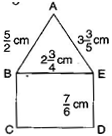
Question 5.Find the perimeter of (i) ΔABE, (ii) the rectangle BCDE in this figure. Whose perimeter is greater?
Answer:
(i) In ΔABE, AB = 25 cm, BE = 243 cm, AE = 353 cm
The perimeter of ΔABE = AB + BE + AE
= 25+243+353 = 25+411+518
= 2050+55+72 = 20177 = 82017 cm
Thus, the perimeter of ΔABEis 82017 cm.
(ii) In rectangle BCDE, BE = 243 cm, ED = 67 cm
Perimeter of rectangle = 2 (length + breadth)
= 2(243+67) = 2(411+67)
= 2(1233+14) = 647 = 765 cm
Thus, the perimeter of rectangle BCDE is 765 cm.
Comparing the perimeter of triangle and that of rectangle,
82017 cm >765 cm
Therefore, the perimeter of triangle ABE is greater than that of rectangle BCDE.
NCERT Solutions for Class 7 Maths Exercise 2.1
Question 6. Salil wants to put a picture in a frame. The picture is 753 cm wide. To fit in the frame the picture cannot be more than 7103 cm wide. How much should the picture be trimmed?
Answer:
Given: The width of the picture = 753 cm and the width of picture frame = 7103 cm
Therefore, the picture should be trimmed = 753–7103 = 538–1073
= 1076–73 = 103 cm
Thus, the picture should be trimmed by 103 cm.
NCERT Solutions for Class 7 Maths Exercise 2.1
Question 7.Ritu ate 53 part of an apple and the remaining apple was eaten by her brother Somu. How much part of the apple did Somu eat? Who had the larger share? By how much?
Answer:
The part of an apple eaten by Ritu = 53
The part of an apple eaten by Somu = 1–53=55–3=52
Comparing the parts of apple eaten by both Ritu and Somu 53>52
Larger share will be more by 53–52=51 part.
Thus, Ritu’s part is 51 more than Somu’s part.
NCERT Solutions for Class 7 Maths Exercise 2.1
Question 8.Michael finished colouring a picture in 127 hour. Vaibhav finished colouring the same picture in 43 hour. Who worked longer? By what fraction was it longer?
Answer:
Time taken by Michael to colour the picture = 127 hour
Time taken by Vaibhav to colour the picture = 43 hour
Converting both fractions in like fractions, 127 and 4×33×3=129
Here, 127<129 ⇒127<43
Thus, Vaibhav worked longer time.
Vaibhav worked longer time by 43–127=129–7=122=61 hour.
Thus, Vaibhav took 61 hour more than Michael.