On the trail of the earlies people
NCERT solutions for History
NCERT Class 6 Social Science Chapter Wise Solutions
History – Our Pasts Part I
- Chapter 1 – What, Where, How and when?
- Chapter 2 – On The Trial of the Earliest People
- Chapter 3 – From Gathering to Growing Food
- Chapter 4 – In the Earliest Cities
- Chapter 5 – What Books and Burials Tell Us
- Chapter 6 – Kingdoms, Kings and an Early Republic
- Chapter 7 – New Questions and Ideas
- Chapter 8 – Ashoka, The Emperor Who gave Up War
- Chapter 9 – Vital, Villages and Pilgrims
- Chapter 10 – Traders, Kings and Pilgrims
- Chapter 11 – New Empires and Kingdoms
- Chapter 12 – Bulidings, Paintings and Books
Geography – The Earth Our Habitat Part I
- Chapter 1 – The Earth in the Solar System
- Chapter 2 – Globe: Latitudes and Longitudes
- Chapter 3 – Motions of the Earth
- Chapter 4 – Maps
- Chapter 5 – Major Landforms of the Earth
- Chapter 6 – Major Domains of the Earth
- Chapter 7 – Our Country – India
- Chapter 8 – India: Climate, Vegetation and Wildlife
Political Science
- Chapter 1 – Understanding Diversity
- Chapter 2 – Diversity and Discrimination
- Chapter 3 – What is Government
- Chapter 4 – Key Elements of a Democratic Government
- Chapter 5 – Panchayati Raj
- Chapter 6 – Rural Administration
NCERT solutions for Class 6 Social Science History on the trail of the Earlies people
Question 1: Complete the sentences:
- Hunter-gatherers chose to live in caves and rock shelters because they provided protection from wild animals and rain, heat and wind.
- Grasslands developed around 12000 years ago.
- Early people painted on the walls of caves.
- In Hunsgi, tools were made of limestone.
Question 2: Look at the present-day political map of the subcontinent on page 136. Find out the states where Bhimbetka, Hunsgi and Kurnool are located. Would Tushar’s train have passed near any of these sites?
Answer: Bhimbetka – Madhya Pradesh
Hunsgi – Karnataka
Kurnool – Andhra Pradesh
Yes, Tushar’s train would have passed through all these sites, since all these places lie on the possible train route from Delhi to Chennai.
Bhimbetka Rock shelters is world heritage site famous for its stone age rock paintings. These are believed to be 150,000 years old. These paintings show hunter-gatherers chasing animals and birds. The main colours used for painting were red and white and occasionally ocher or iron ore and charcoal.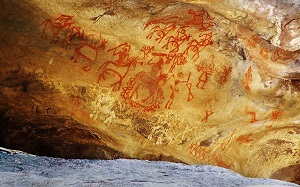
Question 3: Why did the hunter-gatherers travel from place to place? In what ways are these similar to/different from the reasons for which we travel today?
Answer: The hunter-gatherers travelled from place to place for the following possible reasons:
- In search of food, once the available animal and plant resources had exhausted.
- Some rivers and lakes are seasonal. People living near to these regions moved to other places in search of water, when these areas dried up.
- Animals moved from to one place to another place. Hunter-gatherers might move to another place while hunting them.
- Plants bear fruits in different seasons. They might move based on seasons in search of these plants and fruits.
- They might have traveled to meet their friends and relatives.
Now-a-days people travel for different reasons. They usually travel to pursue education, for work, picnics, business purposes, meet their friends and relatives.
Question 4: What tools would you use today for cutting fruit? What would they be made of?
Answer: Now-a-days we use knife for cutting, peelers for peeling and choppers for chopping fruits. These tools are made of stainless steel with wooden or plastic handles. Now a days we also use modern electrical appliances such a processors to cut the fruits which are in turn made up of plastic or aluminium. The modern knives are very different from stone age tools used to cut fruits. Stone age tools were made of stones with handles made up of wood or bones.
Question 5: List three ways in which hunter-gatherers used fire (see page 16). Would you use fire for any of these purposes today?
Answer: The ways in which hunter-gatherers used fire:
- to scare away animals and in their battle for survival.
- to cook and roast meat.
- to keep themselves warm during the cold weather.
- used as a source of light.
Yes, we do use fire for a variety of purposes in our day to day life mainly for cooking and keeping ourselves warm.