New empires and kingdoms
NCERT solutions for History
NCERT Class 6 Social Science Chapter wise Solutions
History – Our Pasts Part I
- Chapter 1 – What, Where, How and when?
- Chapter 2 – On The Trial of the Earliest People
- Chapter 3 – From Gathering to Growing Food
- Chapter 4 – In the Earliest Cities
- Chapter 5 – What Books and Burials Tell Us
- Chapter 6 – Kingdoms, Kings and an Early Republic
- Chapter 7 – New Questions and Ideas
- Chapter 8 – Ashoka, The Emperor Who gave Up War
- Chapter 9 – Vital, Villages and Pilgrims
- Chapter 10 – Traders, Kings and Pilgrims
- Chapter 11 – New Empires and Kingdoms
- Chapter 12 – Bulidings, Paintings and Books
Geography – The Earth Our Habitat Part I
- Chapter 1 – The Earth in the Solar System
- Chapter 2 – Globe: Latitudes and Longitudes
- Chapter 3 – Motions of the Earth
- Chapter 4 – Maps
- Chapter 5 – Major Landforms of the Earth
- Chapter 6 – Major Domains of the Earth
- Chapter 7 – Our Country – India
- Chapter 8 – India: Climate, Vegetation and Wildlife
Political Science
- Chapter 1 – Understanding Diversity
- Chapter 2 – Diversity and Discrimination
- Chapter 3 – What is Government
- Chapter 4 – Key Elements of a Democratic Government
- Chapter 5 – Panchayati Raj
- Chapter 6 – Rural Administration
NCERT solutions for Class 6 Social Science History new empires and kingdoms
Question 1. State whether True or False.
- Harishena composed a prashasti in praise of Gautamiputra Shri Satakarni. (False)
- The rulers of Aryavarta brought tribute for Samudra Gupta. (False)
- There were twelve rulers in Dakshinapatha. (True)
- Taxila and Madurai were important centres under the control of Gupta rulers. (False)
- Aihole was the capital of the Pallavas. (False)
- Local assemblies functioned for several centuries in south India. (True)
Question 2. Mention three authors who wrote about Harshavardhana.
Answer. The three authors who wrote about Harshavardhana are Xuan-Zang, Banabhatta, and Ravikirti.
Question 3. What changes do you find in the army at this time?
Answer. The changes made in the army were:
- Introduction of military leaders called Samantas who provided the king with troops when he needed them.
- They were not paid regular salaries Instead, some of them received grants of land.
- They collected revenue from the land and used this to maintain soldiers and horses and provide equipment for warfare.
Question 4. What were the new administrative arrangements during this period?
Answer. The new administrative arrangements during this period were:
- Some important administrative posts were made hereditary means that sons succeeded father to these posts.
- Sometimes one person held many offices. For instances, besides being a maha-danda-nayaka, Harishena was Kumar-amatya which means an important minister, and a sandhi-vigrahika meaning minister of war and peace.
- Important men probably had a greater say in local or city administration. These included nagara-shresthi or chief banker or merchant of the city, the sarthavaha or leader of the merchant caravans, the Prathama-kulika or the chief craftsman and the head of the Kayasthas or scribes.
Question 5. What do you think Arvind would have to do if he was acting as Samundragupta?
Answer. If Aravind was acting as Samudragupta he would have to :
- Establish an efficient administration and a strong government.
- Hear complaints and decide cases.
- Lead the army and successfully plan his campaign in almost all parts of India.
- Look after the welfare of the people.
- He would also write poems and would play veena.
Question 6. Do you think ordinary people would have read and understood the prashastis? Give reasons for your answer.
Answer: No, the ordinary people would not understand the Prashastis because it was written in Sanskrit language, the language of the learned people.
Question 7. If you had to make a genealogy for yourself, who are the people you would include in it? How many generations would you like to show? Make a chart and fill it.
Answer. If I have to make a genealogy of myself. I will include 4 generations (counting myself) The names are given in Alphabets.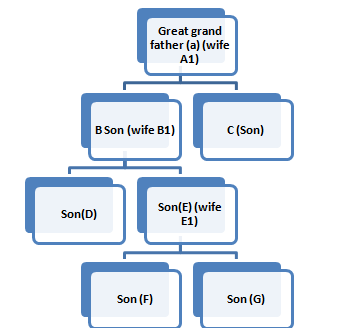
(a) I am (g) I am a small boy.
(b) My father is (E) and mother (E1).
(c) My grandfather (B) and grandmother (B1).
(d) My great grandfather is (a) and My great grandmother is (A1).
Question 8. How do you think wars affect the lives of ordinary people today?
Answer. In the present times, the wars will adversely affect the lives of the people e.g:
- The economy of the country is disturbed and prices of the essential commodities also start booming.
- There can be large scale destruction, caused due to air warfare.
- Chemical warfare and use of nuclear bombs can affect not only the present generation but also many generations to come. It may also lead to environmental degradation.