Understanding elementary shapes Ex-5.5
NCERT solutions for Maths Understanding elementary
NCERT Solutions for Class 6 Maths Understanding elementary
Class –VI
Mathematics
(Ex. 5.5)
Question 1.Which of the following are models for perpendicular lines:
(a)The adjacent edges of a table top.
(b)The lines of a railway track.
(c)The line segments forming the letter ‘L’.
(d)The letter V.
Answer: (a) Perpendicular
(b) Not perpendicular
(c) Perpendicular
(d) Not perpendicular
NCERT Solutions for Class 6 Maths Exercise 5.5
Question 2.Let be the perpendicular to the line segment Let and intersect in the point A. What is the measure of PAY.
Answer: Sol.
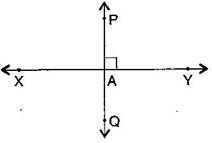
PAY =
Question 3.There are two “set-squares” in your box. What are the measures of the angles that are formed at their corners? Do they have any angle measure that is common?
Answer: One set-square has and other set-square has . They have as common angle.
NCERT Solutions for Class 6 Maths Exercise 5.5
Question 4.Study the diagram. The line is perpendicular to line
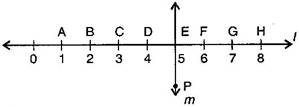
(a)Is CE = EG?
(b)Does PE bisect CG?
(c)Identify any two line segments for which PE is the perpendicular bisector.
(d)Are these true?
(i) AC > FG
(ii) CD = GH
(iii) BC < EH
Answer:
(a) Yes, both measure 2 units.
(b) Yes, because CE = EG
(c) and ,
(d) (i) True, (ii) True, (iii) True