CBSE.club

Fractions Ex-7.4

NCERT solutions for Maths Fractions 
NCERT Solutions for Class 6 Maths Exercise 7.4

NCERT Solutions for Class 6 Maths Fractions

Class –VI Mathematics
(Ex. 7.4)
Question 1.Write shaded portion as fraction. Arrange them in ascending and descending order using correct sign ‘<’, ‘>’, ‘=’ between the fractions:

(a)
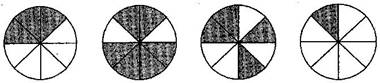
(b)
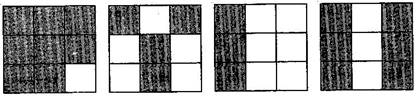
(c)

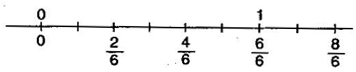
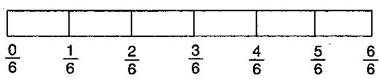
Show 26,46,86\frac{2}{6},\frac{4}{6},\frac{8}{6} and 66\frac{6}{6} on the number line. Put appropriate signs between the fractions given:

56 26,\frac{5}{6}\boxed{{\text{ }}}\frac{2}{6}, 36 0,\frac{3}{6}\boxed{{\text{ }}}0,

16 66,\frac{1}{6}\boxed{{\text{ }}}\frac{6}{6}, 86 56\frac{8}{6}\boxed{{\text{ }}}\frac{5}{6}

Answer:

(a) 38,68,48,18\frac{3}{8},\frac{6}{8},\frac{4}{8},\frac{1}{8}

Ascending order: 18<38<48<68\frac{1}{8} < \frac{3}{8} < \frac{4}{8} < \frac{6}{8}

Descending order: 68>48>38>18\frac{6}{8} > \frac{4}{8} > \frac{3}{8} > \frac{1}{8}

(b) 89,49,39,69\frac{8}{9},\frac{4}{9},\frac{3}{9},\frac{6}{9}

Ascending order: 39<49<69<89\frac{3}{9} < \frac{4}{9} < \frac{6}{9} < \frac{8}{9}

Descending order: 89>69>49>39\frac{8}{9} > \frac{6}{9} > \frac{4}{9} > \frac{3}{9}

(c) Number line

56>26\frac{5}{6}\boxed > \frac{2}{6} 16<66\frac{1}{6}\boxed < \frac{6}{6}

36>06\frac{3}{6}\boxed > \frac{0}{6} 86>56\frac{8}{6}\boxed > \frac{5}{6}


Question 2.Compare the fractions and put an appropriate sign:

(a) 36 56\frac{3}{6}\boxed{{\text{ }}}\frac{5}{6}

(b) 17 14\frac{1}{7}\boxed{{\text{ }}}\frac{1}{4}

(c) 45 55\frac{4}{5}\boxed{{\text{ }}}\frac{5}{5}

(d) 35 37\frac{3}{5}\boxed{{\text{ }}}\frac{3}{7}

Answer:

(a) 36<56\frac{3}{6}\boxed < \frac{5}{6}

(b) 17<14\frac{1}{7}\boxed < \frac{1}{4}

(c) 45<55\frac{4}{5}\boxed < \frac{5}{5}

(d) 35>37\frac{3}{5}\boxed > \frac{3}{7}


NCERT Solutions for Class 6 Maths Exercise 7.4

Question 3.Make five more each pairs and put appropriate signs.

Answer:

(a) 910>610\frac{9}{{10}}\boxed > \frac{6}{{10}}

(b) 13>16\frac{1}{3}\boxed > \frac{1}{6}

(c) 18<15\frac{1}{8}\boxed < \frac{1}{5}

(d) 78<118\frac{7}{8}\boxed < \frac{{11}}{8}

(e) 1113>913\frac{{11}}{{13}}\boxed > \frac{9}{{13}}


Question 4.Look at the figures and write ‘<’ or ‘>’ between the given pairs of fractions:
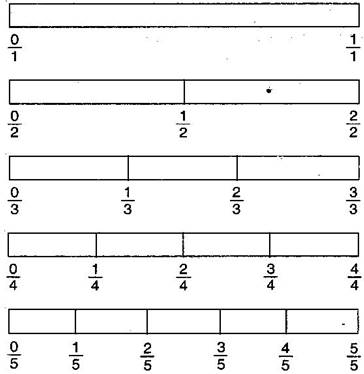
(a) 16 13\frac{1}{6}\boxed{{\text{ }}}\frac{1}{3}

(b) 34 26\frac{3}{4}\boxed{{\text{ }}}\frac{2}{6}

(c) 23 24\frac{2}{3}\boxed{{\text{ }}}\frac{2}{4}

(d) 66 33\frac{6}{6}\boxed{{\text{ }}}\frac{3}{3}

(e) 56 55\frac{5}{6}\boxed{{\text{ }}}\frac{5}{5}

Make five more such problems and solve them with your friends.

Answer:

(a) 16<13\frac{1}{6}\boxed < \frac{1}{3}

(b) 34>26\frac{3}{4}\boxed > \frac{2}{6}

(c) 23>24\frac{2}{3}\boxed > \frac{2}{4}

(d) 66=33\frac{6}{6}\boxed = \frac{3}{3}

(e) 56<55\frac{5}{6}\boxed < \frac{5}{5}

Five more such problems:

(a) 12 36\frac{1}{2}\boxed{{\text{ }}}\frac{3}{6}

(b) 23 35\frac{2}{3}\boxed{{\text{ }}}\frac{3}{5}

(c) 34 46\frac{3}{4}\boxed{{\text{ }}}\frac{4}{6}

(d) 56 22\frac{5}{6}\boxed{{\text{ }}}\frac{2}{2}

(e) 01 06\frac{0}{1}\boxed{{\text{ }}}\frac{0}{6}

Sol.

(a) 12 = 36\frac{1}{2}\boxed{{\text{ = }}}\frac{3}{6}

(b) 23 > 35\frac{2}{3}\boxed{{\text{ > }}}\frac{3}{5}

(c) 34 > 46\frac{3}{4}\boxed{{\text{ > }}}\frac{4}{6}

(d) 56 < 22\frac{5}{6}\boxed{{\text{ < }}}\frac{2}{2}

(e) 01 = 06\frac{0}{1}\boxed{{\text{ = }}}\frac{0}{6}


NCERT Solutions for Class 6 Maths Exercise 7.4

Question 5.How quickly can you do this? Fill appropriate sign (<, =, >):

(a) 12 15\frac{1}{2}\boxed{{\text{ }}}\frac{1}{5}

(b) 24 36\frac{2}{4}\boxed{{\text{ }}}\frac{3}{6}

(c) 35 23\frac{3}{5}\boxed{{\text{ }}}\frac{2}{3}

(d) 34 28\frac{3}{4}\boxed{{\text{ }}}\frac{2}{8}

(e) 35 65\frac{3}{5}\boxed{{\text{ }}}\frac{6}{5}

(f) 79 39\frac{7}{9}\boxed{{\text{ }}}\frac{3}{9}

(g) 14 28\frac{1}{4}\boxed{{\text{ }}}\frac{2}{8}

(h) 610 45\frac{6}{{10}}\boxed{{\text{ }}}\frac{4}{5}

(i) 34 78\frac{3}{4}\boxed{{\text{ }}}\frac{7}{8}

(j) 610 45\frac{6}{{10}}\boxed{{\text{ }}}\frac{4}{5}

(k) 57 1521\frac{5}{7}\boxed{{\text{ }}}\frac{{15}}{{21}}

Answer:

(a) 12 > 15\frac{1}{2}\boxed{{\text{ > }}}\frac{1}{5}

(b) 24 = 36\frac{2}{4}\boxed{{\text{ = }}}\frac{3}{6}

(c) 35 < 23\frac{3}{5}\boxed{{\text{ < }}}\frac{2}{3}

(d) 34 > 28\frac{3}{4}\boxed{{\text{ > }}}\frac{2}{8}

(e) 35 < 65\frac{3}{5}\boxed{{\text{ < }}}\frac{6}{5}

(f) 79 > 39\frac{7}{9}\boxed{{\text{ > }}}\frac{3}{9}

(g) 14 = 28\frac{1}{4}\boxed{{\text{ = }}}\frac{2}{8}

(h) 610 < 45\frac{6}{{10}}\boxed{{\text{ < }}}\frac{4}{5}

(i) 34 < 78\frac{3}{4}\boxed{{\text{ < }}}\frac{7}{8}

(j) 610 < 45\frac{6}{{10}}\boxed{{\text{ < }}}\frac{4}{5}

(k) 57 = 1521\frac{5}{7}\boxed{{\text{ = }}}\frac{{15}}{{21}}


Question 6.The following fractions represent just three different numbers. Separate them into three groups of equivalent fractions, by changing each one to its simplest form:

(a) 212\frac{2}{{12}}

(b) 315\frac{3}{{15}}

(c) 850\frac{8}{{50}}

(d) 16100\frac{{16}}{{100}}

(e) 1060\frac{{10}}{{60}}

(f) 1575\frac{{15}}{{75}}

(g) 1260\frac{{12}}{{60}}

(h) 1696\frac{{16}}{{96}}

(i) 1275\frac{{12}}{{75}}

(j) 1272\frac{{12}}{{72}}

(k) 318\frac{3}{{18}}

(l) 425\frac{4}{{25}}

Answer:

(a) 212=16\frac{2}{12}=\frac{1}{6}

(b) 315=15\frac{3}{15}=\frac{1}{5}

(c) 850=425\frac{8}{50}=\frac{4}{25}

(d) 16100=425\frac{16}{100}=\frac{4}{25}

(e) 1060=16\frac{10}{60}=\frac{1}{6}

(f) 1575=15\frac{15}{75}=\frac{1}{5}

(g) 1260=15\frac{12}{60}=\frac{1}{5}

(h) 1696=16\frac{16}{96}=\frac{1}{6}

(i) 1275=425\frac{12}{75}=\frac{4}{25}

(j) 1272=16\frac{12}{72}=\frac{1}{6}

(k) 318=16\frac{3}{18}=\frac{1}{6}

(l) 425=425\frac{4}{25}=\frac{4}{25}

Equivalent groups:

I group: 15\frac{1}{5} [(b), (f), (g)]

II group: 16\frac{1}{6} [(a), (e), (h), (j), (k)]

III group: 425\frac{4}{{25}} [(c), (d), (i), (l)]


NCERT Solutions for Class 6 Maths Exercise 7.4

Question 7.Find answers to the following. Write and indicate how you solved them:

(a) Is 59\frac{5}{9} equal to 45\frac{4}{5} ?

(b) Is 916\frac{9}{{16}} equal to 59\frac{5}{9} ?

(c) Is 45\frac{4}{5} equal to 1620\frac{{16}}{{20}} ?

(d) Is 115\frac{1}{{15}} equal to 430\frac{4}{{30}} ?

Answer:

(a)59\frac{5}{9} and 45\frac{4}{5}

\Rightarrow 5×59×5=2545\frac{{5 \times 5}}{{9 \times 5}} = \frac{{25}}{{45}} and 4×95×9=3645\frac{{4 \times 9}}{{5 \times 9}} = \frac{{36}}{{45}} [\because L.C.M. of 9 and 5 is 45]

Since, 25453645\frac{{25}}{{45}} \ne \frac{{36}}{{45}}

Therefore, 5945\frac{5}{9} \ne \frac{4}{5}

(b) 916\frac{9}{{16}} and 59\frac{5}{9}

\Rightarrow9×916×9=81144\frac{{9 \times 9}}{{16 \times 9}} = \frac{{81}}{{144}} and 5×169×16=80144\frac{{5 \times 16}}{{9 \times 16}} = \frac{{80}}{{144}} [\because L.C.M. of 16 and 9 is 144]

Since, 8114480144\frac{{81}}{{144}} \ne \frac{{80}}{{144}}

Therefore, 91659\frac{9}{{16}} \ne \frac{5}{9}

(c) 45\frac{4}{5} and 1620\frac{{16}}{{20}}

\Rightarrow4×205×20=80100\frac{{4 \times 20}}{{5 \times 20}} = \frac{{80}}{{100}} and 16×520×5=80100\frac{{16 \times 5}}{{20 \times 5}} = \frac{{80}}{{100}} [\because L.C.M. of 5 and 20 is 100]

Since, 80100=80100\frac{{80}}{{100}} = \frac{{80}}{{100}}

Therefore, 45=1620\frac{4}{5} = \frac{{16}}{{20}}

(d) 115\frac{1}{{15}} and 430\frac{4}{{30}}

\Rightarrow1×215×2=230\frac{{1 \times 2}}{{15 \times 2}} = \frac{2}{{30}} and 4×130×1=430\frac{{4 \times 1}}{{30 \times 1}} = \frac{4}{{30}} [\because L.C.M. of 15 and 30 is 30]

Since, 430=430\frac{4}{{30}} = \frac{4}{{30}} Therefore,

115=430\frac{1}{{15}} = \frac{4}{{30}}


NCERT Solutions for Class 6 Maths Exercise 7.4

Question 8.Ila read 25 pages of a book containing 100 pages. Lalita read 25\frac{2}{5} of the same book. Who read less?

Answer:

Ila read 25 pages out of 100 pages.

Fraction of reading the pages = 25100=14th\frac{{25}}{{100}} = \frac{1}{4}th part of book

Lalita read 25th\frac{2}{5}th part of book = 40100\frac{{40}}{{100}} pages

Since 14<25\frac{1}{4} < \frac{2}{5}

Therefore, Ila read less.


Question 9.Rafiq exercised for 36\frac{3}{6} of an hour, while Rohit exercised for 34\frac{3}{4} of an hour. Who exercised for a longer time?

Answer:

Rafiq exercised 36\frac{3}{6} of an hour.

Rohit exercised 34\frac{3}{4} of an hour.

Since 34>36\frac{3}{4} > \frac{3}{6}

Therefore, Rohit exercised for a longer time.


NCERT Solutions for Class 6 Maths Exercise 7.4

Question 10.In a class A of 25 students, 20 passed in first class; in another class B of 30 students, 24 passed in first class. In which class was a greater fraction of students getting first class?

Answer:

In class A, 20 passed out of 25, i.e., 2025\frac{{20}}{{25}} = 45\frac{4}{5}

In class B, 24 passed out of 30, i.e., 2430\frac{{24}}{{30}} = 45\frac{4}{5}

Hence, each class have same fraction of student getting first class.


Create a free account to download PDFs, bookmark chapters and save notes.Log in