Decimals Ex-8.1
NCERT solutions for Maths Decimals
NCERT Solutions for Class 6 Maths Decimals
Class –VI Mathematics
(Ex. 8.1)
Question 1.Write the following as numbers in the given table:
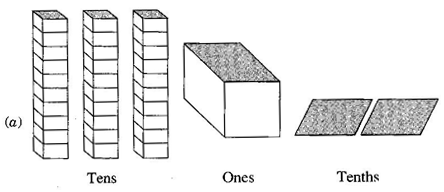
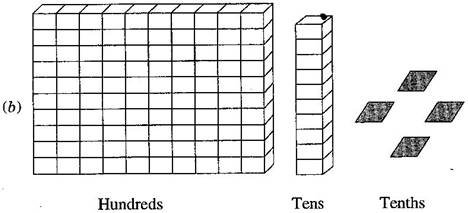
| Hundreds
(100) | Tens
(10) | Ones
(1) | Tenths
|
Answer:
| Hundreds
(100) | Tens
(10) | Ones
(1) | Tenths
|
| 0 | 3 | 2 | 31.2 |
| 1 | 1 | 4 | 110.4 |
Question 2.Write the following decimals in the place value table:
(a) 19.4
(b) 0.3
(c) 10.6
(d) 205.9
Answer:
(a)
| Hundreds | Tens | Once | Tenths |
| 0 | 1 | 9 | 4 |
(b)
| Hundreds | Tens | Once | Tenths |
| 0 | 0 | 0 | 3 |
(c)
| Hundreds | Tens | Once | Tenths |
| 0 | 1 | 0 | 6 |
(d)
| Hundreds | Tens | Once | Tenths |
| 0 | 0 | 5 | 9 |
NCERT Solutions for Class 6 Maths Exercise 8.1
Question 3.Write each of the following as decimals:
(a) seven-tenths
(b) Two tens and nine-tenths
(c) Fourteen point six
(d) One hundred and two-ones
(e) Six hundred point eight
Answer:
(a) seven-tenths = 7 tenths = = 0.7
(b) 2 tens and 9-tenths = 2 x 10 + = 20 + 0.9 =20.9
(c) Fourteen point six = 14.6
(d) One hundred and 2-ones = 100 + 2 x 1 = 100 + 2 = 102
(e) Six hundred point eight = 600.8
Question 4.Write each of the following as decimals:
(a)
(b)
(c)
(d)
(e)
(f)
(g)
(h)
(i)
(j)
(k)
Answer:
(a) = 0.5
(b) = 3 + 0.7 = 3.7
(c) = 200 + 60 + 5 + 0.1 = 265.1
(d) = 70 + 0.8 = 70.8
(e) = 8 + 0.8 = 8.8
(f) = 4 + 0.2 = 4.2
(g) = 1 + 0.5 = 1.5
(h) = 0.4
(i) = 2 + 0.4 = 2.4
(j) = 3 + 0.6 = 3.6
(k) = 4 + 0.5 = 4.5
NCERT Solutions for Class 6 Maths Exercise 8.1
Question 5.Write the following decimals as fraction. Reduce the fractions to lowest terms:
(a) 0.6
(b) 2.5
(c) 1.0
(d) 3.8
(e) 13.7
(f) 21.2
(g) 6.4
Answer:
(a) 0.6 =
(b) 2.5 =
(c) 1.0 = = 1
(d) 3.8 =
(e) 13.7 =
(f) =
(g) 6.4 =
Question 6.Express the following as cm using decimals:
(a) 2 mm
(b) 30 mm
(c) 116 mm
(d) 4 cm 2 mm
(e) 162 mm
(f) 83 mm
Answer:
(a) 10 mm = 1 cm
1 mm = cm
2 mm = x 2 = 0.2 cm
(b) 10 mm = 1 cm
1 mm = cm
30 mm = x 30 = 3.0 cm
(c) 10 mm = 1 cm
1 mm = cm
116 mm = x 116 = 11.6 cm
(d) 4 cm + cm [ 10 mm = 1 cm]
4 + 0.2 = 4.2 cm
(e) 10 mm = 1 cm
1 mm = cm
162 mm = x 162 = 16.2 cm
(f) 10 mm = 1 cm
1 mm = cm
83 mm = x 83 = 8.3 cm
NCERT Solutions for Class 6 Maths Exercise 8.1
Question 7.Between which two whole numbers on the number line are the given lie? Which of these whole numbers is nearer the number?
(a) 0.8
(b) 5.1
(c) 2.6
(d) 6.4
(e) 9.1
(f) 4.9
Answer:
(a) From 0 to 1, 0.8 is nearest to 1.
(b) From 5 to 6, 5.1 is nearest to 5.
(c) From 2 to 3, 2.6 is nearest to 3.
(d) From 6 to 7, 6.4 is nearest to 6.
(e) From 9 to 10, 9.1 is nearest to 9.
(f) From 4 to 5, 4.9 is nearest to 5.
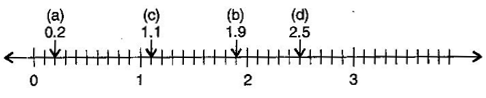
Question 8.Show the following numbers on the number line:
(a) 0.2
(b) 1.9
(c) 1.1
(d) 2.5
Answer:
Question 9.Write the decimal number represented by the points A, B, C, D:

Answer:
A = 0 + = 0.8
B = 1 + = 1.3
C = 2 + = 2.2
D = 2 + = 2.9
NCERT Solutions for Class 6 Maths Exercise 8.1
Question 10.
(a) The length of Ramesh’s notebook is 9 cm and 5 mm. What will be its length in cm?
(b) The length of a young gram plant is 65 mm. Express its length in cm.
Answer:
(a) 9 cm 5 mm = 9 cm + 5 mm = 9 + = 9.5 cm
(b) 65 mm = cm = 6.5 cm.