Miscellaneous
Download as PDF.
NCERT Solutions class 12 Maths Relations and Functions
1. Let  be defined as
 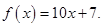 Find the function
  such that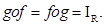
Ans. Given: 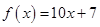
Now  and
and 



2. Let  be defined as
  if
if  is odd and
  if is even. Show that
  is invertible. Find the inverse of
  Here, W is the set of all whole numbers.
Ans. Given: defined as 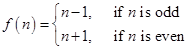
Injectivity: Let  be any two odd real numbers, then


Again, let be any two even whole numbers, then

Is is even and  is odd, then
Also, if  odd and
  is even, then
Hence,
 is an injective mapping.
Surjectivity: Let be an arbitrary whole number.
If is an odd number, then there exists an even whole number  such that

If is an even number, then there exists an odd whole number  such that

Therefore, every  W has its pre-image in W.
So, is a surjective. Thus is invertible and  exists.
For : 
 and
and 

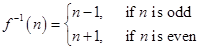
Hence, 
NCERT Solutions class 12 Maths Miscellaneous
3. If is defined by 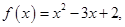 find
find 
Ans. Given: 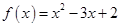

 =
= 

NCERT Solutions class 12 Maths Miscellaneous
4. Show that the function  defined by
 R is one-one and onto function.
Ans. is one-one: For any  R – {+1}, we have


Therefore, is one-one function.
If is one-one, let  R – {1}, then


It is cleat that R for all R – {1}, also 
Because 

 which is not possible.
Thus for each R – {1} there exists  R – {1} such that
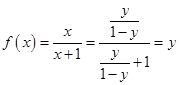
Therefore is onto function.
NCERT Solutions class 12 Maths Miscellaneous
5. Show that the function given by  is injective.
Ans. Let  R be such that


Therefore, is one-one function, hence is injective.
NCERT Solutions class 12 Maths Miscellaneous
6. Give examples of two functions  and
and  such that
  is injective but
  is not injective.
(Hint: Consider  and
and  )
)
Ans. Given: two functions and
Let and 

Therefore, is injective but is not injective.
NCERT Solutions class 12 Maths Miscellaneous
7. Give examples of two functions  and
and  such that is onto but is not onto.
(Hint: Consider  and
and 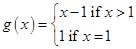 )
)
Ans. Let
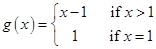
These are two examples in which is onto but is not onto.
NCERT Solutions class 12 Maths Miscellaneous
8. Given a non empty set X, consider P (X) which is the set of all subsets of X.
Define the relation AR in P (X) as follows:
For subsets A, B in P (X), ARB if and only if A B. Is R an equivalence relation on P (X)? Justify your answer.
Ans. (i) A A R is reflexive.
(ii) A B  B A R is not commutative.
(iii) If A B, B C, then A C R is transitive.
Therefore, R is not equivalent relation.
9. Given a non-empty set X, consider the binary operation * : P (X) x P (X)  P (X) given by A * B = A
  B
B  A, B in P (X), where P (X) is the power set of X. Show that X is the identity element for this operation and X is the only invertible element in P (X) with respect to the operation *.
Ans. Let S be a non-empty set and P(S) be its power set. Let any two subsets A and B of S.
A  B S
B S
A B  P(S)
P(S)
Therefore,  is an binary operation on P(S).
Similarly, if A, B P(S) and A – B P(S), then the intersection of sets and difference of sets are also binary operation on P(S) and A S = A = S A for every subset A of sets
A S = A = S A for all A P(S)
S is the identity element for intersection  on P(S).
10. Find the number of all onto functions from the set {1, 2, 3, ……., } to itself.
Ans. The number of onto functions that can be defined from a finite set A containing elements onto a finite set B containing elements = 
NCERT Solutions class 12 Maths Miscellaneous
11. Let S =  and T = {1, 2, 3}. Find
  of the following functions F from S to T, if it exists.
(i) F = 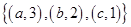
(ii) F = 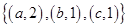
Ans. S = and T = {1, 2, 3}
(i) F =



(ii)
F is not one-one function, since element  and
and  have the same image 1.
Therefore, F is not one-one function.
NCERT Solutions class 12 Maths Miscellaneous
12. Consider the binary operation * : R x R R and o = R x R R defined as  and
and  R. Show that * is commutative but not associative, o is associative but not commutative. Further, show that
  R,
R,  [If it is so, we say that the operation * distributes over the operation o]. Does o distribute over *? Justify your answer.
Ans. Part I: also  operation * is commutative.
Now, 
And 
Here,  operation * is not associative.
Part II:  R
R
And, 
 operation
  is not commutative.
Now 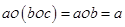 and
and 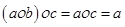
Here 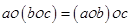 operation is associative.
Part III: L.H.S.  =
=
R.H.S.  =
=  = L.H.S. Proved.
Now, another distribution law: 
L.H.S. 
R.H.S. 
As L.H.S. R.H.S.
Therefore, the operation does not distribute over.
NCERT Solutions class 12 Maths Miscellaneous
13. Given a non-empty set X, let * : P (X) x P (X) P (X) be defined as A * B = (A – B) (B – A), A, B P (X). Show that the empty set  is the identity for the operation * and all the elements A of P (X) are invertible with A-1 = A. (Hint:
  and
and  )
)
Ans. For every A P(X), we have
 =
= 
And  =
= 
is the identity element for the operation * on P(X).
Also A * A = (A – A) (A – A) = 
Every element A of P(X) is invertible with  = A.
= A.
NCERT Solutions class 12 Maths Miscellaneous
14. Define binary operation * on the set {0, 1, 2, 3, 4, 5} as 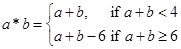
Show that zero is the identity for this operation and each element  of the set is invertible with
  being the inverse of
Ans. A binary operation (or composition) * on a (non-empty) set is a function * : A x A A. We denote  by
by  for every ordered pair
  A x A.
A binary operation on a no-empty set A is a rule that associates with every ordered pair of elements  (distinct or equal) of A some unique element of A.
* | 0 | 1 | 2 | 3 | 4 | 5 |
0 | 0 | 1 | 2 | 3 | 4 | 5 |
1 | 1 | 2 | 3 | 4 | 5 | 0 |
2 | 2 | 3 | 4 | 5 | 0 | 1 |
3 | 3 | 4 | 5 | 0 | 1 | 2 |
4 | 4 | 5 | 0 | 1 | 2 | 3 |
5 | 5 | 0 | 1 | 2 | 3 | 4 |
For all  A, we have
  (mod 6) = 0
And 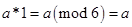 and
and 
0 is the identity element for the operation.
Also on 0 = 0 – 0 = 0 *
2 * 1 = 3 = 1 * 2


NCERT Solutions class 12 Maths Miscellaneous
15. Let A = {–1, 0, 1, 2}, B = {–4, –2, 0, 2} and  be the functions defined by
 A and
A and 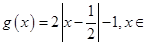 A. Are and equal? Justify your answer.
(Hint: One may note that two functions  and
and  such that
 A, are called equal functions).
Ans. When then 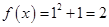 and
and 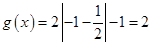
At 
 and
and 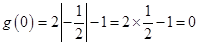
At 
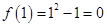 and
and 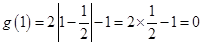
At 
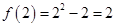 and
and 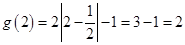
Thus for each A,
Therefore, and are equal function.
NCERT Solutions class 12 Maths Miscellaneous
16. Let A = {1, 2, 3}. Then number of relations containing (1, 2) and (1, 3) which are reflexive and symmetric but not transitive is:
(A) 1
(B) 2
(C) 3
(D) 4
Ans. It is clear that 1 is reflexive and symmetric but not transitive.
Therefore, option (A) is correct.
17. Let A = {1, 2, 3}. Then number of equivalence relations containing (1, 2) is:
(A) 1
(B) 2
(C) 3
(D) 4
Ans. 2
Therefore, option (B) is correct.
NCERT Solutions class 12 Maths Miscellaneous
18. Let be the Signum Function defined as  and
and  be the Greatest Function given by
  where
where  is greatest integer less than or equal to
  Then, does
  and coincide in (0, 1)?
Ans. It is clear that  and
and 
Consider  which lie on (0, # 1)
Now, 
And 
 in (0, 1]
Therefore, option (B) is correct.
NCERT Solutions class 12 Maths Miscellaneous
19. Number of binary operation on the set  are:
are:
(A) 10
(b) 16
(C) 20
(D) 8
Ans. A =
A x A = 
 = 4
= 4
Number of subsets =  = 16
= 16
Hence number of binary operation is 16.
Therefore, option (B) is correct.