Exercise 3.1
Download as PDF.
NCERT Solutions class 12 Maths Matrices
1. In the matrix A = 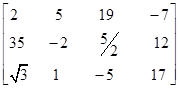 , write:
(i) The order of the matrix.
(ii) The number of elements.
(iii) Write the elements 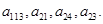
Ans. (i) There are 3 horizontal lines (rows) and 4 vertical lines (columns) in the given matrix A.
Therefore, Order of the matrix is 3 x 4.
(ii) The number of elements in the matrix A is 3 x 4 = 12.
(iii) Element in first row and third column = 19
 Element in second row and first column = 35
 Element in third row and third column =
 Element in second row and fourth column = 12
 Element in second row and third column =
NCERT Solutions class 12 Maths Exercise 3.1
2. If a matrix has 24 elements, what are possible orders it can order? What, if it has 13 elements?
Ans. Since, a matrix having  element is of order
(i) Therefore, there are 8 possible matrices having 24 elements of orders 1 x 24, 2 x 12, 3 x 8, 4 x 6, 24 x 1, 12 x 2, 8 x 3, 6 x 4.
(ii) Prime number 13 = 1 x 13 and 13 x 1
Therefore, there are 2 possible matrices of order 1 x 13 (Row matrix) and 13 x 1 (Column matrix).
3. If a matrix has 18 elements, what are the possible orders it can have? What if has 5 elements?
Ans. Since, a matrix having element is of order
(i) Therefore, there are 6 possible matrices having 18 elements of orders 1 x 18, 2 x 9, 3 x 6, 18 x 1, 9 x 2, 6 x 3.
(ii) Prime number 5 = 1 x 5 and 5 x 1
Therefore, there are 2 possible matrices of order 1 x 5 (Row matrix) and 5 x 1 (Column matrix).
NCERT Solutions class 12 Maths Exercise 3.1
4. Construct a 2 x 2 matrix A =  whose elements are given by:
(i) 
(ii) 
(iii) 
Ans. (i) Given: ……….(i)
Putting  in eq. (i)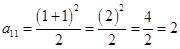
Putting  in eq. (i)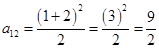
Putting  in eq. (i)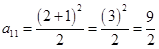
Putting  in eq. (i)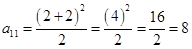
 A2 x 2 =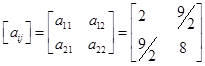
(ii) Given: ……….(i)
Putting in eq. (i) 
Putting in eq. (i) 
Putting in eq. (i) 
Putting in eq. (i) 
A2 x 2 = 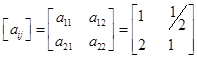
(iii) Given: ……….(i)
Putting in eq. (i) 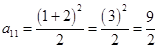
Putting in eq. (i) 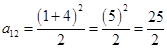
Putting in eq. (i)
Putting in eq. (i) 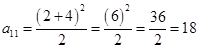
A2 x 2 = 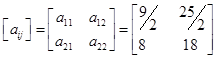
NCERT Solutions class 12 Maths Exercise 3.1
5. Construct a 3 x 4 matrix, whose elements are given by:
(i) 
(ii) 
Ans. (i) Given: ……….(i)
Putting in eq. (i) 
Putting in eq. (i) 
Putting  in eq. (i)
Putting  in eq. (i)
Putting in eq. (i) 
Putting in eq. (i) 
Putting  in eq. (i)
Putting  in eq. (i)
Putting  in eq. (i)
Putting  in eq. (i)
Putting  in eq. (i)
Putting  in eq. (i)
A3 x 4 = 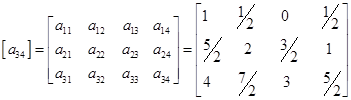
(ii) Given: ……….(i)
Putting in eq. (i) 
Putting in eq. (i) 
Putting in eq. (i) 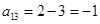
Putting in eq. (i) 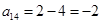
Putting in eq. (i) 
Putting in eq. (i) 
Putting in eq. (i) 
Putting in eq. (i) 
Putting in eq. (i) 
Putting in eq. (i) 
Putting in eq. (i) 
Putting in eq. (i) 
A3 x 4 = 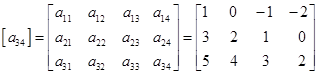
NCERT Solutions class 12 Maths Exercise 3.1
6. Find the values of  and
and  from the following equations:
(i) 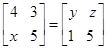
(ii) 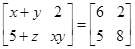
(iii) 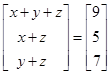
Ans. (i)Given:
By definition of Equal matrices, 
(ii)
Equating corresponding entries,  ……….(i)


 ……….(ii)
And 
 [From eq. (i),
  ]
]


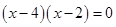
 or
or 
Putting these values of  in eq. (i), we have
  and
and 

(iii) Given:
Equating corresponding entries,  ……….(i)
 ………. (ii)
And  ……….(iii)
Eq. (i) – Eq. (ii) =  9 – 5 = 4
Eq. (i) – Eq. (iii) =  9 – 7 = 2
Putting values of and  in eq. (i),



NCERT Solutions class 12 Maths Exercise 3.1
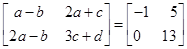
7. Find the values of  and
and  from the equation
  .
.
Ans. Equating corresponding entries,
 ……….(i)
 ……….(ii)
 ……….(iii)
 ……….(iv)
Eq. (i) – Eq. (ii) = 

Putting in eq. (i), 


Putting in eq. (iii), 


Putting in eq. (iv), 



8. A =  is a square matrix if:
(A)  (B)
(B)  (C)
(C)  (D) None of these
Ans. By definition of square matrix , option (C) is correct.
NCERT Solutions class 12 Maths Exercise 3.1
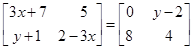
9. Which of the given values of and make the following pairs of matrices equal:
(A) 
(B) Not possible to find
(C) 
(D) 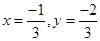
Ans. Equating corresponding sides,


And 

Also 
And 

Since, values of are not equal, therefore, no values of and exist to make the two matrices equal.
Therefore, option (B) is correct.
NCERT Solutions class 12 Maths Exercise 3.1
10. The number of all possible matrices of order 3 x 3 with each entry 0 or 1 is:
(A) 27
(B) 18
(C) 81
(D) 512
Ans. Since, general matrix of order 3 x 3 is 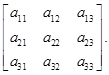
This matrix has 9 elements.
The number of choices for  is 2 (as 0 or 1 can be used)
Similarly, the number of choices for each other element is 2.
Therefore, total possible arrangements (matrices) =  times =
Therefore, option (D) is correct.