The d and f block elements part 1
Download as PDF.
NCERT Class 12 Chemistry Chapter-wise Solutions
- 1 – The Solid State
- 2 – Solutions
- 3 – Electrochemistry
- 4 – Chemical Kinetics
- 5 – Surface Chemistry
- 6 – General Principles and Processes of Isolation of Elements
- 7 – The p-Block Elements
- 8 – The d-and f-Blocks Elements
- 9 – Coordination Compounds
- 10 – Haloalkanes and Haloarenes
- 11 – Alcohols, Phenols and Ethers
- 12 – Aldehydes, Ketones and Carboxylic Acids
- 13 – Amines
- 14 – Biomolecules
- 15 – Polymers
- 16 – Chemistry in Everyday Life
CHAPTER EIGHT THE D-AND F-BLOCKS ELEMENTS
- 8.1 Position in the Periodic Tabble
- 8.2 Electronic Configurations of the d-Block Elements
- 8.3 General Properties of the Transition Elements (d-Block)
- 8.4 Some important Compounds of Transition Elements
- 8.5 The Lanthanoids
- 8.6 The Actinoids
- 8.7 Some Applications of d-and f-Block Elements
NCERT Solutions class 12 Chemistry The d and f block elements part 1
Part-1
1. Write down the electronic configuration of:
(i)  +
+
(ii) 
(iii) 
(iv) 
(v) 
(vi) 
(vii) 
(viii) 
2. Why are compounds more stable than  towards oxidation to their +3 state?
3. Explain briefly how +2 state becomes more and more stable in the first half of the first row transition elements with increasing atomic number?
4. To what extent do the electronic configurations decide the stability of oxidation states in the first series of the transition elements? Illustrate your answer with examples.
5. What may be the stable oxidation state of the transition element with the following d electron configurations in the ground state of their atoms:  and
and  ?
?
6. Name the oxometal anions of the first series of the transition metals in which the metal exhibits the oxidation state equal to its group number.
7. What is lanthanoid contraction? What are the consequences of lanthanoid contraction?
8. What are the characteristics of the transition elements and why are they called transition elements? Which of the d-block elements may not be regarded as the transition elements?
9. In what way is the electronic configuration of the transition elements different from that of the non-transition elements?
10. What are the different oxidation states exhibited by the lanthanoids?
11. Explain giving reasons:
(i) Transition metals and many of their compounds show paramagnetic behaviour.
(ii) The enthalpies of atomisation of the transition metals are high.
(iii) The transition metals generally form coloured compounds.
(iv) Transition metals and their many compounds act as good catalyst.
12. What are interstitial compounds? Why are such compounds well known for transition metals?
13. How is the variability in oxidation states of transition metals different from that of the non-transition metals? Illustrate with examples.
14. Describe the preparation of potassium dichromate from iron chromite ore. What is the effect of increasing pH on a solution of potassium dichromate?
15. Describe the oxidising action of potassium dichromate and write the ionic equations for its reaction with:
(i) iodide
(ii) iron(II) solution and
(iii) 
16. Describe the preparation of potassium permanganate. How does the acidified permanganate solution react with (i) iron (II) ions (ii)  and (iii) oxalic acid? Write the ionic equations for the reactions.
17. For  and
and  systems, the
  values for some metals are as follows:
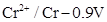



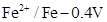

Use this data to comment upon:
(i) The stability of  in acid solution as compared to that of or
  and
and
(ii) The ease with which iron can be oxidised as compared to a similar process for either chromium or manganese metal.
18. Predict which of the following will be coloured in aqueous solution?  and . Give reasons for each.
19. Compare the stability of +2 oxidation state for the elements of the first transition series.
20. Compare the chemistry of actinides with that of the lanthanide with special reference to:
(i) electronic configuration (iii) oxidation state
(ii) atomic and ionic sizes and (iv) chemical reactivity.
To download NCERT Solutions for class 12 Chemistry, Physics, Biology, History, Political Science, Economics, Geography, Computer Science, Home Science, Accountancy, Business Studies and Home Science; do check CBSE.club app or website. CBSE.club provides sample papers with solution, test papers for chapter-wise practice, NCERT solutions, NCERT Exemplar solutions, quick revision notes for ready reference, CBSE guess papers and CBSE important question papers. Sample Paper all are made available through and CBSE.club website.
covers both organic and inorganic chemistry. Please note that CBSE has reduced the syllabus for class 12 Chemistry. So, you must check the latest syllabus of CBSE while going through the NCERT solution of any chapter given in the class 12 NCERT book.