Haloalkanes and haloarenes In-text Questions
Download as PDF.
NCERT Class 12 Chemistry Chapter-wise Solutions
- 1 – The Solid State
- 2 – Solutions
- 3 – Electrochemistry
- 4 – Chemical Kinetics
- 5 – Surface Chemistry
- 6 – General Principles and Processes of Isolation of Elements
- 7 – The p-Block Elements
- 8 – The d-and f-Blocks Elements
- 9 – Coordination Compounds
- 10 – Haloalkanes and Haloarenes
- 11 – Alcohols, Phenols and Ethers
- 12 – Aldehydes, Ketones and Carboxylic Acids
- 13 – Amines
- 14 – Biomolecules
- 15 – Polymers
- 16 – Chemistry in Everyday Life
CHAPTER TEN HALOALKANES AND HALOARENES
- 10.1 Classification
- 10.2 Nomenclature
- 10.3 Nature of C-X Bond
- 10.4 Methods of Preparation
- 10.5 Physical properties
- 10.6 Chemical Reactions
- 10.7 Polyhalogen Compounds
NCERT Solutions class 12 Chemistry Haloalkanes and haloarenes In text Questions
In-text Question
1. Write structures of the following compounds:
(i) 2-Chloro-3-methylpentane
(ii) 1-Chloro-4-ethylcyclohexane
(iii) 4-tert. Butyl-3-iodoheptane
(iv) 1,4-Dibromobut-2-ene
(v) 1-Bromo-4-sec. butyl-2-methylbenzene
2. Why is sulphuric acid not used during the reaction of alcohols with KI?
3. Write structures of different dihalogen derivatives of propane.
4. Among the isomeric alkanes of molecular formula C5H12, identify the one that on photochemical chlorination yields
(i) A single monochloride.
(ii) Three isomeric monochlorides.
(iii) Four isomeric monochlorides.
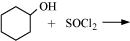
5. Draw the structures of major monohalo products in each of the following reactions:
(i)
(ii)
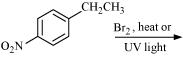
(iii)
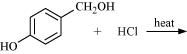
(iv)
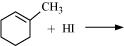
(v)

(vi)
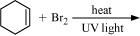
6. Arrange each set of compounds in order of increasing boiling points.
(i) Bromomethane, Bromoform, Chloromethane, Dibromomethane.
(ii) 1-Chloropropane, Isopropyl chloride, 1-Chlorobutane.
7. Which alkyl halide from the following pairs would you expect to react more rapidly by an SN2 mechanism? Explain your answer.
(i)

(ii)
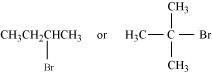
(iii)

8. In the following pairs of halogen compounds, which compound undergoes faster SN1 reaction?
(i)
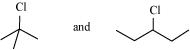
(ii)

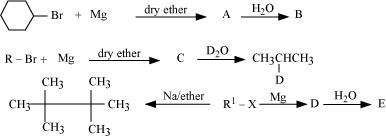
9. Identify A, B, C, D, E, R and R1in the following:
covers both organic and inorganic chemistry. Please note that CBSE has reduced the syllabus for class 12 Chemistry. So, you must check the latest syllabus of CBSE while going through the NCERT solution of any chapter given in the class 12 NCERT book.