Chemical kinetics part 2
Download as PDF.
NCERT Class 12 Chemistry Chapter-wise Solutions
- 1 – The Solid State
- 2 – Solutions
- 3 – Electrochemistry
- 4 – Chemical Kinetics
- 5 – Surface Chemistry
- 6 – General Principles and Processes of Isolation of Elements
- 7 – The p-Block Elements
- 8 – The d-and f-Blocks Elements
- 9 – Coordination Compounds
- 10 – Haloalkanes and Haloarenes
- 11 – Alcohols, Phenols and Ethers
- 12 – Aldehydes, Ketones and Carboxylic Acids
- 13 – Amines
- 14 – Biomolecules
- 15 – Polymers
- 16 – Chemistry in Everyday Life
CHAPTER FOUR CHEMICAL KINETICS
- 4.1 Rate of a Chemical Reaction
- 4.2 Factors Influencing Rate of a Reaction
- 4.3 Integrated Rate Equations
- 4.4 Pseudo First Order Reaction
- 4.5 Temperature Dependence of the rate of a Reaction
- 4.6 Collision Theory of Chemical Reactions
NCERT Solutions class 12 Chemistry Chemical kinetics part 2
16. The rate constant for a first order reaction is 60 s-1. How much time will it take to reduce the initial concentration of the reactant to its 1/16th value?
17. During nuclear explosion, one of the products is  with half-life of 28.1 years. If
  of was absorbed in the bones of a newly born baby instead of calcium, how much of it will remain after 10 years and 60 years if it is not lost metabolically.
18. For a first order reaction, show that time required for 99% completion is twice the time required for the completion of 90% of reaction.
19. A first order reaction takes 40 min for 30% decomposition. Calculate  .
.
20. For the decomposition of azoisopropane to hexane and nitrogen at 543 K, the following data are obtained.
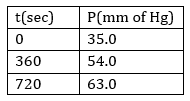
Calculate the rate constant.
21. The following data were obtained during the first order thermal decomposition of  at a constant volume.

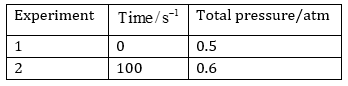
Calculate the rate of the reaction when total pressure is 0.65 atm.
22. The rate constant for the decomposition of  at various temperatures is given below:

Draw a graph between ln k and 1/T and calculate the values of A and  . Predict the rate constant at
  and
and  .
.
23. The rate constant for the decomposition of hydrocarbons is  at 546 K. If the energy of activation is 179.9 kJ/mol, what will be the value of pre-exponential factor.
24. Consider a certain reaction A  Products with
 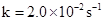 . Calculate the concentration of A remaining after 100 s if the initial concentration of A is
  .
.
25. Sucrose decomposes in acid solution into glucose and fructose according to the first order rate law, with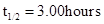 . What fraction of sample of sucrose remains after 8 hours?
26. The decomposition of hydrocarbon follows the equation  .
.
Calculate  .
.
27. The rate constant for the first order decomposition of  is given by the following equation:
  Calculate for this reaction and at what temperature will its half-period be 256 minutes?
28. The decomposition of A into product has value of k as  at
at  and energy of activation
  . At what temperature would k be
  ?
?
29. The time required for 10% completion of a first order reaction at 298 K is equal to that required for its 25% completion at 308 K. If the value of A is  . Calculate k at 318 K and .
30. The rate of a reaction quadruples when the temperature changes from 293 K to 313 K. Calculate the energy of activation of the reaction assuming that it does not change with temperature.
covers both organic and inorganic chemistry. Please note that CBSE has reduced the syllabus for class 12 Chemistry. So, you must check the latest syllabus of CBSE while going through the NCERT solution of any chapter given in the class 12 NCERT book.