Chemical kinetics part 1
Download as PDF.
NCERT Class 12 Chemistry Chapter-wise Solutions
- 1 – The Solid State
- 2 – Solutions
- 3 – Electrochemistry
- 4 – Chemical Kinetics
- 5 – Surface Chemistry
- 6 – General Principles and Processes of Isolation of Elements
- 7 – The p-Block Elements
- 8 – The d-and f-Blocks Elements
- 9 – Coordination Compounds
- 10 – Haloalkanes and Haloarenes
- 11 – Alcohols, Phenols and Ethers
- 12 – Aldehydes, Ketones and Carboxylic Acids
- 13 – Amines
- 14 – Biomolecules
- 15 – Polymers
- 16 – Chemistry in Everyday Life
CHAPTER FOUR CHEMICAL KINETICS
- 4.1 Rate of a Chemical Reaction
- 4.2 Factors Influencing Rate of a Reaction
- 4.3 Integrated Rate Equations
- 4.4 Pseudo First Order Reaction
- 4.5 Temperature Dependence of the rate of a Reaction
- 4.6 Collision Theory of Chemical Reactions
NCERT Solutions class 12 Chemistry Chemical kinetics part 1
1. From the rate expression for the following reactions, determine their order of reaction and the dimensions of the rate constants.
(i) 
(ii) 
(iii) 
(iv) 
2. For the reaction: 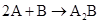 the rate =
  with
with  . Calculate the initial rate of the reaction when
  ,
,  . Calculate the rate of reaction after [A] is reduced to
  .
.
3. The decomposition of  on platinum surface is zero order reaction. What are the rates of production of
  and
and  if
if  ?
?
4. The decomposition of dimethyl ether leads to the formation of  ,and CO and the reaction rate is given by Rate =
 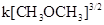 . The rate of reaction is followed by increase in pressure in a closed vessel, so the rate can also be expressed in terms of the partial pressure of dimethyl ether, i.e.,
 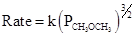 If the pressure is measured in bar andtime in minutes, then what are the units of rate and rate constants?
5. Mention the factors that affect the rate of a chemical reaction.
6. A reaction is second order with respect to a reactant. How is the rate of reaction affected if the concentration of the reactant is
(i) doubled
(ii) reduced to half?
7. What is the effect of temperature on the rate constant of a reaction? How can this temperature effect on rate constant be represented quantitatively?
8. In a pseudo first order hydrolysis of ester in water, the following results were obtained:

(i) Calculate the average rate of reaction between the time interval 30 to 60 seconds.
(ii) Calculate the pseudo first order rate constant for the hydrolysis of ester.
9. A reaction is first order in A and second order in B.
(i) Write the differential rate equation.
(ii) How is the rate affected on increasing the concentration of B three times?
(iii) How is the rate affected when the concentrations of both A and B are doubled?
10. In a reaction between A and B, the initial rate of reaction  was measured for different initial concentrations of A and B as given below:
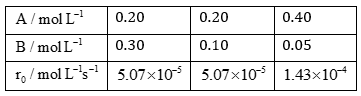
What is the order of the reaction with respect to A and B?
11. The following results have been obtained during the kinetic studies of the reaction:

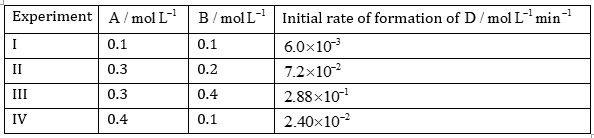
Determine the rate law and the rate constant for the reaction.
12. The reaction between A and B is first order with respect to A and zero order with respect to B. Fill in the blanks in the following table:
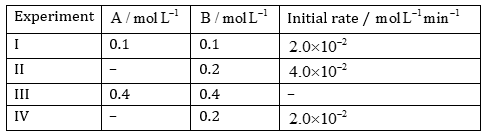
13. Calculate the half-life of a first order reaction from their rate constants given below:
(i) 
(ii) 
(iii) 4 
14. The half-life for radioactive decay of 14C is 5730 years. An archaeological artifact wood had only 80% of the 14C found in a living tree. Estimate the age of the sample.
15. The experimental data for decomposition of 
 in gas phase at 318 K are given below:

(i) Plot  against t.
(ii) Find the half-life period for the reaction.
(iii) Draw a graph between log and t.
(iv) What is the rate law?
(v) Calculate the rate constant.
(vi) Calculate the half-life period from k and compare it with (ii).
covers both organic and inorganic chemistry. Please note that CBSE has reduced the syllabus for class 12 Chemistry. So, you must check the latest syllabus of CBSE while going through the NCERT solution of any chapter given in the class 12 NCERT book.