Photosynthesis in higher plants
Download as PDF.
NCERT Class 11 Biology Chapter wise Solutions
UNIT I: DIVERSITY IN THE LIVING WORLD
- 1 : The Living World
- 2 : Biological Classification
- 3 : Plant Kingdom
- 4 : Animal Kingdom
UNIT II: STRUCTURAL ORGANISATION IN PLANTS AND ANIMALS
- 5 : Morphology of Flowering Plants
- 6 : Anatomy of Flowering Plants
- 7 : Structural Organisation in Animals
UNIT III: CELL: STRUCTURE AND FUNCTIONS
- 8 : Cell : The Unit of Life
- 9 : Biomolecules
- 10 : Cell Cycle and Cell Division
UNIT IV: PLANT PHYSIOLOGY
- 11 : Transport in Plants
- 12 : Mineral Nutrition
- 13 : Photosynthesis in Higher Plants
- 14 : Respiration in Plants
- 15 : Plant Growth and Development
UNIT V: HUMAN PHYSIOLOGY
- 16 : Digestion and Absorption
- 17 : Breathing and Exchange of Gases
- 18 : Body Fluids and Circulation
- 19 : Excretory Products and their Elimination
- 20 : Locomotion and Movement
- 21 : Neural Control and Coordination
- 22 : Chemical Coordination and Integration
NCERT Solutions For Class 11 Biology Chapter 13 Photosynthesis in higher plants
- 13.1 What do we Know?
- 13.2 Early Experiments
- 13.3 Where does Photosynthesis take place?
- 13.4 How many Pigments are involved in Photosynthesis?
- 13.5 What is Light Reaction?
- 13.6 The Electron Transport
- 13.7 Where are the ATP and NADPH Used?
- 13.8 The C4 Pathway
- 13.9 Photorespiration
- 13.10 Factors affecting Photosynthesis
NCERT Solutions For Class 11 Biology Photosynthesis in higher plants
1. By lookingat a plant externally can you tell whether a plant is C3 or C4? Why and how?
2. By looking at which internal structure of a plant can you tell whether a plant is C3 or C4? Explain.
3. Even though a very few cells in a C4 plant carry out the biosynthetic – Calvin pathway, yet they are highly productive. Can you discuss why?
4. RuBisCo is an enzyme that acts both as a carboxylase and oxygenase. Why do you think RuBisCo carries out more carboxylation in C4 plants?
5. Suppose there were plants that had a high concentration of Chlorophyll-b, but lacked chlorophyll-a, would it carry out photosynthesis? Then why do plants have chlorophyll-b and other accessory pigments?
6. Why is the colour of a leaf kept in the dark frequently yellow, or pale green? Which pigment do you think is more stable?
7. Look at leaves of the same plant on the shady side and compare it with the leaves on the sunny side. Or, compare the potted plants kept in the sunlight with those in the shade. Which of them has leaves that are darker green? Why?
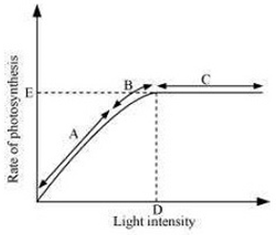
8. Figure shows the effect of light on the rate of photosynthesis. Based on the graph, answer the following questions:
(a) At which point/s (A, B or C) in the curve is light a limiting factor?
(b) What could be the limiting factor/s in region A?
(c) What do C and D represent on the curve?
9. Give comparison between the following:
(a) C3 and C4 pathways
(b) Cyclic and non-cyclic photophosphorylation
(c) Anatomy of leaf in C3 and C4 plants