Sources of Energy Part-2
NCERT solutions for Class 10 Science Sources of Energy
NCERT Class 10 Science Chapter wise Solutions
- 1 – Chemical Reactions and Equations
- 2 – Acids, Bases and Salts
- 3 – Metals and Non-metals
- 4 – Carbon and Its Compounds
- 5 – Periodic Classification of Elements
- 6 – Life Processes
- 7 – Control and Coordination
- 8 – How do Organisms Reproduce?
- 9 – Heredity and Evolution
- 10 – Light Reflection and Refraction
- 11 – Human Eye and Colourful World
- 12 – Electricity
- 13 – Magnetic Effects of Electric Current
- 14 – Sources of Energy
- 15 – Our Environment
- 16 – Management of Natural Resources
NCERT Solutions for Class 10 Science Sources of Energy Part 2
1. A solar water heater cannot be used to get hot water on
(a) a sunny day
(b) a cloudy day.
(c) a hot day
(d) a windy day.
Ans. (b) cloudy day.
NCERT Solutions for Class 10 Science Sources of Energy Part 2
2. Which of the following is not an example of a bio-mass energy?
(a) wood
(b) gobar-gas
(c) nuclear energy
(d) coal
Ans. (c) nuclear energy
NCERT Solutions for Class 10 Science Sources of Energy Part 2
3. Most of the sources of energy we use represent stored solar energy. Which of the following is not ultimately derived from the Sun’s energy?
(a) geothermal energy
(b) wind energy
(c) nuclear energy
(d) bio-mass
Ans. (c) nuclear energy
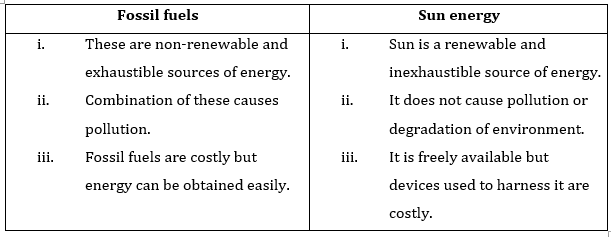
4. Compare and contrast fossils fuels and the Sun as direct sources of energy.
Ans. Distinction between fossils fuels and Sun energy:
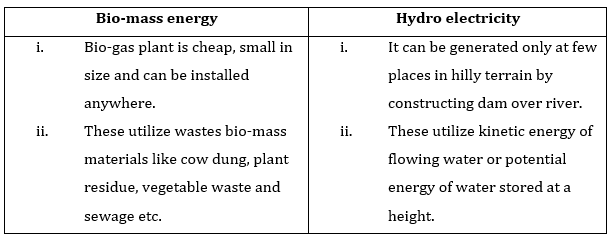
5. Compare and contrast bio-mass and hydro electricity as sources of energy.
Ans. Difference between bio-mass and hydroelectricity:
NCERT Solutions for Class 10 Science Sources of Energy Part 2
6. What are the limitations of extracting energy from:
(a) the wind?
(b) waves?
(c) tides?
Ans. Limitation of extracting energy from the wind:
i. It can be established at those places only, where wind blows for the greater part of a year.
ii. Wind speed should be higher than 15 km/h.
iii. It requires high level of maintenance.
Limitation of extracting wave energy and tidal energy:
i. It can be harnessed by trapping the sea waves in a dam. Only very few suitable sites exist where dams can be constructed.
ii. It is not a continuous and reliable source of energy.
iii. it is extremely costly and difficult to use.
NCERT Solutions for Class 10 Science Sources of Energy Part 2
7. On what basis would you classify energy sources as
(a) renewable and non-renewable?
(b) exhaustible and inexhaustible?
Are the options given in (a) and (b) the same?
Ans. (a) Renewable sources of energy are those sources which can be regenerated again. Non-renewable sources of energy are those sources which would get depleted some day and cannot be regenerated.
(b) Exhaustible sources of energy are those which will be exhausted some day and cannot be regenerated. Inexhaustible sources of energy are those which can be regenerated again due to some continuing or repetitive currents of energy and are inexhaustible.
Options in both cases are exactly same.
NCERT Solutions for Class 10 Science Sources of Energy Part 2
8. What are the qualities of an ideal source of energy?
Ans. The qualities of ideal sources of energy are:
(a) It should be easily accessible, inexhaustible and a renewable source of energy and cost of harnessing energy should be reasonably small.
(b) It should be easily stored and transported.
(c) It should have high calorific value.
(d) It should be pollution free.
NCERT Solutions for Class 10 Science Sources of Energy Part 2
9. What are the advantages and disadvantages of using a solar cooker? Are there places where solar cookers would have limited utility?
Ans. Advantage of solar cooker:
a. There is no cost of fuel.
b. It is environment friendly and there is no residue like ash etc.
c. Cooking is hygienic and nutritious.
Disadvantage of solar cooker:
a. The cooking is slow.
b. It cannot be used at all times.
c. A solar cooker can perform only limited functions.
NCERT Solutions for Class 10 Science Sources of Energy Part 2
10. What are the environmental consequences of the increasing demand for energy? What steps would you suggest to reduce energy consumption?
Ans. The increasing demand for energy is largely being met by the use of fossil fuels. But these fuels are exhaustible and non-renewable sources of energy. Moreover, burning of fossils fuels cause air pollution. Release of acidic oxides leading to acid rain that affect our water and soil resources. These gases also produce greenhouse effect leading to increase the temperature of earth.
To reduce energy consumption we should lead a simple and a natural life. As an example, instead of using an air conditioner in a closed room we should live in an airy room having appropriate number of windows.