Human Eye and Colourful World Part-2
NCERT solutions for Class 10 Science Human Eye and Colourful World
NCERT Class 10 Science Chapter wise Solutions
- 1 – Chemical Reactions and Equations
- 2 – Acids, Bases and Salts
- 3 – Metals and Non-metals
- 4 – Carbon and Its Compounds
- 5 – Periodic Classification of Elements
- 6 – Life Processes
- 7 – Control and Coordination
- 8 – How do Organisms Reproduce?
- 9 – Heredity and Evolution
- 10 – Light Reflection and Refraction
- 11 – Human Eye and Colourful World
- 12 – Electricity
- 13 – Magnetic Effects of Electric Current
- 14 – Sources of Energy
- 15 – Our Environment
- 16 – Management of Natural Resources
NCERT Solutions for Class 10 Science Human Eye and Colourful World Part 2
1. The human eye can focus objects at different distances by adjusting the focal length of the eye lens. This is due to
(a) Presbyopia
(b) Accommodation
(c) Near-sightedness
(d) Far-sightedness
Ans. (b) accommodation
NCERT Solutions for Class 10 Science Human Eye and Colourful World Part 2
2. The human eye forms the image of an object at its
(a) Cornea
(b) Iris
(c) Pupil
(d) Retina
Ans. (d) retina
3. The least distance of distinct vision for an eye lens is caused by the action of the
(a) 25 m
(b) 2.5 cm
(c) 25 cm
(d) 2.5 m
Ans. (c) 25 cm
4. The change in focal length of an eye lens is caused by the action of the
(a) Pupil
(b) Retina
(c) Cilliary muscles
(d) Iris
Ans. (c) Cilliary muscles
NCERT Solutions for Class 10 Science Human Eye and Colourful World Part 2
5. A person needs a lens of power -5.5 dioptre for correcting his distinct vision. For correcting his near vision he needs a lens +1.5 dioptre. What is the focal length of the lens required for correcting (i) distinct vision, and (ii) near vision?
Ans. (i) Power of lens needed for correction distant vision of the person (P) = -5.5 D
Focal length of lens required for correcting distant vision (f)
= 1/P = 1/-5.5 m = 0.18 m = 18 cm.
(ii) For correcting near vision the power of lens required (P) = +1.5 D
Focal length of lens required for correcting near vision (f)
= 1/P = 1/1.5 m = 0.67 m = 66.7 cm.
6. The far point of a myopic person is 80 cm in front of the eye. What is the nature and power of the lens required to correct the problem?
Ans. To correct the myopia the person concerned should use concave lens of focal length (f) = -80 cm = -0.80 m
Power of lens (P) = 1/f(m) = 1/-0.80 = 100/-80 = -1.25 D.
NCERT Solutions for Class 10 Science Human Eye and Colourful World Part 2
7. Make a diagram to show how hypermetropia is corrected. The near point of a hypermetropic eye is 1 m. What is the power of the lens required to correct this defect? Assume that near point of the normal eye is 25 cm.
Ans. Diagram representing the correction of hypermetropia is a follows:
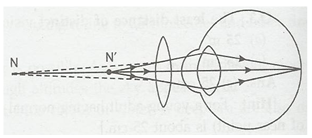
Near point of defective eye is 1 m and that of normal eye is 25 cm.
Here, u = -25 cm, v = -1m = 100 cm.
Using lens formula
1/f = 1/v – 1/u
1/f = 1/-100 + 1/25 = 3/100
f = 100/3 cm = 1/3m.
P = 1/f(m) = 1/0.33 = +3.0 D.
8. Why is a normal eye not able to see clearly the objects placed closer than 25 cm?
Ans. Due to limit of power of accommodation, the focal length of the eye lens cannot be decreased below certain minimum limit. So, a normal eye cannot see clearly the objects placed closer than minimum distance, called near point of the eye.
9. What happen to the image distance in the eye when we increase the distance of an object from the eye?
Ans. The image is formed on the retina even on increasing the distance of an object from the eye. In fact, the eye lens becomes thinner and its focal length increases as the object is moved away from the eye and consequently image is formed on the retina.
10. Why do stars twinkle?
Ans. Stars twinkle due to atmospheric refraction of starlight. As the stars are very away they behave as almost point sources of light. As on account of atmospheric refraction, the path of rays of light coming from the star goes on varying slightly, the apparent position of the star fluctuates and the amount of light entering the eye flickers, so sometimes the star appear brighter and at some other time, fainter. Thus the stars twinkle.
NCERT Solutions for Class 10 Science Human Eye and Colourful World Part 2
11. Explain why the planets do not twinkle.
Ans. Planets are much closer to the earth and are seen as extended source. So, a planet may be considered as a collection of a large number of point-sized light sources. Although light coming from individual point-sized sources flickers but the total amount of light entering our eye from all the individual point-sized sources average out to be constant. Thereby, planets appear equally brighter and there is no twinkling of planets.
NCERT Solutions for Class 10 Science Human Eye and Colourful World Part 2
12. Why does the Sun appear reddish early in the morning?
Ans. In early morning, the Sun is situated near horizon. Light from the Sun passes through thicker layers of air and covers a larger distance in earth’s atmosphere before reaching our eyes. While passing through atmosphere blue light is mostly scattered away and the Sun appear reddish.
NCERT Solutions for Class 10 Science Human Eye and Colourful World Part 2
13. Why does the sky appear dark instead of blue to astronaut?
Ans. Blue colour of the sky is on account of scattering of light of shorter wavelength by particles in the atmosphere of earth. If the earth had no atmosphere, there would not have been any scattering and sky would have looked dark. When astronaut in his spacecraft goes above the atmosphere of earth, sky appears dark to him because there is no scattering of light.