How do Organisms Reproduce? Part-2
NCERT solutions for Class 10 Science How do Organisms Reproduce
NCERT Class 10 Science Chapter wise Solutions
- 1 – Chemical Reactions and Equations
- 2 – Acids, Bases and Salts
- 3 – Metals and Non-metals
- 4 – Carbon and Its Compounds
- 5 – Periodic Classification of Elements
- 6 – Life Processes
- 7 – Control and Coordination
- 8 – How do Organisms Reproduce?
- 9 – Heredity and Evolution
- 10 – Light Reflection and Refraction
- 11 – Human Eye and Colourful World
- 12 – Electricity
- 13 – Magnetic Effects of Electric Current
- 14 – Sources of Energy
- 15 – Our Environment
- 16 – Management of Natural Resources
NCERT Solutions for Class 10 Science How do Organisms Reproduce? Part 2
1. Asexual reproduction takes place through budding in
(a) Amoeba
(b) Yeast
(c) Plasmodium
(d) Leishmania.
Ans. (b) Yeast
2. Which of the following is not a part of female reproductive system in human beings?
(a) Ovary
(b) Uterus
(c) Vas deferens
(d) Fallopian tube
Ans. (c) Vas deferens
NCERT Solutions for Class 10 Science How do Organisms Reproduce? Part 2
3. The anther contains
(a) Sepals
(b) Ovules
(c) Carpel
(d) Pollen grains.
Ans. (d) Pollen grains.
NCERT Solutions for Class 10 Science How do Organisms Reproduce? Part 2
4. What are the advantages of sexual reproduction over asexual reproduction?
Ans. Sexual reproduction leads to variation due to recombination of genetic material DNA. These variations are essential for survival of species. On the contrary, asexual reproduction does not bring about variations.
5. What are the functions performed by the testis in human beings?
Ans. In human beings, testes perform dual function:
(i) Production of sperms
(ii) Secretion of male hormone testosterone.
NCERT Solutions for Class 10 Science How do Organisms Reproduce? Part 2
6. Why does menstruation occurs.
Ans. When in human female if the egg is not fertilized, it lives for about one day. Since the ovary releases one egg every month, the uterus also prepares itself every month to receive a fertilized egg. Thus, its lining becomes thick and spongy. This would be required for nourishing the embryo if had fertilized. However, this lining is not required any longer. So, the lining slowly breaks and comes out through the vagina as blood and mucous. This cycle takes roughly every month and is known as menstruation.
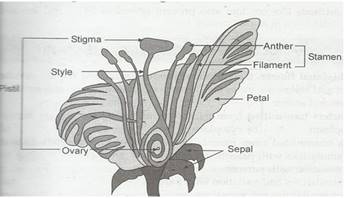
7. Draw a labeled diagram of the longitudinal section of a flower.
Ans.
NCERT Solutions for Class 10 Science How do Organisms Reproduce? Part 2
8. What are the different methods of contraception?
Ans. Various methods used for regulation of child birth can broadly categories as:
(i) Barrier methods: In this method, physical devices such as condom, diaphragm, cervical cap and Copper-T are used.
(ii) Chemical method: use of spermicidal jelly by woman, oral pills and vaginal pills.
(iii) Surgical method: In surgical method, a small portion of vas deferens in male and the oviduct of female, is surgically removed or ligated. It is called vasectomy in male and Tubectomy in females.
9. How are the modes of reproduction different in unicellular and multicellular organism?
Ans. In unicellular organisms, cell division, or fusion leads to the creation of new individuals.
In multicellular organisms with simple body organization budding, fragmentation may work but in complex multicellular organisms only sexual reproduction takes place.
10. How does reproduction help in providing stability to populations of species?
Ans. The consistency of DNA copying during reproduction is important for the maintenance of body design features that allow the organism to use the particular niche. Reproduction is, therefore, linked to the stability to populations of species.
NCERT Solutions for Class 10 Science How do Organisms Reproduce? Part 2
11. What could be the reasons for adopting contraceptive methods?
Ans. The sexual act always has the potential to lead to pregnancy. Pregnancy will make major demands on the body and the mind of the woman and if she is not ready for it, her health will adversely affected. Therefore, adopting contraceptive methods are essential. Some contraceptive methods like condom also prevent spread of STDs and lethal diseases like HIV-AIDS.