How do Organisms Reproduce? Part-1
NCERT solutions for Class 10 Science
NCERT Class 10 Science Chapter wise Solutions
- 1 – Chemical Reactions and Equations
- 2 – Acids, Bases and Salts
- 3 – Metals and Non-metals
- 4 – Carbon and Its Compounds
- 5 – Periodic Classification of Elements
- 6 – Life Processes
- 7 – Control and Coordination
- 8 – How do Organisms Reproduce?
- 9 – Heredity and Evolution
- 10 – Light Reflection and Refraction
- 11 – Human Eye and Colourful World
- 12 – Electricity
- 13 – Magnetic Effects of Electric Current
- 14 – Sources of Energy
- 15 – Our Environment
- 16 – Management of Natural Resources
NCERT Solutions for Class 10 Science How do Organisms Reproduce
1. What is the importance of DNA copying in reproduction?
Ans. DNA contains information for the inheritance of features from parents to next generation. DNA presents in nucleus of cells are the information source for making protein. If information is different, different protein will be made that lead to altered body design.
2. Why is variation beneficial to the species but not necessarily for the individual?
Ans. Variations are useful for the survival of species in changed environment situations. If a population of reproducing organism were suited to a particular niche and if the niche is drastically altered the population could be wiped out. However, some variations are present some species will survive. Thus, variation is useful to species but not the individual.
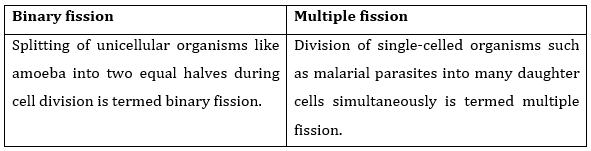
1. How does binary fission differ from multiple fissions?
Ans. Difference between binary fission and multiple fission:
2. How will an organism be benefited if it reproduces through spores?
Ans. The spores are covered by thick walls that protect them until they come into contact with suitable moist surface and can begin to grow.
3. Can you think of reasons why more complex organism cannot give rise to new individuals through regeneration?
Ans. The reason is that complex organisms are not merely random collection of cells. Specialized cells are organized in them as tissues are organized in organs. These organs have to be placed at definite positions in the body. So, regeneration is not possible in multicellular organism.
4. Why is vegetative propagation practiced for growing some types of plants?
Ans. (i) Plants raised by vegetative propagation can bear flower and fruits earlier than those produced from seeds.
(ii) Such methods also make possible the propagation of plants such as banana, orange, rose and jasmine that have lost the capacity to produce seeds.
(iii) All plants produced by this method are genetically similar enough to the parent plant to have its all characteristics.
NCERT Solutions for Class 10 Science How do Organisms Reproduce? Part 1
5. Why is DNA coping essential part of the process of reproduction?
Ans. DNA contains information for the inheritance of features from parents to next generation. DNA presents in nucleus of cells are the information source for making protein. If information is different, different protein will be made that lead to altered body design.
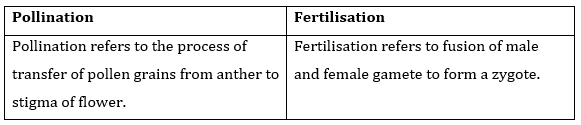
1. How is process of pollination different from fertilization?
Ans. Distinction between pollination and fertilisation:
2. What is the role of the seminal vesicles and the prostate gland?
Ans. Secretions of seminal vesicles and prostate gland provide fluid medium to sperm to move and also provide nutrition to them.
NCERT Solutions for Class 10 Science How do Organisms Reproduce? Part 1
3. What are the changes seen in girls at the time of puberty?
Ans. During puberty breast size begins to increase with darkening of the skin of the nipples at the tip of breasts. Also, girls begin to menstruate at around this time.
4. How does the embryo get nourishment inside the mother’s body?
Ans. The embryo gets nutrition from the mother’s blood with the help of a special tissue called placenta. This is a disc which is embedded in the wall of uterus. It contains finger-like projections villi on the embryo’s side of the tissue. On mother’s sides are blood spaces, which surround the villi. This provides a large surface area for glucose and oxygen to pass the mother to the embryo and waste products from embryo to mother.
5. If a woman is using a Copper-T, will it help in protecting her from sexually transmitted diseases?
Ans. Copper-T cannot protect the woman from acquiring sexually transmitted disease. It will protect her from only unwanted pregnancy.