Control and Coordination Part-1
NCERT solutions for Class 10 Science Control and Coordination
NCERT Class 10 Science Chapter wise Solutions
- 1 – Chemical Reactions and Equations
- 2 – Acids, Bases and Salts
- 3 – Metals and Non-metals
- 4 – Carbon and Its Compounds
- 5 – Periodic Classification of Elements
- 6 – Life Processes
- 7 – Control and Coordination
- 8 – How do Organisms Reproduce?
- 9 – Heredity and Evolution
- 10 – Light Reflection and Refraction
- 11 – Human Eye and Colourful World
- 12 – Electricity
- 13 – Magnetic Effects of Electric Current
- 14 – Sources of Energy
- 15 – Our Environment
- 16 – Management of Natural Resources
NCERT Solutions for Class 10 Science Control and Coordination Part 1
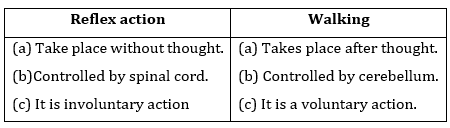
1. What is the difference between a reflex action and walking?
Ans. Difference between reflex action and walking:
2. What happens at the synapse between two neurons?
Ans. At synapse, the electrical impulse generated a dendrite of a neuron is passed on to dendrite of another neuron in form of chemical impulses. The chemical present at synapse is called neurotransmier.
3. Which part of the brain maintains posture and equilibrium of the body?
Ans. Cerebellum
4. How do we detect the smell of an agarbatti (incense stick)?
Ans. Smell of agarbatti is detected by olfactory receptors in the temporal lobe of fore-brain. It is first received by olfactory receptors in our nose.
5. What is the role of brain in reflex action?
Ans. Reflex arcs are formed in the spinal cord itself although the information also goes on to brain where the encounter remains the memory and make us aware of our action.
1. What are plant hormones?
Ans. They are chemical which help to coordinate growth, development, flowering and response to the environment in plants.
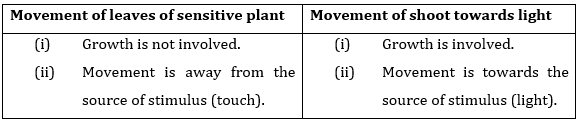
2. How is the movement of leaves of the sensitive plant different from the movement of a shoot towards light?
Ans. Difference between movement of leaves of sensitive plants and movement of shoot towards light:
3. Give an example of a plant hormone that promote growth.
Ans. Auxin promotes growth of cells.
NCERT Solutions for Class 10 Science Control and Coordination Part 1
4. How do auxins promote the growth of a tendril around a support?
Ans. When tendrils come in contact of any support, the part of the tendril in contact does not grow as rapidly as the part away from the object due to auxin secreted moves away from the object in contact. This rapid growth on one side causes tendril to circle around the object.
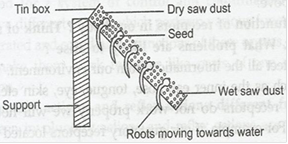
5. Design an experiment to demonstrate hydrotropism.
Ans. Take a tin box with hole at bottom. Fill it with moist saw dust. Sow some gram seeds in it. Keep the tin box in tilted position. When seeds start germinating, water the saw dust only in lower side of the tin box. You will observe that the radicle move towards the wet saw dust. This shows that root is positively hydrotropic.
1. How does chemical coordination take place in animals?
Ans. The chemical coordination is maintained by hormones. These are secreted by endocrine glands. These hormones are poured into blood through which they reach the target tissue or organ to act.
NCERT Solutions for Class 10 Science Control and Coordination Part 1
2. Why is the use of iodised salt advisable?
Ans. Iodine is necessary for the thyroid gland to make thyroxin hormone. In case, iodine is absent in our diet, there is a possibility of Goitre. Iodised common salt contains proper content of iodine. To avoid deficiency of iodine, iodised salt is recommended.
NCERT Solutions for Class 10 Science Control and Coordination Part 1
3. How does our body respond when adrenaline is secreted into the blood?
Ans. When adrenaline reaches the various target organ through blood. All these organs respond together to enable our body to deal with situation like running away from scary situation. When adrenaline reaches the heart, it beats faster to supply more oxygen to our muscles. The small arteries around digestive system and skins contracts to divert the blood towards muscles. All these response enable our body to deal with situation.
NCERT Solutions for Class 10 Science Control and Coordination Part 1
4. Why are some patients of diabetes treated by giving injections of insulin?
Ans. Diabetes is caused due to non or less secretion of hormone insulin by pancreas. In such person, the blood sugar level is high. Insulin converts extra sugar present in blood into glycogen. Patients suffering from diabetes are given insulin injection to control their blood sugar level.