Coordinate Geometry Exercise 7.3
NCERT solutions for Maths Coordinate Geometry
NCERT Solutions for Class 10 Maths Coordinate Geometry
1. Find the area of the triangle whose vertices are:
(i) (2, 3), (–1, 0), (2, –4)
(ii) (–5, –1), (3, –5), (5, 2)
Ans. (i) (2, 3), (–1, 0), (2, –4)
Area of Triangle = 
=  [2 {0 − (−4)} – 1 (−4 − 3) + 2 (3 − 0)]
= [2 (0 + 4) – 1 (−7) + 2 (3)]
= (8 + 7 + 6) =  sq. units
(ii) (–5, –1), (3, –5), (5, 2)
Area of Triangle =
= [−5 (−5 − 2) + 3 {2 − (−1)} + 5 {−1 − (−5)}]
= [−5 (−7) + 3 (3) + 5 (4)]
= (35 + 9 + 20)
= (64) = 32 sq. units
NCERT Solutions for Class 10 Maths Exercise 7.3
2. In each of the following find the value of ‘k’, for which the points are collinear.
(i) (7, –2), (5, 1), (3, k)
(ii) (8, 1), (k, –4), (2, –5)
Ans. (i) (7, –2), (5, 1), (3, k)
Since, the given points are collinear, it means the area of triangle formed by them is equal to zero.
Area of Triangle = 
⇒ [7 (1 − k) + 5 {k − (−2)} + 3 (−2 − 1)]
= (7 − 7k + 5k + 10 − 9) = 0
⇒ (7 − 7k + 5k + 1) = 0
⇒ (8 − 2k) = 0
⇒ 8 − 2k = 0
⇒ 2k = 8
⇒ k = 4
(ii) (8, 1), (k, –4), (2, –5)
Since, the given points are collinear, it means the area of triangle formed by them is equal to zero.
Area of Triangle = 
⇒ [8 {−4 − (−5)} + k (−5 − 1) + 2 {1 − (−4)}]
= (8 − 6k + 10) = 0
⇒ (18 − 6k) = 0
⇒18 − 6k = 0
⇒ 18 = 6k
⇒ k = 3
NCERT Solutions for Class 10 Maths Exercise 7.3
3. Find the area of the triangle formed by joining the mid–points of the sides of the triangle whose vertices are (0, –1), (2, 1) and (0, 3). Find the ratio of this area to the area of the given triangle.
Ans. Let A = (0, –1) = , B = (2, 1) =
  and
and
C = (0, 3) = 
Area of △ABC =
⇒ Area of △ABC
= [0 (1 − 3) + 2 {3 − (−1)} + 0 (−1 − 1)] = 
= 4 sq. units
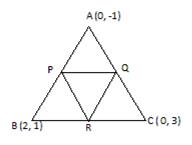
P, Q and R are the mid–points of sides AB, AC and BC respectively.
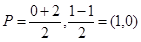
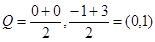
Applying Section Formula to find the vertices of P, Q and R, we get
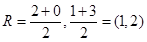
Applying same formula, Area of △PQR = [1 (1 − 2) + 0 (2 − 0) + 1 (0 − 1)] = 
= 1 sq. units (numerically)
Now, 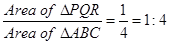
NCERT Solutions for Class 10 Maths Exercise 7.3
4. Find the area of the quadrilateral whose vertices taken in order are (–4, –2), (–3, –5), (3, –2) and (2, 3).
Ans. Area of Quadrilateral ABCD
= Area of Triangle ABD +
Area of Triangle BCD … (1)
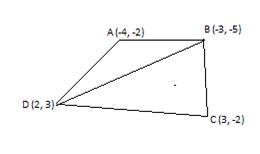
Using formula to find area of triangle:
Area of  ABD
ABD
=
= [−4 (−5 − 3) – 3 {3 − (−2)} + 2 {−2 − (−5)}]
= (32 – 15 + 6)
= (23) = 11.5 sq units … (2)
Again using formula to find area of triangle:
Area of △BCD =
= [−3 (−2 − 3) + 3 {3 − (−5)} + 2 {−5 − (−2)}]
= (15 + 24 − 6)
= (33) = 16.5 sq units … (3)
Putting (2) and (3) in (1), we get
Area of Quadrilateral ABCD = 11.5 + 16.5 = 28 sq units
NCERT Solutions for Class 10 Maths Exercise 7.3
5. We know that median of a triangle divides it into two triangles of equal areas. Verify this result for △ABC whose vertices are A (4, –6), B (3, –2) and C (5, 2).
Ans. We have △ABC whose vertices are given.
We need to show that ar(△ABD) = ar(△ACD).
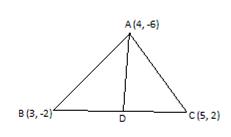
Let coordinates of point D are (x, y)
Using section formula to find coordinates of D, we get
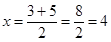
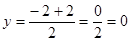
Therefore, coordinates of point D are (4, 0)
Using formula to find area of triangle:
Area of △ABD =
= [4 (−2 − 0) + 3 {0 − (−6)} + 4 {−6 − (−2)}]
= (−8 + 18 −16)
= (−6) = −3 sq units
Area cannot be in negative.
Therefore, we just consider its numerical value.
Therefore, area of △ABD = 3 sq units … (1)
Again using formula to find area of triangle:
Area of △ACD =
= [4 (2 − 0) + 5 {0 − (−6)} + 4 {−6 −2 )}]
= (8 + 30 − 32) = ½ (6) = 3 sq units … (2)
From (1) and (2), we get ar(△ABD) = ar(△ACD)
Hence Proved.