Coordinate Geometry Exercise 7.1
NCERT solutions for Maths Coordinate Geometry
NCERT Solutions for Class 10 Maths Coordinate Geometry
1. Find the distance between the following pairs of points:
(i) (2, 3), (4,1)
(ii) (–5, 7), (–1, 3)
(iii) (a, b), (–a, –b)
Ans. (i) Applying Distance Formula to find distance between points (2, 3) and (4,1), we get
d = 
(ii) Applying Distance Formula to find distance between points (–5, 7) and (–1, 3), we get
d = 
(iii) Applying Distance Formula to find distance between points (a, b) and (–a, –b), we get
d = 
NCERT Solutions for Class 10 Maths Exercise 7.1
2. Find the distance between the points (0, 0) and (36, 15). Also, find the distance between towns A and B if town B is located at 36 km east and15 km north of town A.
Ans. Applying Distance Formula to find distance between points (0, 0) and (36, 15), we get
d = 
Town B is located at 36 km east and15 km north of town A. So, the location of town A and B can be shown as:
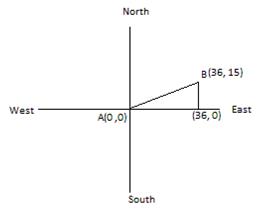
Clearly, the coordinates of point A are (0, 0) and coordinates of point B are (36, 15).
To find the distance between them, we use Distance formula:
d =  km
km
NCERT Solutions for Class 10 Maths Exercise 7.1
3. Determine if the points (1, 5), (2, 3) and (–2, –11) are collinear.
Ans. Let A = (1, 5), B = (2, 3) and C = (–2, –11)
Using Distance Formula to find distance AB, BC and CA.
AB = 
BC = 
CA = 
Since AB + AC ≠ BC, BC + AC  AB and AC BC.
Therefore, the points A, B and C are not collinear.
NCERT Solutions for Class 10 Maths Exercise 7.1
4. Check whether (5, –2), (6, 4) and (7, –2) are the vertices of an isosceles triangle.
Ans. Let A = (5, –2), B = (6, 4) and C = (7, –2)
Using Distance Formula to find distances AB, BC and CA.
AB = 
BC = 
CA = 
Since AB = BC.
Therefore, A, B and C are vertices of an isosceles triangle.
NCERT Solutions for Class 10 Maths Exercise 7.1
5. In a classroom, 4 friends are seated at the points A (3, 4), B (6, 7), C (9, 4) and D (6, 1). Champa and Chameli walk into the class and after observing for a few minutes Champa asks Chameli. “Don’t you think ABCD is a square?”Chameli disagrees. Using distance formula, find which of them is correct.
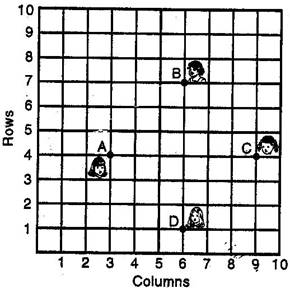
Ans. We have A = (3, 4), B = (6, 7), C = (9, 4) and D = (6, 1)
Using Distance Formula to find distances AB, BC, CD and DA, we get
AB = 
BC = 
CD = 
DA = 
Therefore, All the sides of ABCD are equal here. … (1)
Now, we will check the length of its diagonals.
AC = 
BD = 
So, Diagonals of ABCD are also equal. … (2)
From (1) and (2), we can definitely say that ABCD is a square.
Therefore, Champa is correct.
NCERT Solutions for Class 10 Maths Exercise 7.1
6. Name the type of quadrilateral formed, if any, by the following points, and give reasons for your answer.
(i) (–1, –2), (1, 0), (–1, 2), (–3, 0)
(ii) (–3, 5), (3, 1), (0, 3), (–1, –4)
(iii) (4, 5), (7, 6), (4, 3), (1, 2)
Ans. (i) Let A = (–1, –2), B = (1, 0), C= (–1, 2) and D = (–3, 0)
Using Distance Formula to find distances AB, BC, CD and DA, we get
AB = 
BC = 
CD = 
DA = 
Therefore, all four sides of quadrilateral are equal. … (1)
Now, we will check the length of diagonals.
AC = 
BD = 
Therefore, diagonals of quadrilateral ABCD are also equal. … (2)
From (1) and (2), we can say that ABCD is a square.
(ii) Let A = (–3, 5), B= (3, 1), C= (0, 3) and D= (–1, –4)
Using Distance Formula to find distances AB, BC, CD and DA, we get
AB = 
BC = 
CD = 
DA = 
We cannot find any relation between the lengths of different sides.
Therefore, we cannot give any name to the quadrilateral ABCD.
(iii) Let A = (4, 5), B= (7, 6), C= (4, 3) and D= (1, 2)
Using Distance Formula to find distances AB, BC, CD and DA, we get
AB = 
BC = 
CD = 
DA = 
Here opposite sides of quadrilateral ABCD are equal. … (1)
We can now find out the lengths of diagonals.
AC = 
BD = 
Here diagonals of ABCD are not equal. … (2)
From (1) and (2), we can say that ABCD is not a rectangle therefore it is a parallelogram.
NCERT Solutions for Class 10 Maths Exercise 7.1
7. Find the point on the x–axis which is equidistant from (2, –5) and (–2, 9).
Ans. Let the point be (x, 0) on x–axis which is equidistant from (2, –5) and (–2, 9).
Using Distance Formula and according to given conditions we have:

⇒ 
Squaring both sides, we get
⇒  =
= 
⇒ −4x + 29 = 4x + 85
⇒ 8x = −56
⇒ x = −7
Therefore, point on the x–axis which is equidistant from (2, –5) and (–2, 9) is (–7, 0)
NCERT Solutions for Class 10 Maths Exercise 7.1
8. Find the values of y for which the distance between the points P (2, –3) and Q (10, y) is 10 units.
Ans. Using Distance formula, we have

⇒ 
⇒ 
Squaring both sides, we get
100 = 
⇒ 
Solving this Quadratic equation by factorization, we can write
⇒ 
⇒ y (y + 9) – 3 (y + 9) = 0
⇒ (y + 9) (y − 3) = 0
⇒ y = 3, −9
NCERT Solutions for Class 10 Maths Exercise 7.1
9. If, Q (0, 1) is equidistant from P (5, –3) and R (x, 6), find the values of x. Also, find the distances QR and PR.
Ans. It is given that Q is equidistant from P and R. Using Distance Formula, we get
PQ = RQ



⇒ 
⇒ 
Squaring both sides, we get
⇒ 25 + 16 = 
⇒ 
⇒ x = 4, −4
Thus, Q is (4, 6) or (–4, 6).
Using Distance Formula to find QR, we get
Using value of x = 4 QR = 
Using value of x = –4 QR = 
Therefore, QR = 
Using Distance Formula to find PR, we get
Using value of x = 4 PR = 
Using value of x =–4 PR = 
Therefore, x = 4, –4
QR = , PR = 
NCERT Solutions for Class 10 Maths Exercise 7.1
10. Find a relation between x and y such that the point (x, y) is equidistant from the point (3, 6) and (–3, 4).
Ans. It is given that (x, y) is equidistant from (3, 6) and (–3, 4).
Using Distance formula, we can write

⇒ 
Squaring both sides, we get
⇒ 
= 
⇒ −6x − 12y + 45
= 6x − 8y + 25
⇒ 12x + 4y = 20
⇒ 3x + y = 5