Triangles Exercise 6.6
NCERT solutions for Maths Triangles
NCERT Solutions for Class 10 Maths Triangles
1.In figure, PS is the bisector of  QPR of
  PQR. Prove that
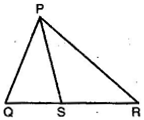
Ans. Given: PQR is a triangle and PS is the internal bisector of QPR
meeting QR at S.
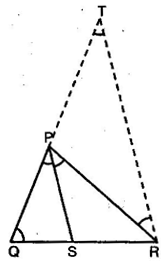
 QPS = SPR
To prove: 
Construction: Draw RT  SP to cut QP produced at T.
Proof: Since PS TR and PR cuts them, hence,
SPR = PRT ……….(i) [Alternate s]
And QPS = PTR ……….(ii)[Corresponding s]
But QPS = SPR [Given]
PRT = PTR[From eq. (i) & (ii)]
 PT = PR……….(iii)
[Sides opposite to equal angles are equal]
Now, in QRT,
RT SP[By construction]
 [Thales theorem]
[From eq. (iii)]
NCERT Solutions for Class 10 Maths Exercise 6.6
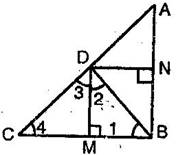
2. In figure, D is a point on hypotenuse AC of ABC, BD AC, DM BC and DN AB. Prove that:
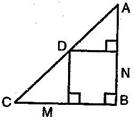
(i)  = DN.MC
(ii)  = DM.AN
Ans. Since, AB BC and DM BC
AB DM
Similarly, BC AB and DN AB
CB DN
quadrilateral BMDN is a rectangle.
BM = ND
(i) In BMD, 1 + BMD + 2 = 
1 +  + 2 =
+ 2 =
1 + 2 =
Similarly, in DMC,3 + 4 =
Since BD AC,
2 + 3 =
Now, 1 + 2 = and 2 + 3 =
1 + 2 = 2 + 3
1 = 3
Also, 3 + 4 = and 2 + 3 =
3 + 4 = 2 + 3
4 = 2
Thus, in BMD and DMC,
1 = 3 and 4 = 2
BMD  DMC
DMC

 [BM = ND]
 = DN.MC
(ii) Processing as in (i), we can prove that
BND  DNA
DNA

 [BN = DM]
 = DM.AN
NCERT Solutions for Class 10 Maths Exercise 6.6
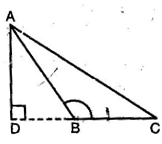
3. In figure, ABC is a triangle in which ABC > and AD CB produced. Prove that:
 .BD
.BD
Ans. Given: ABC is a triangle in which ABC > and AD CB produced.
To prove: .BD
.BD
Proof: SinceADB is a right triangle, right angled at D, therefore, by Pythagoras theorem,
 ………(i)
Again,ADB is a right triangle, right angled at D, therefore, by Pythagoras theorem,
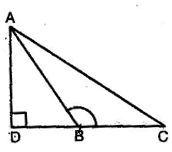


 .BC
.BC
 .BC
.BC
 .BC
.BC
[Using eq. (i)]
NCERT Solutions for Class 10 Maths Exercise 6.6
4. In figure, ABC is a triangle in which ABC < and AD BC produced. Prove that:
 .BD
.BD
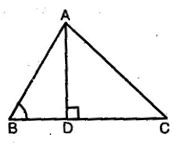
Ans. Given: ABC is a triangle in which ABC < and AD BC produced.
To prove: .BD
.BD
Proof: SinceADB is a right triangle, right angled at D, therefore, by Pythagoras theorem,
 ………(i)
Again,ADB is a right triangle, right angled at D, therefore, by Pythagoras theorem,

 – 2BC.BD
 – 2DB.BC
 – 2DB.BC
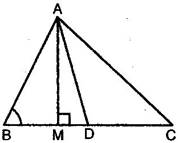
[Using eq. (i)]
NCERT Solutions for Class 10 Maths Exercise 6.6
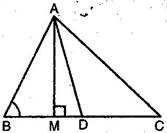
5. In figure, AD is a median of a triangle ABC and AM BC. Prove that:
(i) 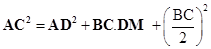
(ii) 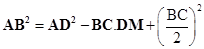
(iii) 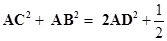 BC
BC
Ans. Since AMD =  therefore ADM < and ADC >
Thus, ADC is acute angle and ADC is obtuse angle.
(i) In ADC, ADC is an obtuse angle.

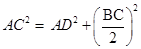 + 2.
+ 2. .DM
.DM
+ BC.DM
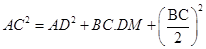 ……….(i)
(ii) In ABD, ADM is an acute angle.

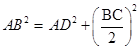 – 2..DM
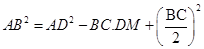 ……….(ii)
(iii) From eq. (i) and eq. (ii),
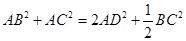
NCERT Solutions for Class 10 Maths Exercise 6.6
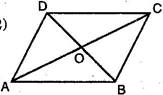
6. Prove that the sum of the squares of the diagonals of parallelogram is equal to the sum of the squares of its sides.
Ans. If AD is a median of ABC, then
[See Q.5 (iii)]
Since the diagonals of a parallelogram bisect each other, therefore, BO and DO are medians of triangles ABC and ADC respectively.
AB2 + BC2 = 2BO2 +  AC2 ……….(i)
And AD2 + CD2 = 2DO2 + AC2 ……….(ii)
Adding eq. (i) and (ii),
AB2 + BC2 + AD2 + CD2 = 2 (BO2 + DO2) + AC2
AB2 + BC2 + AD2 + CD2 = 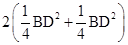 + AC2
+ AC2
AB2 + BC2 + AD2 + CD2 = AC2 + BD2
NCERT Solutions for Class 10 Maths Exercise 6.6
7. In figure, two chords AB and CD intersect each other at the point P. Prove that:
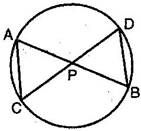
(i) APC DPB
(ii) AP.PB = CP.DP
Ans. (i) In the triangles APC and DPB,
APC = DPB [Vertically opposite angles]
CAP = BDP [Angles in same segment of a circle are equal]
By AA-criterion of similarity,
APC DPB
(ii) Since APC DPB
 AP x PB = CP x DP
NCERT Solutions for Class 10 Maths Exercise 6.6
8. In figure, two chords AB and CD of a circle intersect each other at the point P (when produced) outside the circle. Prove that:
(i) PAC PDB
(ii) PA.PB = PC.PD
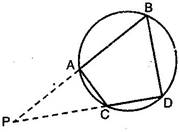
Ans. (i) In the triangles PAC and PDB,
APC = DPB [Common]
CAP = BDP [ BAC =
BAC =  PAC and PDB = CDB]
= BAC =  = PAC]
By AA-criterion of similarity,
APC DPB
(ii) Since APC DPB
PA.PB = PC.PD
NCERT Solutions for Class 10 Maths Exercise 6.6
9. In figure, D is appointing on side BC of ABC such that  Prove that AD is the bisector of BAC.
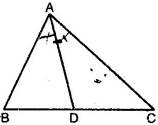
Ans. Given: ABC is a triangle and D is a point on BC such that 
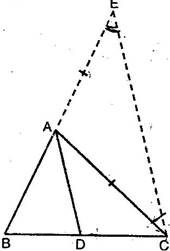
To prove: AD is the internal bisector of BAC.
Construction: Produce BA to E such that AE = AC. Join CE.
Proof: In AEC, since AE = AC
AEC = ACE ……….(i)
[Angles opposite to equal side of a triangle are equal]
Now, [Given]
 [ AE = AC, by construction]
By converse of Basic Proportionality Theorem,
DA CE
Now, since CA is a transversal,
BAD = AEC ……….(ii) [Corresponding s]
And DAC = ACE ……….(iii) [Alternate s]
Also AEC = ACE [From eq. (i)]
Hence, BAD = DAC [From eq. (ii) and (iii)]
Thus, AD bisects BAC internally.
NCERT Solutions for Class 10 Maths Exercise 6.6
10. Nazima is fly fishing in a stream. The tip of her fishing rod is 1.8 m above the surface of the water and the fly at the end of the string rests on the water 3.6 m away and 2.4 m from a point directly under the tip of the rod. Assuming that her string (from the tip of her rod to the fly) is taur, how much string does she have out (see figure)? If she pulls in the string at the rate of 5 cm per second, what will be the horizontal distance of the fly from her after 12 seconds?
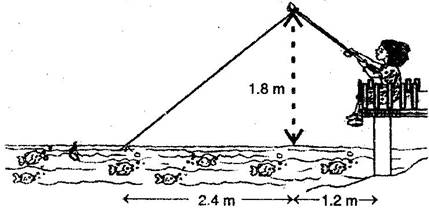
Ans. I. To find: The length of AC.
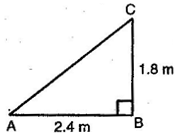
By Pythagoras theorem,
AC2 = (2.4)2 + (1.8)2
AC2 = 5.76 + 3.24 = 9.00
AC = 3 m
Length of string she has out= 3 m
Length of the string pulled at the rate of 5 cm/sec in 12 seconds
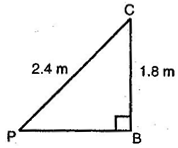
= (5 x 12) cm = 60 cm = 0.60 m
Remaining string left out = 3 – 0.6 = 2.4 m
II. To find: The length of PB
PB2 = PC2 – BC2
= (2.4)2 – (1.8)2
= 5.76 – 3.24 = 2.52
PB =  = 1.59 (approx.)
Hence, the horizontal distance of the fly from Nazima after 12 seconds
= 1.59 + 1.2 = 2.79 m (approx.)